
Pumper, Mobur, Frenys are words that no longer call anything. But they are nostalgia keys for several generations of Argentines, words capable of evoking images, flavors and aromas of another era, a prosaic and less glamorous version of Marcel Proust's muffle and his search for lost time. During the last decades of the last century, those names designated certain hamburgers, sandwiches and fries. They were some of the products offered by Pumper Nic, the first Fast-Food food chain that operated in Argentina. Created in the image and likeness of its American relatives, the company came to bill millions and have more than 60 stores, in a career that exceeded the constant political and economic obstacles of the South American country. Until it flows into a calamitic end. The history of its origin, boom and disappearance is the subject of a dream Made in Argentina, the book of journalist Solange Levinton (Buenos Aires, 43 years old). RECEIVED PUBLISHED BY BOOKS OF THE ASTERAID, Levinton's work won in 2023 the non -fiction award of the Spanish publishing house. The jury made up of Jordi Amat, Daniel Capó, Leila Guerriero, Daniel Gascón and Luis Solano then highlighted “the originality of the project, its literary quality and the exhaustive work of journalistic research of the author”, in addition to “their ability to portray the complex political reality of Argentina at the end of the twentieth century through a surprising and unique family history”.Pumper Nic archive images, the first “Fast-Food” Argentino. Rodrigo Fontela Seed of the book, says Levinton, germinated with a childish memory, a surely shared memory-with circumstantial differences-by thousands of Argentines. «When I was in primary school, my grandmother was going to look for me once a week and led me to eat a Pumper Nic. For me, it was a plan and today is one of the happiest memories of my childhood.» Some years ago, Levinton began to wonder who and how he had created «the first Fast-Food of Argentina», a risky and disruptive decision, he says, in a country where bifes were savored and not hamburgers, and where «the fact of sitting to eat had another liturgy», a culture that seemed incompatible with fast food. The investigation to answer those questions insumed to Levinton two years of work and about 200 years of work to former workers and businessmen, consumers and academics. The first fact that surprised her was the date of birth of Pumper Nic, 1974, a year marked in Argentina by the armed struggle of political organizations and for the beginning of the kidnappings and the disappearances with which state terrorism would ravage the country until 1983. The second fact that surprised her was the relationship of Nazism with the origin of the company.
The beginning
In 1935, the butcher Ludwig Lowenstein, 23, had to flee from the German people where he lived and was born, threatened by the anti -Semitism of the Nazi regime. He wanted to exile in the United States, but ended in Argentina. In the town of Basavilbaso, province of Entre Ríos, formed a family and exploited its first livestock and then commercial skills. In 1952, already installed in Buenos Aires, he founded his own refrigerator and continued to expand his business in the real estate market. His three children followed the same path. One of them created the Paty brand, which in Argentina is still synonymous with hamburger. Another created Pumper Nic. The idea assaulted Alfredo Lowenstein (Basavilbaso, 80 years old) in 1971, while lunching with his children in a fast food store in Miami. “Around it people enter, ask, pay, eat and leave. Alfredo observes from his chair that predictable and virtuous circuit as if he just discovered it. He sees the customers asking for food, the registered machines billing without truce, the furniture of bright colors, the tables with families, friends, couples and young people who seem to have fun and then, finally, he realized. Eyes, available for anyone with money to do it and insolence to replicate it, ”writes Levinton in his book. That epiphany followed a stage of rudimentary espionage to know how Fast-Food companies operated in the US, the copy of their procedures manuals, the purchase of the same machines that Burger King used, the selection of an establishment and employees in Buenos Aires. Lowenstein transferred to Argentina the process that had turned “to the artisanal act of cooking into a revolutionary assembly line to the Henry Ford”, but with a touch of local flavor: the condiment of hamburgers, the way to roast them. Pumper Ing – whose name took from a German bread, Pumpernickel – had its premiere in the Porteño center, meters from the Obelisk, on October 8, 1974. In a few months it became a success, especially motorized by young people, who breathed there a snack of the future.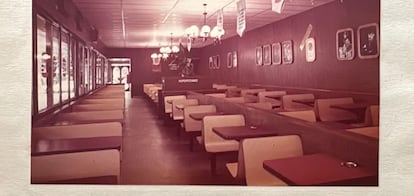 Pumper Nic archive images, the first “Fast-Food” Argentino. Rodrigo Fonte
Ascent and decline
Levinton's book weaves the business plot in parallel to the avatars of Argentine history. «At that time, the country was taken by political violence,» says the author. «I thought that context was going to arise only in the interviews, but I had to look for a lot to emerge the violence, the dictatorship. It allowed me to confirm something that to the following generations it is difficult for us to understand: how did they continue with their lives? Pumper Nic, like other spaces of society, worked like a bubble, the policy was outside and did not affect the business.» While Argentina was going through economic crises and plunged into the bloody military dictatorship since 1976, Pumper Nic began to open branches and inaugurated the franchise system in the country, which would also allow him to operate in Brazil and Uruguay. The vertiginous growth was enhanced with the restoration of democracy and continued during the eighties, immune to hyperinflation. The first cloud on that horizon appeared with the opening in Buenos Aires, in 1986, of a local McDonald's giant. Others would follow. And since 1989 those of Burger King would be added. More clouds brought the multiple branches and franchises of Pumper deployed throughout the country, an apparent strength that ended up being a weakness for the inability to sustain in all the premises the same quality of products and services that the other chains of hamburgers wore. The storm broke out in the mid -nineties, when the neoliberal model driven by the government of Carlos Menem (1989-1999) evidenced initial exhaustion signs. In 1995, the lowenstein family, already overturned to other businesses, sold the company: the book does not affirm it, because there are no certainties, but many suspect that it was an emptying led in the shadows by its own founders. Since then, dismissals, payments of payments, debts, judgments, evictions. Until the closing of the last place, after a long agony, in May 2000. As well as in its boom Pumper Nic he had managed Write Solange Levinton. «The illusion of that first world in South America had begun to fade.»
