Debt expansion and high inflation have eroded trust in traditional money. Bitcoin is the best alternative to return financial sovereignty to people. For many – specially those who are starting in economy issues – can be difficult to believe, but the truth is that, for centuries, monetary systems always had support. The economy was based for a long time on the gold standard, which gave the coins a very relevant security layer. Carl Menger explains that money is a creation among private, not something imposed by politicians or states, but this contrasts with the principles of our current financial system. Today, money not only lacks support, but its broadcast can be practically unlimited, depending on the needs of the politician on duty. Gold, as a scarce physical good, served for centuries as support for the value of the currency And let's not forget La Plata, which was also highly quoted to perform transactions. People trusted that, although they could not always have the metal directly, the value of their money was backed by a reserve of it. The last nail in the coffin of this system was put by the president of the United States., Richard Nixon, in 1971. From then harmful inflation tax – the worst of all. The objective was clear: harm the true producers of wealth, which sadly became second -class citizens. The saddest thing is that, even today, you can still talk with hundreds of people who believe in the existence of an optimal amount of money. The simple increase in the amount of paper money does not translate into greater well -being for peopleand that is something that Diego Giacomini, a renowned economist, masterfully explains in his book «The Revolution of Freedom.»
Suppose the amount of money is doubled from one day to another by magic … people are happy, and many go out to spend the new money. But the reality is that nothing of the important thing has changed. Neither society nor the economy will be better, since real resources, labor, capital, intermediate goods, consumer goods, natural resources and productivity remain the same as the previous day. However, as people spend the surplus money in goods and services, demand curves move up and prices rise … Finally, the general price level will end up duplicating when the entire adjustment process is over. Diego Giacomini, economist.
After the abandonment of the gold pattern, money began to depend more and more on politicians' promises; That is, it became something that existed alone because governments claimed that it was worth. The coins and bills were no longer backed by a physical resource, but by the «trust» that the Government or the Central Bank would guarantee its value. The result is evident: an uncontrolled expansion of the monetary mass that has caused a notable loss of purchasing power due to the inflation taxnegatively affecting savings and investment levels. According to data provided by the World Bank, Global accumulated inflation from 1981 to 2023 is approximately 517.7%. This means that world prices, on average, multiplied for more than 6 times (or increased 517.7%) in that period.
«World accumulated inflation (1981-2023): 517.7%-Source: World Bank, inflation, consumer prices (% annual) Milton Friedman enters the scene at this point it is pertinent to mention Milton Friedman, the renowned American economist and defender of the free market. Friedman argued that The money supply should expand at a fixed and predictable rate every year, in line with the real growth of the economy. For example, if the real GDP of a country increases on average by 3% per year, the amount of money in circulation should also be increased by 3% to guarantee price stability and prevent both inflation and deflation. Friedman criticized excessive money emission as a tool to stimulate the short -term economy, warning that this only generated inflation without sustainable benefits. Your famous phrase, «Inflation is always and everywhere a monetary phenomenon»it became a mantra repeated tirelessly by Javier Milei during his presidential campaign in Argentina, no matter how much some of the most emblematic precepts of liberalism – either by convenience or necessity, but that is another story. The proposal of the legendary economist looks very well written on paper, but in practice it is difficult to guarantee its long -term fulfillment, since it collides directly with the needs of politics, since it limits the ability of the central governments and banks to intervene in the economy. Politicians usually opt for more flexible tools that allow them to expand the money supply, in order to feed clientelism and finance tax deficits. This is where the «little machine» of printing bills, whose excess triggers inflation and quickly translates into a visible crisis in the streets comes into play. Bitcoin emerges as the best alternative the collapse of the gold pattern and the proliferation of inflationary policies by governments left people without a real alternative to protect their purchasing power. It was in this context that, in 2009, Bitcoin was born: a scarce, decentralized and immune asset to state manipulation. With a Maximum supply of 21 million unitsthe creation of Satoshi Nakamoto is the antithesis of the Fíat money, whose expansion can be unlimited according to the needs of the government on duty. Its deflationary nature and its resistance to censorship have made it an attractive refuge in front of currencies that lose value over time. It is no accident that, in countries with high inflation rates, BTC has been adopted as a financial refuge by millions of people who seek to protect their savings from state monetary looting. In fact, Bitcoin also emerged as a direct response to the 2008 crisiswhich highlighted the lack of preparation and forecast by world leaders. In the early 2000s, the price of homes in the US and other countries shot due to the low interest rates and the belief that they would continue to rise. In this context, banks granted high -risk loans («subprime») with lax conditions, but at high rates. The problem exploded when housing prices began to fall and interest rates rose, so many borrowers, who were granted mortgages even without solid credit history, could not face the payments. This led to a wave of breaches and, ultimately, to collapse. Bitcoin, as he took relevance, began to earn the opposition of the ruling elites and various multilateral organisms. The result is that, in the end, there was no way to continue swimming against the countercurrent. Despite the efforts of bankers, politicians and businessmen to discredit it, its attempts, as I like to say, They have been as effective as trying to stop the rain with their hands. In economics, although it is possible to try to stop market preferences for a while, what there is no way to achieve is to prevent the market from rearranging things. Eventually, it is the market that validates people's decisions, shaping trend changes. Thus, either by conviction or convenience, those who criticized end up adding to the movement.
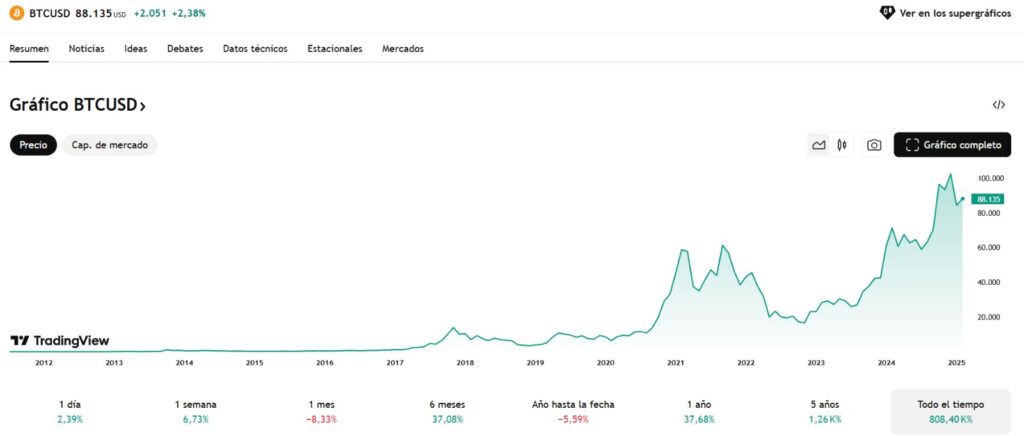
Bitcoin appreciation since 2011. Source: TrainingView. In this way, the most relevant cryptocurrency not only survived criticism and suppression attempts, but continued to grow until significant acceptance in various corners of the world. A key milestone was its adoption as a legal tender in El Salvador in 2021, under the leadership of Nayib Bukele – yes, two or three times by generation, politics makes a good one – who saw in the cryptoactive a tool to democratize financial access and reduce dependence on traditional banking systems. The impulse then grew with the launch of the Bitcoin ETFs, which They opened the doors for more institutional investors to access the market more easily and regulated. The climax of this ascent came with the decision of President Donald Trump to establish a strategic Bitcoin reserve in the US., A movement that could well redefine the global monetary landscape and validate the vision of those who, since its inception, bet on BTC as the only tool really capable of returning financial sovereignty to individuals. The future of money and the measure of its value must revolve around a standard that is resistant to manipulation and that preserves its purchasing power over time. In this context, Bitcoin stands as the only currency truly free of the influence of central governments and banks, whose value does not depend on promises or political decisions. While the dollar and the euro stagger under the weight of the debt and the uncontrolled impression, BTC offers an objective and decentralized metric. Measure all coins against the creation of Satoshi must become a need for those who seek to understand the real value in a monetary system where the intervention of the states is minimal and the market imposes its verdict.
Discharge of responsibility: The views and opinions expressed in this article belong to its author and do not necessarily reflect those of cryptootics. The author's opinion is informatively and under no circumstances constitutes an investment recommendation or financial advice.