In 1898, while Spain was losing Cuba, two British scientists discovered neon gas. In a London laboratory, William Ramsay and Moris Travers were astonished to discover that, if they stored this gas in a glass tube and let the electric current pass through, it emitted an intense and vibrant red light that seemed to have no end. But a little more than a decade had to pass for the commercial debut of this discovery. And it was not them but Georges Claude; This French engineer presented the first neon lamp during the Paris Motor Show of 1910. Claude’s design consisted of sealed glass tubes containing neon, an inert gas present in the atmosphere in small quantities. The popularity of neon lights skyrocketed and in the 1920s it flooded the streets of the French capital. The fashion for the illuminated signs of Pigalle and the Champs-Elysées immediately crossed the pond. In 1923, a Los Angeles businessman had neon signs brought from France to illuminate his car dealership and marked a point of no return. That “liquid fire” spread quickly through the streets of New York, Las Vegas and the large urban centers of the planet until it became one of the emblems of 20th century modernity. When he was a teenager, Leoncio Villoro (Barcelona, 87 years old) told his father – an electrician – that he no longer wanted to study anymore. Do you want to work? Then get to work! The next day, he started as an apprentice in the Lisbona workshop, which was dedicated to signs. «There I was the errand boy: go get water, go get wine… And that’s how I spent three years without earning a penny. But I paid a lot of attention to everything they did. They didn’t teach me, I learned,» recalls Villoro, who finished his training in the workshop of Castro Núñez, one of the first to bring neon lights to Spain after traveling to the United States. Although Villoro has already been retired for years, until four days ago he was still helping his son in his workshop in the Barcelona neighborhood of Sant Martí de Provençals, on whose door there is a most eloquent sign: Luminosos Villoro. “After working for others, I finally set out on my own and in 1970 we moved to this location,” he says. Half a century later, he is still there, but his son Leo Villoro (Barcelona, 47 years old) is the one in charge. “He came out like me, he wasn’t a very good student,” the father jokes. «But he grew up here. He liked work and learned quickly. Now he’s better than me. Look at him, look at him,» he says proudly. More information On an old wooden table, Villoro Jr. easily manipulates a greenish glass tube. “They are the remains of a lot that we bought many years ago,” he explains. Thanks to a small blowtorch, that rigidity takes the shape that has previously been drawn on paper. «He is making a lamp in the shape of a cactus. In 1975 I saw a western movie and a lamp like that appeared. I took a pencil, I drew it and since then we have not stopped making it,» explains the father. With the exception of this cactus and a pink flamingo, Luminosos Villoro does not make its own production. They always work to order. For decades, the bulk of the business was commercial signs, which at their peak were distributed among seven workshops in Barcelona. Today there are only two left and the technique – 100% handmade – remains almost the same as it was a century ago. “The big difference is that now the glass is pyrex,” exclaims Villoro Sr. “Before, we had a hard time with soft glass, we had to be very precise!” Roadside bars, restaurants, hotels, haberdasheries, nightclubs, pharmacies, property administrations, perfumeries, record stores… In the seventies, eighties and even nineties, Barcelona and any other European city would have had its own neon route. Now many signs have been lost, and, of those that remain, the most emblematic are protected as historical heritage. «We are also dedicated to repairing them. Although they last a long time, a blow or break can be fatal because they cause a gas leak and they stop working,» explains Villoro Jr. For this reason, in recent times those who want a neon sign have switched to the LED version, which is also more economical. “But it’s not the same, it’s not the same,” Villoro Sr. murmurs. And he is absolutely right: they lack the soul of “liquid fire”, because they obviously do not contain any gas: neither neon, nor argon, nor xenon, the triad most used for lighting. Despite the emergence of LEDs, an ode of neon nostalgia – which started about 15 years ago in London – once again rescued the taste for authentic neon lights. Hence, new establishments have once again opted for this retro aesthetic. In Barcelona, many of them have passed through the hands of the Villoro family, from the Libertine cocktail bar in Casa Bonay to the La Porca hamburger restaurant. And the orders, luckily, continue to come into Luminosos Villoro. Latest? A new restaurant to open in Marseille.In the image, a composition of different neons hanging in the Luminosos Villoro workshop.Albert GarciaAs we speak, Villoro Jr. has already shaped the cactus. Next, place the electrodes on each of the two ends. Now comes the most delicate part: removing the air inside the glass tube with a vacuum pump and then introducing the gas at low pressure. If this operation is not done correctly, the cactus lamp will not light up when it comes into contact with electrical current. But it does, and gives off a very intense green light. In this job, the topic of colors is a whole world. Villoro Jr. points to a panel on the wall. There are a dozen samples of glass tubes lit and labeled according to their hue: France Red, Purple Red, Pink, Salmon, Banana Yellow, Intense Blue, Turquoise, Green, White… It’s your particular Pantone. 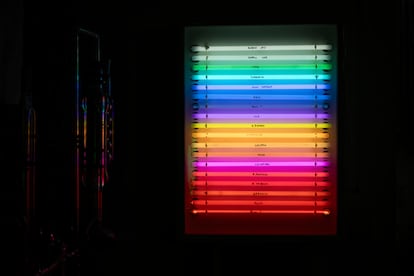 Sample of the different colors that can be made at Luminosos Villoro.Albert GarciaThe tinting of the glass tubes—which comes from the factory—is achieved thanks to some matches that, when mixed with the injected gas, allow the creation of a range of colors. «It’s like a game: if I inject neon gas into a green tube, I get an orange tone. On the other hand, if I inject argon gas, as I just did with the cactus, this intense green color appears. If the tube were tinted blue and I injected neon gas, then the color that would appear would be Pink France,» he details.
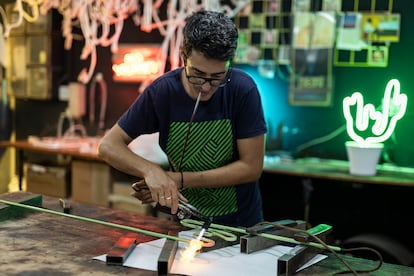 Leo Villoro blows on the tube while heating it with a blowtorch to give one of his creations the shape of a cactus. Albert Garcia In the history of neon lights, and also of art, the year 1951 was crucial. The Argentine artist of Italian descent Lucio Fontana (1899-1968) participated in the IX Milan Triennale with the installation Luce spaziale. Nothing more and nothing less than a huge neon tube suspended from the ceiling that gave light the ability to configure the space. With this work, Fontana opened a door that was later crossed by other artists who consolidated light tubes—whether neon gas or commercial fluorescent tubes—as a creative material. This is how Light art was born. But six years before Fontana, in Buenos Aires, Gyula Kosice had already built abstract sculptures with neon lights, a line of experimentation that would continue throughout his life. After them, in the sixties and seventies, Bruce Nauman, Mario Merz, Keith Sonnier and Joseph Kosuth consolidated neon lights as their own language, integrating them into different artistic currents such as conceptual art, postminimalism and arte povera. A trend that—with its ups and downs—has continued to this day, with relevant names such as Jeppe Hein, whose installation Please (2008) is part of the permanent collection of the Museum of Fine Arts in Boston, to name just one example.
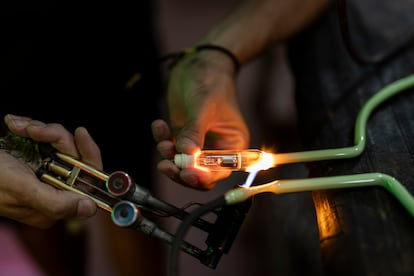 Leo Villoro solders an electrode after having shaped a tube into a cactus. Albert Garcia «Our clientele has changed a lot. For some time now we have been working for museums and art galleries. In my father’s time we were mainly sign makers,» explains Villoro Jr. Something similar happened with Rudi Stern, who in the seventies opened a studio in New York and specialized in building neon lights for Broadway shows. Over time, he ended up collaborating with artists such as Jeff Koons, Keith Haring and Robert Rauschenberg. «We also collaborate with artists: Samuel de Sagas, Pedro Torres, Enrique Baeza… The last one was Marria Pratts. Some come and want to learn to do it themselves, but they quickly realize that this is a trade, that you need many years of practice, very specific machinery and that it is better to leave it in our hands,» he says. In fact, he himself is a kind of eternal learner. «When I plan my vacation I always save a few days to visit neon makers and see how they work. I contact them on Instagram and they are always delighted to welcome me to their workshops. In August I was in Hong Kong and visited one who still works with soft glass. It was amazing! I have invited him to come to Barcelona and see how we work with pyrex. On another trip to New York, I visited Rudi Stern’s space, which his partner now runs. And do you see that sign that says No Vacancy? I love it He gave a neon book that I found while driving on Route 66. We immediately recognized each other. We are like a sect,” he jokes. And father and son laugh in unison, as they have done for so many years in this same workshop.