The infrastructure will allow tokenizing and moving client funds in real time. At the same time, it will launch “AI Mode”, a service that uses AI to compare and optimize suppliers. Alibaba has announced an ambitious bet to modernize its international payments: it will build a settlement network based on tokenized versions of dollars and euros, type stablecoins, developed together with JPMorgan. The proposal, revealed by Kuo Zhang, president of Alibaba.com, converts bank deposits into transferable tokens within a blockchain infrastructure controlled by regulated entities. The goal is for transfers between buyers and suppliers to be processed in real time, with fewer intermediaries and greater traceability, without introducing a volatile asset to the B2B ecosystem. In an interview with CNBC, Zhang stated that these tokens will function as 1:1 digital representations of fiat currency backed by bank reserves, distinguishing them from private stablecoins issued by third parties.
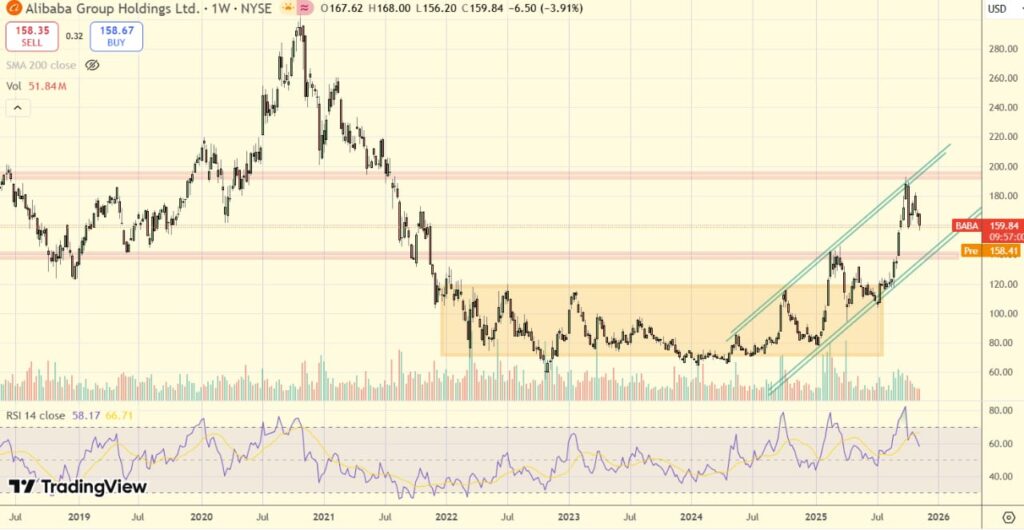
At the market level, Alibaba shares have shown significant recent movement and its tokenization initiative could influence investors’ perception of its global services. Source: TradingView «In this way, when American or European buyers pay certain amounts in euros or dollars, it is not necessary for the funds to circulate through different banks around the world; instead, tokenization and blockchain are used,” Zhang told CNBC. By operating under regulatory frameworks and issuing from bank balances, the solution seeks to offer the speed and efficiency of blockchains without giving up regulatory controls and compliance. Initially, The implementation will focus on key Asian markets such as Hong Kong, Singapore and China, where it is expected to replace processes that today take days with settlements in seconds.
Alibaba will also integrate AI into its processes
In parallel, Alibaba.com will launch “AI Mode”, a subscription service that uses artificial intelligence algorithms to compare suppliers according to price, logistics and production capacity, with indicative rates that seek to be accessible for small and medium-sized companies. On the other hand, in December the deployment of “Agentic Pay” is also planned, a tool that will automate the generation of contracts and administrative steps based on commercial conversations between buyers and sellers, reducing manual tasks and accelerating the commercial cycle.