The latest statements by the main economic policy makers provide relevant information about the foreseeable path of the Spanish economy. In a simplified way, the economy faces two challenges: increasing investment to maintain expansion and strengthen the welfare state, and reducing the deficit to ensure fiscal sustainability. In this respect, recent announcements have cast both light and shadow. The European Central Bank (ECB) remains concerned about inflation, especially in the service sectors with prices that continue to grow above 4%, although it has not closed the door to a new interest rate cut in September. Lagarde acknowledges that the growth in wages is due to specific agreements to compensate for the purchasing power lost since the beginning of the inflationary outbreak. But some members of the ECB council warn of the risk of a price-wage loop, particularly in sectors that have more market power to set margins, so it is most likely that the interest rate cut will be more gradual than expected.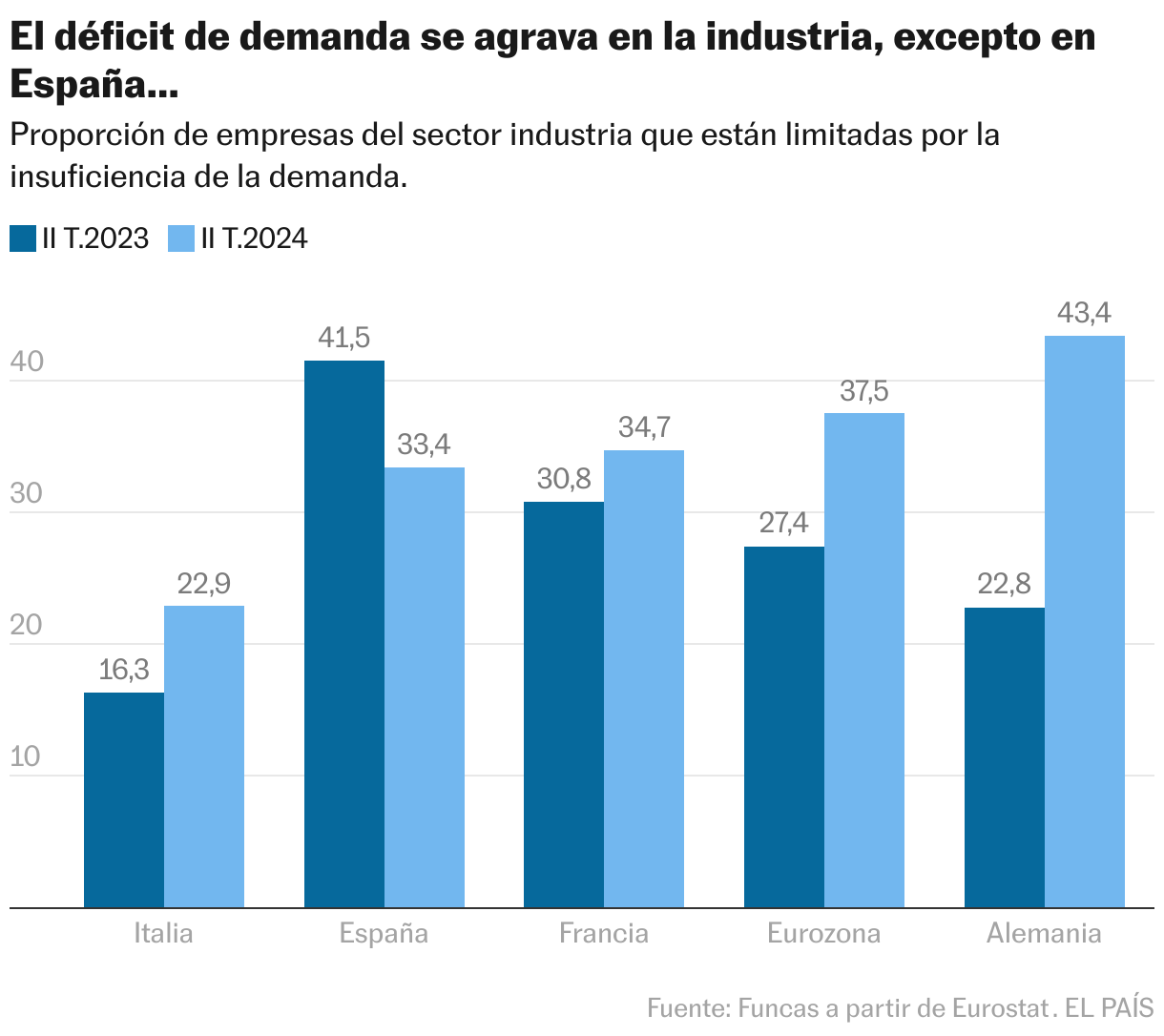
 As for the economic lung of the European Commission, the good news is the prioritisation of investment in the investiture speech of version 2.0 of Ursula von der Leyen's presidency. The Spanish productive fabric would benefit from greater financial integration, as promised, but how will it convince countries that have been opposing a deepening of the union for years? Residential investment and other measures to deal with the housing crisis looming over Europe is another promise that looks good in principle. It is not clear, however, what the practical consequence will be: a new round of European investment with joint financing, a reallocation of current budgets (with cuts in other areas such as cohesion funds or agricultural policy), or a pure exercise of voluntarism. Past experience does not encourage much optimism, but there is a sense of urgency in the face of geopolitical risks and the rise of populism. Based on these European elements, the macroeconomic triangle is completed by national fiscal policy, which concerns us par excellence. The budget plan, only outlined in general terms, contains two apparently contradictory objectives: on the one hand, a reduction of the budget deficit to 2.5% in the next fiscal year, falling sharply until 2027, lightening the burden of public debt, which is one of our main vulnerabilities in the face of markets on alert; and on the other hand, an increase in net expenditure on tax adjustments of more than 3%. To meet both objectives simultaneously, the economy must grow at least 2% throughout the adjustment period. This is precisely the Government's prediction, under the hypothesis of a strong recovery in investment. This is the challenge, now lacking a strategy to boost investment. However, to be in tune with the current situation, the policy mix should be less restrictive on the monetary side, less expansive from the point of view of fiscal policy, and with a reinforced European axis. But be careful because the content of the policies counts as much or more than their impact on demand, which is a less determining factor in activity: the Commission's own surveys point to the growing relevance of the lack of qualified personnel and equipment in companies. This is in Spain, because the situation is more complex in other large European countries, which face the same challenges but with almost non-existent growth. We will see if the consensus, both at European level and here, converges on a strategy more in line with the real needs of our societies. It will take good character and success of the monetary, fiscal and European triangle against the architects of chaos.
Territorial dimension
The post-pandemic expansion phase has been accompanied by a reduction in the differences between territories in terms of unemployment. Compared to 2019, the unemployment rate has fallen more in the autonomous communities with the worst initial situation, such as Andalusia, the Canary Islands, Castilla-La Mancha and Extremadura. On the other hand, the population is increasing or stabilizing in all territories, even in those most threatened by demographic decline. The common element in these demographic and employment trends is immigration, according to Funcas. However, a convergence in productivity is not detected. Raymond Torres is Funcas's economics director. In X: @RaymondTorres_Follow all the information on Economy and Business on Facebook and Twitter. Xor in our weekly newsletter