“Bitcoin has been trading as the barometer of global stress,” said Adam Livingston. Trump threatened a 10% tariff on global imports. The Supreme Court of the United States annulled on Friday, February 20, the tariffs established by President Donald Trump on imports, considering that he exceeded his powers by implementing them. However, the president responded that he will continue using this tool, through other legal alternatives in his power. This series of movements opens a new chapter in the trade dispute, which renews the impact on the financial markets. In that context, bitcoin writer and educator Adam Livingston indicated why tariffs declared illegal could be bullish for bitcoin (BTC). According to their analysis, during the last 18 months, Investors had internalized a “tax on political uncertainty” generated by the possibility of new trade barriers and retaliation between countries. “Bitcoin has been trading as the barometer of global stress,” reflecting changes in macroeconomic risk perception, he said. The specialist highlighted that since the announcement of tariffs on the so-called “Liberation Day” in April 2025, the price of bitcoin fell from USD 82,525 to USD 66,595, which represents a drop of close to 19%. Meanwhile, from the historical maximum of USD 126,000 marked in October 2025, the correction is around 46%, a movement attributed to the reduction of risk exposure by investors. Livingston argued that Cancellation of tariffs reduces the probability of inflationary shocks derived from abrupt commercial measures and contributes to compressing the risk premium in the markets. In his view, this could favor a revaluation of the asset by institutional and macroeconomic capital.
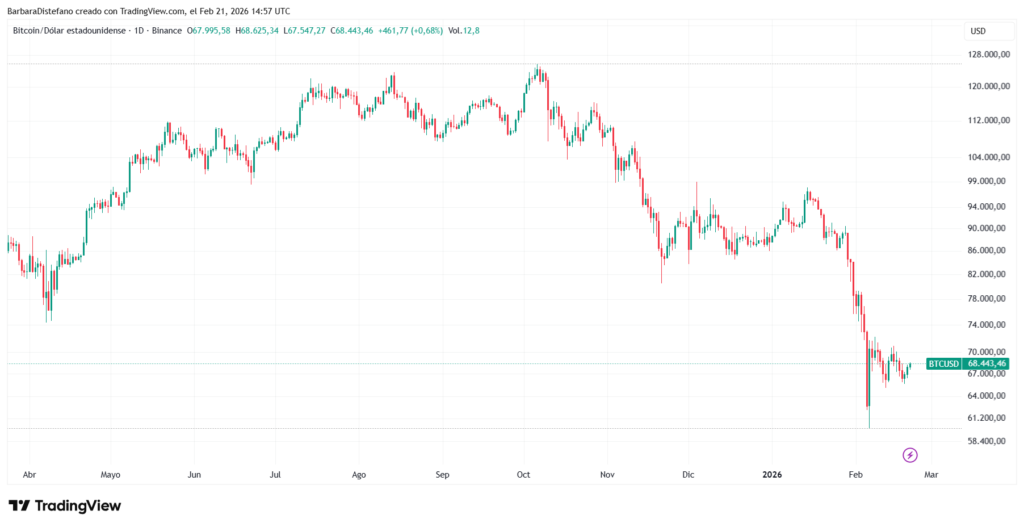 The Supreme Court’s decision comes at a time of weakness for the bitcoin market. Source: TradingView.
Potential liquidity effect
The decision was also interpreted as a liquidity factor for the economy. Financial journalist Murtuza J Merchant stated that the return of some USD 150 billion in illegal tariffs may represent “an accidental injection” of money into the cryptocurrency market. “Bitcoin is stuck in a defensive regime because new capital flows have basically dried up. “This ruling requires money to be returned to a private sector that currently faces intense political uncertainty,” Merchant added. The analyst suggested that even a partial allocation of said funds towards financial markets could act as a catalyst for bitcoin priceby modifying the liquidity dynamics that has limited its recent performance. However, the immediate market reaction was muted. According to Livingston, both the US stock markets and cryptocurrencies did not react strongly upwards due to the expectation of a political response that would maintain uncertainty, which did not take long to arrive within a few hours. After hearing the court decision, Trump criticized the verdict, stating that it favors other countries over the United States. As he highlighted, this allows him to keep the established tariffs in force and add new ones to strengthen the nation. Under that thesis, announced a new 10% tariff for all global imports. “Welcome to modern America, where the rule of law takes a victory lap and then empire finds a loophole faster than you can update your brokerage app,” Livingston commented.
 Livingston is long-term bullish on bitcoin amid trade war. Source: @AdamLivingstonBTC – YouTube.
Trump maintains trade pressure despite ruling
The writer argued that markets value predictability and that the succession of decisions and countermeasures maintains an environment conducive to episodes of financial nervousness. In his opinion, this environment generates a dual dynamic for bitcoin. According to the educator, uncertainty and liquidity restriction can harm its price in the short term by being treated as a risk asset. However, in the long term, these events reinforce the narrative of bitcoin as an alternative to monetary systems subject to political decisions.
In the short term, bitcoin is affected by chaos, but in the long term, it obviously benefits from chaos because it announces the need for an exit. Bitcoin remains on the sidelines, quietly amassing believers in this environment as the empire cycles through another season of economic policy live from the panic room.
However, in the event that the tariffs cannot advance due to the court’s decision, the writer sees a bullish reaction of the markets feasible. Although, other analysts believe that this scenario could unleash uncertainty about how the government will support the fiscal deficit. “If the courts ultimately require the Treasury to return a significant portion of previously collected tariff revenue, the resulting fiscal deficit would have to be financed through increased issuance,” said Dan Siluk, global head of short duration and liquidity at Janus Henderson. In this sense, Volatility is to be expected in the markets depending on how this scenario develops. Attention is focused on how the court responds and the trade war promoted by Trump that currently has no end. This context occurs in a year that is expected to be bearish for bitcoin, according to its historical pattern. As reported by BitcoinDynamic, the digital currency always reached the end of an upward trend the year after the halving, the most recent edition of which occurred in 2024.