
Shows the 10 most used clients, nodes with BIP110 signaling and others. The project is hosted on GitHub and allows installation via Obtainium without application stores. For more than a decade, the physical architecture underpinning Bitcoin has operated as a “black box” to the average user. But that technical barrier was broken this Thursday, February 19, 2026 with the launch of Crawly, an open source application that allows you to transform an Android phone into a radar capable of mapping the global connections of the pioneering digital currency. Developed by independent programmer Josema, the tool has no financial purposes, that is, it is not a wallet nor does it allow mining. Its function is purely analytical, allowing anyone to verify, without intermediaries, how many nodes maintain the consensus of Bitcoin rules and, crucially, where they operate from. The value of Crawly lies in its ability to audit segments of the network that often remain hidden. While traditional browsers like Bitnodes and Coin Dance that only detect standard connections (IPv4, IPv6 and some onions). Therefore, they report around 24,000–25,000 reachable nodes (full nodes only). While Crawly performs active scanning of privacy and mesh networks that usually remain hidden or are not visible from conventional internet connections. Therefore, Crawly estimates a much broader network with 161,000 nodes in total, which offers a more complete view of real decentralization. The new application also identifies nodes that operate through anonymity protocols such as Tor (v2 and v3) and I2P. Also detects nodes in emerging decentralized infrastructures such as CJDNS and Yggdrasil, as detailed by the Decentralized team. This high number of nodes aligns with broader estimates such as Luke Dashjr’s historical estimates that often report additional tens of thousands when including non-public nodes and light nodes.
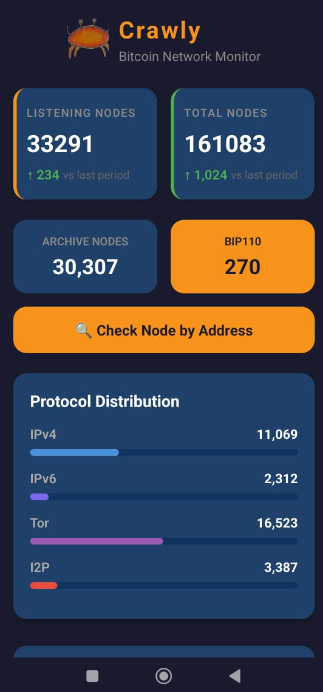 As of today, it indicates that the Bitcoin network has 161,000 nodes, of which only 270 indicate their agreement with BIP110. Source: BitcoinDynamic.
X-ray of Bitcoin decentralization
The application shows the ability to reveal parts of the Bitcoin network that remain inaccessible from conventional internet connections. In this way, the tool helps to understand the real resistance of the network against censorship attempts, since it demonstrates the practical difficulty of blocking it through regional restrictions on standard traffic. When running the scan from the device itself, Crawly offers a snapshot of ecosystem diversity. Preliminary data accessible through the app confirms a strong dependence on the Bitcoin Core client, which dominates among 80% of active nodes, which has been verified as the best client, according to what was reported by BitcoinDynamic. However, the tool also allows researchers and developers to track the evolution of the protocol, identifying what percentage of the network has adopted new improvement proposals, such as BIP110, which seeks to limit the space for non-monetary or arbitrary data in the distributed file blocks. This turns the mobile phone into a market intelligence terminal, capable of measuring the speed with which the community updates its infrastructure.
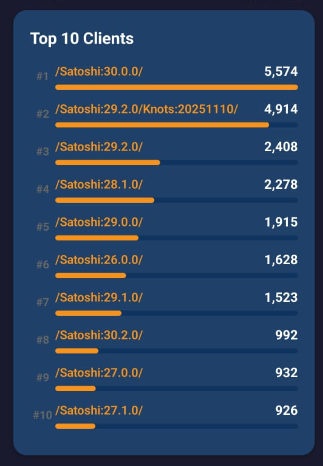 Bitcoin Core leads with around 80% of reachable nodes, followed by Bitcoin Knots and other minority implementations, based on a real-time scan from mobile. Source: BitcoinDynamic. The release of Crawly also marks a stance on software security. The project is available on Google Play, but also offers the option to access it directly through GitHub. This decision allows the source code to be auditable by anyone, ensuring that the application does not hide malicious functions. For its installation, the use of package managers such as Obtainium is promoted, which allow obtaining updates directly from the original source. With this approach, the application democratizes access to network data, and at the same time reinforces the philosophy that, in a decentralized system, P2P or peer-to-peer verification is superior to trust in third parties.
