«To accommodate something or someone, making the appropriate modifications,» this is how the word defines the word adapt. If we extrapolate this definition to a restaurant, Constance Barrère and Damien Teixidor, French nationality and as a stage, their Native restaurant, in Lastres (Asturias) appear on the summer of 2021, Barrère, commissioner of art, and the teixidor, sculptor, they went to visit a friend to Lastres, in the council of Colunga, they were clear. «On the eight -hour journey from Asturias to Perpiñán, we decided to sell our restaurant and the annexed house. A process that lasted approximately six months,» says Constance Barrè. It was earlier this year, when a picnic cider house, located on the outskirts, became his new life project with his daughter. Upon entering Native, nothing suggests that you are in a restaurant with a fishing village on the Cantabrian coast. Both their decoration and their way of understanding the restoration, or even themselves, follow the codes of a place located in the Gràcia neighborhood, in Barcelona; Malasaña, in Madrid; or in the Haut Marais, in Paris. Even so, when you open the letter, Native fits naturally and works in a coherent way. The local clientele, who initially entered only something to drink, was gradually encouraged to try the less daring elaborations of Damien Teixidor's kitchen. Native Native Restaurant. Pedro regulates integration with the product and the local producer is evident, almost obsessive. Example of this are Hazas anchovies, present in several elaborations, such as chocolate ganache and olive oil or the eggs to the mimosa with Mahonesa de Miso. With the veal meat of Caravia, supplied by her friend Ana Rebollar, they prepare a Steak Tartar with Piparra, to provide the spicy touch, at a tight price of 16 euros. In the case of the fish, Damien Teixidor avoids talking about nearby streams and prefers to specify the name of the boats, such as the picu pienzu or the new bosco, whose patterns are friends of the couple. The avocados arrive in lights, less than two kilometers from the restaurant and thus continues an endless list of products and producers with name and surnames, thus creating a network of local suppliers with community wicks. No kitchen training, Teixidor confesses that he learned to cook with YouTube videos. Among the books distributed by the restaurant, mixed with authors such as Virginia Woolf or Antonio Machado, is White Trash Cooking, by Ernest Matthew Mickler, whom he considers his own Bible.  Frigged potatoes with Asturian cottage cheese, lemon and olive presented on a personalized bag with the shield and colors of the sporting of Gijónpedro regueraunque the eclecticism of its proposal makes it difficult to label – something of what both refuse for fear of beating -, they are clear that their letter is adaptable and is always marked by what each season offers. Thus, their ferments are a natural response to that cycle, allowing them to prolong the lives of certain ingredients and combine them with the fresh products available. An example of this are asparagus with smoked cream and peas with a gelified veil of water -fermentation water of habaneros peppers, at 16 euros. Another aspect that is reflected in the letter is the influence of the countries in which they have lived. Thus, the fried potatoes are presented in a personalized bag with the shield and colors of the Sporting de Gijón, serving with Asturian cottage cheese, lemon and olive, in a clear wink to the street stalls in Mexico City, a city where they lived previously. Visually, it is a fun game for the local client and, in the factual, a perfect snack to accompany the vermouth, for 7 euros.
  Asparagus, smoked cream, peas and veil of fermented pepper water of the Asturian restaurant Native, in Lastres.Pedro reguerauna of the most outstanding elaborations of the letter is the oyster with pork pilpil, prepared in a similar way to the traditional cod pilpil, but using the pork collagen as a base. With regard to decoration, the restaurant configures a space that transmits its history. Books of his own library, works of art and paintings of friends. Something that is shocking, but that works, are the red plastic tables and chairs – mannerly serigraphed with the par excellence cool -, dressed with tablecloths, silver covered, fabric napkins and fresh flowers.
 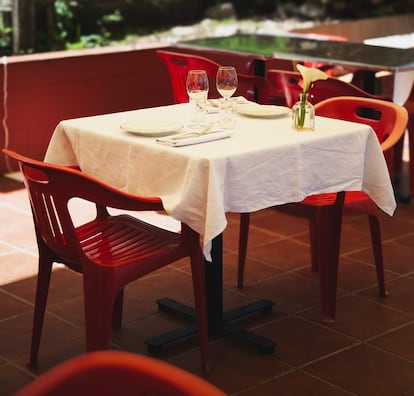 Table for two diners at the Nativepedro Reguera restaurant
 Table for two in the Asturian Bar in Nativepedro Reguerapara Constance Barrère, this remains in line with not wanting to typecast either in a high restoration restaurant, or in a more informal one. «The tablecloths are made from some sheets that belonged to my grandmother; the silver cutlery, are also of it and the plastic terrace furniture, evokes their childhood. So they have a sentimental element for me,» he says. In the liquid part of the letter, although they have natural cider, local beers or kombuchas in the area, Barrère confesses that what is costing him most is to build a letter of local natural wines, so for now they work with references from Italy, France or El Bierzo, in León.
  Chocolate ganache with Aove and Hazas Anchovies from the Native Restaurant, in Lastres, Asturias.Pedro Regueranative is not just a restaurant, here a philosophy of life underlies, a way of understanding the restoration away from what one would expect to find. A coexistence with their staff, which they consider main column of the project and, why not, an example to follow. If for something the touristification has highlighted it is for a loss of identity when it comes to riding restaurants, being carried away by what the tourist wants in place of offering the best of themselves. The case of sweeping and teixidor is totally different. Without a deep knowledge of the local recipe book, they have managed to understand the product, look for recipes and, above all, conserve an identity, in a continuous exchange between the region and them. Adapting to a place is not just to adopt your recipes, it also implies the work of integrating into the local community.
The French who fell in love with Asturias and left everything to set up a restaurant in a fishing village

By TP