Little is remembered, today that we live in a nightmare of digital surveillance and massive sale of data, that Google was founded in 1998 under the motto Don’t be evil. When the press emerged between the 17th and 18th centuries as the “fourth estate” against abuse of authority, it was not expected to become a propaganda tool for the elites. OpenAI was born non-profit to develop safe and beneficial artificial intelligence for humanity, avoiding monopolies; today it lives to attract investors by aggressively competing for leadership in the AI race. We like to call this phenomenon of straying from the founding principles the tragedy of massification, and we believe that Bitcoin is beginning to suffer from it.
While Satoshi never expressed a mission, vision, or values for his creation, and most of his communications remained technical, his design decisions for Bitcoin and some of the rationale reveal values that were carved into the character of the Bitcoin movement. Values that support individual sovereignty, and that today are being diluted in favor of intermediation.
The root of the problem with conventional currency is all the trust that is required to make it work. The central bank must be trusted not to debase the currency, but the history of fiat currencies is full of violations of that trust. Banks should be trusted to hold our money and transfer it electronically, but they lend it out in waves of credit bubbles with barely a fraction in reserve. We must trust them with our privacy, trust that they will not let identity thieves empty our accounts. Satoshi Nakamoto
In this famous quote, collected from the email sent by Satoshi to the P2P Foundation, several such principles are intuited: reduced trustespecially in traditional financial entities; no currency debasement; no fractional reserve; privacy protection. These elements are included in the implementation of its peer-to-peer electronic cash system. Mitigation of the need for trust is present in the fact that all nodes are vigilant among themselves that behavior is honest and there is no corruption or central points of failure. The inelastic supply of almost 21 million units protects against currency debasement. Since it is not a lending entity, fractional reserves are not possible in the Bitcoin protocol. With the use of asymmetric cryptography, identities on the network become alphanumeric strings, covering the physical identity of each user under a pseudonym. In different communications, other of these values that Satoshi had in mind when creating Bitcoin are revealed. But, despite having been its creator, Nakamoto only actively participated in three of the seventeen years that this technology has been in development, and from the beginning he presented it as a free open source community project. In this sense, both its development and the values around which its heterogeneous community has revolved They have been the result of the free and voluntary confluence of its participants.
But this freedom and openness also means that priorities are mobile and transformed in accordance with the main actors of the moment. Today we see how the new participants in this monetary system have priorities that modify the principles that guided the evolution of Bitcoin to what it is today. The problem is not the protocol, but the social, economic and political use that is being built on top of it.
Don’t trust, verify
Third-party verifiability and auditability was always the root cause and reason for this system. Being able to confirm and have certainty, instead of trusting that a third party will not betray our trust, was one of the most profound paradigmatic changes that Bitcoin introduced to the world of money. With massification, tragically, less and less is verified. We trust that exchanges and centralized custodians hold our money, even though we cannot see how our transactions are moving in a block explorer. We trust that governments will not expropriate money that is in the hands of custodians, whom we also trust. We trust that certain governments continue to purchase BTC. And we trust that the United States has good intentions in promoting cryptocurrencies. We trust companies to protect our data, and then it is hacked and leaked, putting us at risk; we trust that the block explorer’s accounting is correct rather than checking with our own node; we trust that a paper bitcoin as an ETF will be redeemable at any time for a real bitcoin; We trust the changes that developers introduce to Bitcoin. We trusted so much that, instead of using Bitcoin, we returned to dollars, the evil we wanted to solve, only in a digital version. In all cases, we trust again where Bitcoin taught us to verify.
If they’re not your keys, they’re not your coins / Be your own bank
Self-custody and radical ownership are themselves a revolution. For the first time in history we have a store of value that only requires a little study and knowledge to store safely, without having to pay third parties and without the risks that this entails: hacks, confiscations, corralitos, limits on transfers and withdrawals, or the intrinsic risks of cash, such as burning, getting wet or, in short, being irreparably damaged. Today Convenience trumps responsibility. According to VanEck, self-custody fell 7% in 2025 in favor of exchanges. Yes, managing private keys securely requires being responsible, and culturally we have learned that responsibility can be a burden, so it is more comfortable to leave funds in the hands of third parties such as exchanges, banks and custodians, repeating the mistakes of history. 23% of the bitcoin supply is currently held by centralized custodians. This is a growing trend: ETFs and funds increased their control of supply by 2% in a year and now only Satoshi manages more bitcoin than BlackRock, while corporate reserves grew 170% in the same period. And on the opposite side, this institutionalization of Bitcoin is believed to be one of the causes behind OG bitcoiners selling part of their holdings.
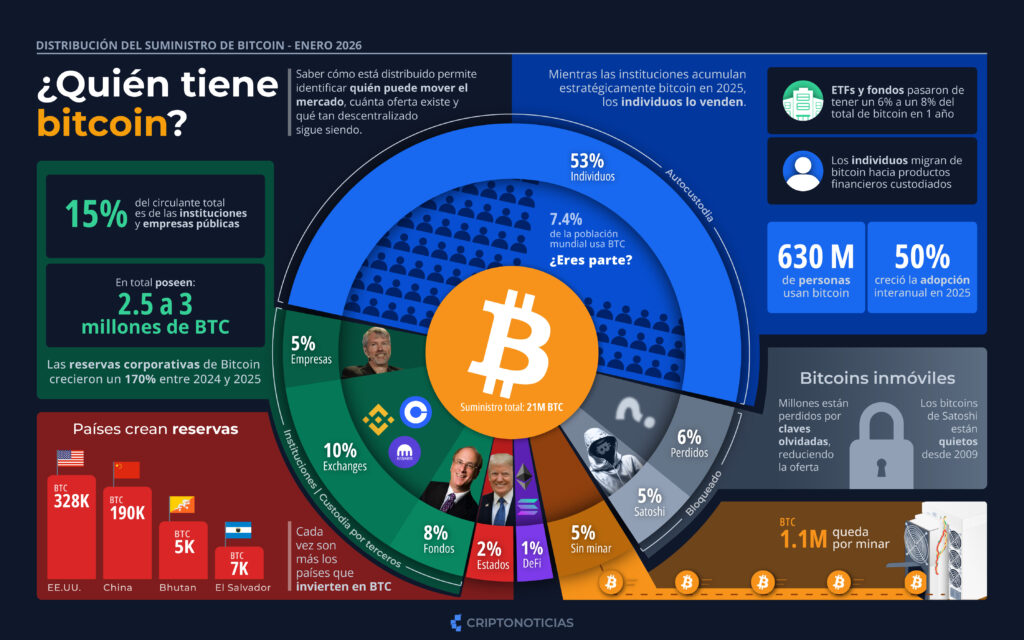 Bitcoin supply is becoming more centralized. Infographic created by BitcoinDynamic.
Separation of money and the State
With the increasing institutionalization of Bitcoin and its reaching the masses, the narrative of Bitcoin becoming money is not only being pushed aside, it is being fought. Relevant actors such as Strategy or Coinbase do not promote the substitution of fiat
for Bitcoin, but they give it a subordinate role as an instrument that will give more life to the system that has enriched elites at the expense of the population during the last fifty years. The priority of fixing the world by returning to a hard money standard has taken a backseat in relation to personal, business or government enrichment in fiat terms. Bitcoin is discouraged from being used as a means of payment so as not to challenge the hegemony of the dollar.
Censorship resistance and privacy
More and more ground has been given up for legacy banking regulations to encroach on the Bitcoin and decentralized finance space. Under the excuse of mass adoption, are accepted and celebrated regulations imposing KYC and Travel Rule to decentralized protocols that are not custodians of money; Platforms like Tornado Cash and privacy-focused developers like Samourai Wallet are persecuted, without it being a priority for the community to defend them; On-chain spy software is happily adopted and obstacles are put in place to accept transactions that have gone through a privacy system.
Freedom has left the chat
Another symptom of the tragedy of massification is that the center of the conversation among bitcoiners has ceased to be individual freedom and sovereignty to focus on financial and regulatory debates. The focus is on whether Strategy’s shares rise or if it goes private, on creating corporate treasuries, on banking adoption, on the inflows and outflows of ETFs, on whether the supposed regulatory clarity increases. The growth of Bitcoin seems to have brought a distancing from the initial values and ethos so that the new ones focus on “what sells”, what will give people the greatest return in terms of fiat. The risk with this is not idealistic whim. These principles are the pillars that They support the nature of Bitcoin and without which this asset has no value. If Bitcoin stops being free and neutral money and becomes an asset captured by a few, where KYC is required to participate and where some transactions are not admissible, it will not be long before they will want to modify the consensus rules and even increase the supply of coins because governments have not accumulated enough BTC. The principles and values are there for historical reasons, and detaching ourselves from them will lead us to repeat the mistakes of past and decadent monetary systems. Bitcoin is not about reproducing or sustaining fiat, but about surpassing it to bring about a more prosperous society based on sound money. There are still spaces and spokespersons where these values and principles are defended: circular economies, where communities strive for bitcoin to be used as money and adopted from the grassroots; conferences such as Baltic Honeybadger or Watch Out! Bitcoin, which keeps the debate focused on technology and the aspects that matter; podcast such as Lunaticoin or the recently launched one by BitcoinDynamic, Separating Money and the State, which seek to be a space of resistance to spread the word about Bitcoin and freedom. Without undermining the importance of dialogue and debate, Bitcoin is not defended on Twitter or Wall Street, it is defended by using it as it was designed. Running own node; guarding it personally; securing through inheritance tools; paying with BTC when possible and even promote it to be accepted as payment; supporting privacy tools. It should be noted that, for now, the Bitcoin protocol continues to function without the need for trust and faithful to its principles; This is above all a problem of the social layer. However, it should not be taken for granted either. Bitcoin can lose by becoming trivialized and, thus, captured and modified by its enemies. We must avoid the tragedy of massification and, with it, the decline of the bitcoiner ethos.