On the outskirts of Coín (Málaga, 25,809 inhabitants) there is an industrial ship that goes unnoticed, hidden among the facilities of the municipal operating services. It has a blue gate. And inside he keeps a bite of objects that baffles. There are damajuanas, pallets, many cardboard boxes. On a table they rest an old printer, a microwave and an old radio with tape plates. And, beyond, you can see wooden barrels and bottles, many bottles of wine. It does not seem, but this corner is a cellar from which natural wines come out in the United States, the United Kingdom, Canada or Denmark. They are the result – without web or advertising and few social networks – of the passion and talent of Samuel Párraga, a 36 -year -old Malaga winemaker who began in the sector by family tradition and, after deepening modern oenology, has preferred to take a step back to bet on a process as artisan as exempt from chemicals. Judging for his success, he has given on the nail. Párraga finishes sweeping the ground to stay calm before starting this interview. Then open the laptop and search Spotify for some jazz. Donald Byrd's trumpet sounds and then breathes, drink water and feels before starting to tell its story. «I come from a family of wines: my grandfather did it in Colmenar and my father in Cártama,» he starts, then telling how they forced him to go to the vineyards to work or pruning. It is recreated in detail in the enjoyment that meant collecting the grape and, above all, stepping on the lagar. «I was excited,» he confirms. He smiles when he talks about the prize was to drink the fresh must. They made wine from the land, with hardly any knowledge and leaving virtually all random. Sometimes it went well, sometimes regular and sometimes worse, but the important thing was to drink it between friends. Today he is excited to recall those times: although they were rustic and homemade processes, love and confidence in making good natural wines arose from them. The same ones that are already served in the Celler of Can Roca or celebrate in London restaurants such as Duck Soup or Elliot, where last year they prepared a special day to pair them with sardines, fried eggplants and Malaga Ajoblanco. Samuel Párraga inside his winery in Coín, Málaga.García-Santos (El País) has not been easy to get there. Learning has been slow, patient. First he did it with the winemaker who hired his family when, in 2010, they decided to found a warehouse from those wines of the land. Párraga was then a teenager and hit the professional to absorb knowledge. He was so passionate that he went to Manilva to study a training cycle of viticulture and, later, to Cádiz to pursue a degree of oenology. «The first two years are practically the same as those of biotechnology. And the other two of sciences applied to the vineyard and wine. There are mathematics, physics, chemistry or edaphology, I learned a lot,» he says. Before graduating he already moved to launch his own project. During the studies and his practices he learned how the traditional sector worked and that did not like it: addition of sulphites, yeasts, acids, clarifications, filtered. «The quality of the grape was lost with each process. It lost all the grace,» he says. In 2016, he tested the natural wines of the Granada Bodea – Poneros in the Sector – Dark Barranco, as well as those made by Antonio Vílchez – also in Granada – or Fernando Angulo in Sanlúcar de Barrameda (Cádiz). He discovered a new world, the definitive push to become independent from the family winery. He did it the following year, hungry for learning. He began an exploration process that led him to lease vineyards in diverse lands, with native varieties – as Rome, Vigiriega or Montúa – and orientations to learn as much as possible. His first stop were two plots of the Malaga region of the Axarquía. Then he leased small farms in Cartajima, Comares, Mollina, Los Montes de Málaga and even tested in Polycar, Albuñol and Cádiar, already in the Alpujarra, all always cared for under ecological criteria. That year he also traveled to Napa Valley, in California, during the harvest to know how they worked there with the latest technologies. Later he went to the Loira Valley, in France, to harvest with producer Mark Angeli, where he deepened the natural wines. 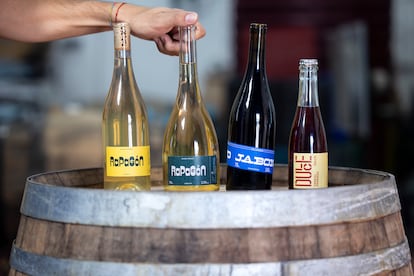 Four bottles of wine from Samuel Párraga.García-Santos (El País)
Rapagad, sweet and high soaps
His first wines were born in his father's winery, but in 2020 he got a ship in Coín, in which he continues today. That year ten different wines came out and the next, 25. «I wanted to try everything, rehearse, learn, improve,» he says. «Then I realized that it was better to concentrate production on specific places. And I opted for the Montes de Málaga because incredible things can be done,» he explains. Today its production is concentrated in five wines. Of its two small farms in the axarchy – media hectare each, handcrafted, in Sedella and Competen – leaves sweet, an exquisite Moscatel. From other four -hectare farms in the mountains, near Colmenar, he gets a red -called high soaps and a target pending marketing. Finally, Mollina arrives the two called Rapagón: a white and an ancestral sparkling who ferments a year in bottle. All are prepared in its Coín facilities, full of junk because it hosts the entire process: from the pressing and waste of the grape to its fermentation, step to barrels, bottled and labeling. All craft, bottle bottle. And its prices range from 15 euros the white rapagon to 47 El Dulce. They can be tested in a handful of Malaga restaurants – the dog's house, Kaleja, Juana Paloma, Bardal, among others – and a few more in Catalonia. «There are countries where natural wines are the norm in letters, but here are the exception,» he says with some pessimism. «But I think that little by little all that will change,» he says with a glimpse of optimism. While that time comes, 80% of its production goes abroad. The United States and the United Kingdom are its best markets, although it also sells to Canada, Denmark, Belgium, Switzerland, Germany and France. On average elaborates about 10,000 annual bottles, which from this campaign will be about 30,000 if everything goes well. And that everything goes well is not easy. The elaboration of natural wines is a risky trip. Without chemicals, industrial additives or sulphites, wine evolves at its pace. The process can be controlled, but requires experience, tino, good product and a little luck. «The risk is huge, that's why almost nobody does,» he says who knows that sometimes the thing twists. It happened in 2023, with a grape very affected by the strong drought. The white went, lost all the production. He did not throw her out: now he prepares a vinegar with her. After more than an hour of talk and taste some of the new wines – surprising brightness and clarity – that prepares for the future, more relaxed, smiles after finishing his story. Look around and say that the office work takes away the illusion – faactures, charges control, responding emails, quarterly VAT – but that it recovers energy every time it goes to the field or spends the hours in your cellar. Also when a client, winemaker or friend tells him something good about his wines. «That Josep Roca tells you that he loves and buys them for his restaurant is incredible,» he says, something restless already because they can get on the car to get closer to the vineyards, where the grape is already practically ready: in just one month the new harvest starts. One more step to continue conquering the world.