The document exempts returns from stablecoin balances that are not active and establishes fines. The White House took the initiative and on this occasion led the discussion. The debate over stablecoin rewards in the United States appears to be on track, albeit with setbacks for the emerging digital asset industry. In a third meeting, the White House, bankers and cryptocurrency entrepreneurs They agreed on one point.: Interest payments to inactive stablecoins, those that remain in wallets or platforms without making transactions, passively generating returns, were ruled out. According to the information handled by the American journalist, Eleanor Terrett, the private meeting in Washington was attended by representatives of cryptocurrency firms such as Coinbase, Ripple and a16z. They spoke with banking organizations such as the American Bankers Association (ABA), the Bank Policy Institute (BPI) and the Independent Community of American Bankers (ICBA). Unlike previous meetings, which ended without agreement, in this last one the government took the lead. White House Cryptocurrency Council Executive Director Patrick Witt Presented Draft Clarity Law which served as the central axis of the conversation.
The text acknowledged concerns raised by banks around stablecoin yields and potential deposit flight. At the same time he made it clear that any future restrictions on rewards would be limited in scope. In the text, says Terrett, it is clarified that obtaining returns on inactive stablecoin balances (an issue that has been a key objective of the cryptocurrency industry) is practically ruled out. The debate now centers on whether companies can offer rewards tied to certain activities, such as transactions. Additionally, the draft establishes fines of $500,000 per day for anyone who evades this restriction and offers these interests.
The third meeting at the White House had a different tone. Source: Wikipedia.
What do bankers and cryptocurrency entrepreneurs say?
As Terrett points out, sources in the cryptocurrency sector argued after the meeting that the banks’ concern about these returns seems to come more from competitive pressures than the possible flight of bank deposits. Likewise, Paul Grewal, legal director of Coinbase, stated that the dialogue «was constructive» and in a «cooperative» tone. Something similar was pointed out by Ji Hun Kim, from the Cryptocurrency Council for Innovation, who described the meeting as “constructive” and showed new progress in the days to come. However, from the traditional sector they insist on the risks of stablecoin returns on deposits and propose including a study on their exit in the Clarity law. they want make the relationship clear between the growth of the payment stablecoin market and its possible impact on bank deposits. Bankers, Terrett says, «were encouraged by the language proposed in the bill.» In his opinion, it would give the SEC, the Treasury and the CFTC authority to enforce «a prohibition on paying returns on dormant balances with civil monetary penalties.» Other visions of the meeting in Washington, such as that of journalist Paul Barron, suggest that the banks are now the ones who have the ball and that, under pressure from the White House, «they hold the Clarity law hostage.» This view highlights the idea that the sector “continues to want to ban the performance of stablecoins because they fear competition,” the reporter said. «I hope they give in soon,» Barron said. He recalled that banks «have already lost billions of dollars in financial technology because their products are terrible.» «It is not, nor will it ever be, a leak of deposits! Now they try to push for a better deal for the common man just to protect their pockets. Congress: Let’s not allow the United States to become the graveyard of cryptocurrencies while the rest of the world dominates it,” said Barron.
And now what will happen to the Clarity Law?
With this advance, the next thing is that bankers assess whether there is room for an agreement with the cryptocurrency sector to finally unlock the game and allow for Clarity’s legislative advancement. If so, rewards for stablecoins would be allowed in certain activities. «A source indicated that a deadline [de la Casa Blanca] end of the month does not seem unrealistic, and that talks will continue in the coming days,» Terret said. Although it is assumed that the deadline is next March 1. In line, Patrick Witt made a post in X where he highlighted that the meeting represented «a big step forward» and assured that The parties are close to a final agreement.
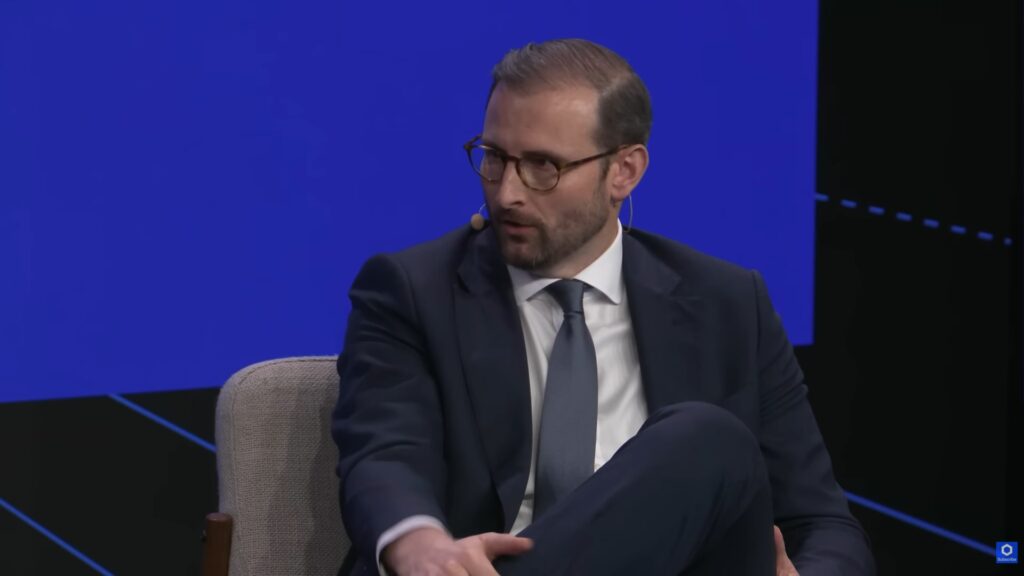 Witt showed expectations for an agreement in the short term. Source: @chainlink – YouTube. «As long as we continue to have a good faith commitment from both sides on this issue, I fully expect that we will meet our deadline,» Witt said. Remember that the deadline established by the White House, which is March 1. The Clarity Act is expected to be signed into law by US President Donald Trump in April.