Visa and Mastercard dominate the sector by offering rewards of up to 8% on bitcoin. Adoption in Latin America grew by 63% with new options for Mexico, Brazil and Argentina. By 2025, at least 112 cryptocurrency cards are competing in the market, intensifying the battle to capture users’ daily spending. This is revealed by researcher Alex Obchakevich in his exhaustive list of active projects globally. The boom driven by fintechs and cryptocurrency exchanges seeks to solve a classic user dilemma. That is facilitate the use of digital assetssuch as bitcoin (BTC) or stablecoins, in everyday purchases. Card issuers range from fintech players – such as the neobank Revolut and the cryptoasset wallet MetaMask – to industry exchanges – Binance, Coinbase, among many others – and cryptocurrency ecosystems – such as Solana and Cardano. Although money is onchain, the digital infrastructure that moves it remains classic. According to Obchakevich’s data, the traditional duopoly remains the backbone of the sector. That’s because 64% of these cards operate under the Visa network, while the remaining 36% do so with Mastercard.
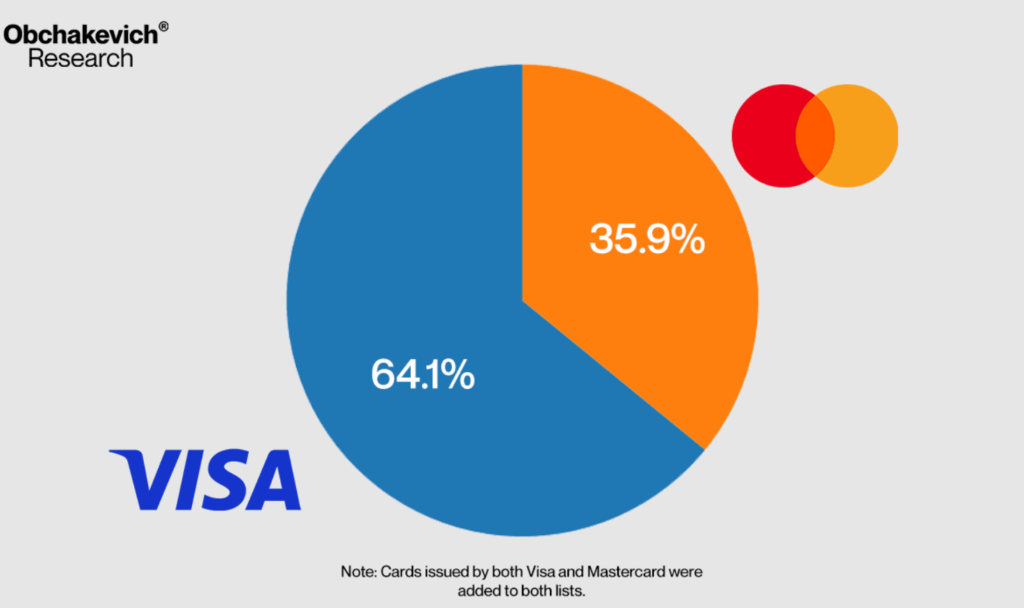
64.1% of the 112 cryptocurrency cards active in 2025 identified operate with Visa. Source: X/obchakevich_. However, the real battle is not in the network, but in the benefits. Companies have understood that custody and speed are no longer enough; Now they must seduce the user with rewards.
Alex Obchakevich’s list includes cryptocurrency cards focused on global accessibility, rewards, and stablecoin support. Proof of this are the following just to mention a few. Revolut allows you to manage more than 150 assets under the support of Visa and Mastercard. In Brazil, for example, it offers accounts in reals with 100% returns from the Interbancário Deposit Certificate (CDI) and tax-free transfers (IOF). Nexo provides a hybrid Mastercard card that allows you to spend against the value of assets without having to sell them. It is for those who bet on the long term (holders). It offers up to 2% cashback on NEXO tokens (scalable to 6% on premium tiers) and a 14% annual return on unused balances. Available in Latin America through its app, it also facilitates free ATM withdrawals of up to 2,000 euros per month. For its part, Wirex is committed to massive diversity, supporting more than 685 cryptocurrencies. Its most recent launch, the Cardano Card (November 2025), enables ADA payments at 80 million Visa merchants with no foreign exchange fees. With up to 8% cashback for elite users and staking options, it has positioned itself in Brazil and Mexico, integrating perfectly with Apple and Google Pay.
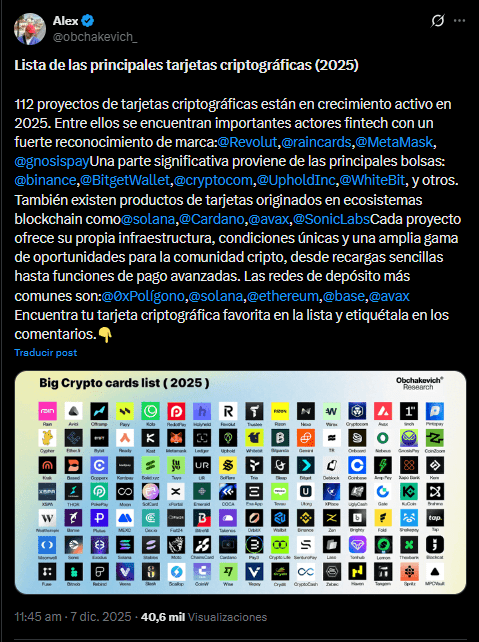 From leaders like Crypto.com and Binance to ecosystems like Solana and Cardano, they are competing to transform everyday spending in cryptocurrencies. Crypto.com has its Visa card operational in 180 countries. Its proposal focuses on benefits with returns of up to 5% (and 8% at higher levels) and perks such as full refunds for subscriptions to services such as Netflix. Although it requires staking to access the best rewards, its presence in places like Brazil and Mexico keeps it as a benchmark. Among those that stand out in the first group is also RedotPay, which emerges as another practical solution for everyday life. Focused on stablecoins like USDT and USDC, this Visa card prioritizes usability over rewards. It is without annual commissions, with high limits of up to 50,000 dollars (USD) per month. It is used in regions such as Latin America for everyday payments and invoices.
Latin America, a crucial testing ground
It is in emerging economies such as Latin America that cryptocurrency cards take on a special meaning, going from being a technological novelty to a financial necessity. In key markets such as Brazil, Mexico, Argentina and Colombia, the offer is specialized according to the user profile. For those seeking to maximize their wealth, strategies vary by latitude. In Mexico, the Gemini Credit Card offers 4% rewards in bitcoin or ether with no annual fees. In Argentina, Uphold responds to inflation by betting on the Avalanche (AVAX) ecosystem, offering 4% initial cashback and staking options with annual returns of 16.1%, all without international fees. Additionally, for digital nomads and frequent travelers, cards from exchanges such as Coinbase and Binance are positioned as tools in the Mexico-Colombia-Argentina axis. As BitcoinDynamic reported, its automatic conversion capacity eliminates the usual border frictions.