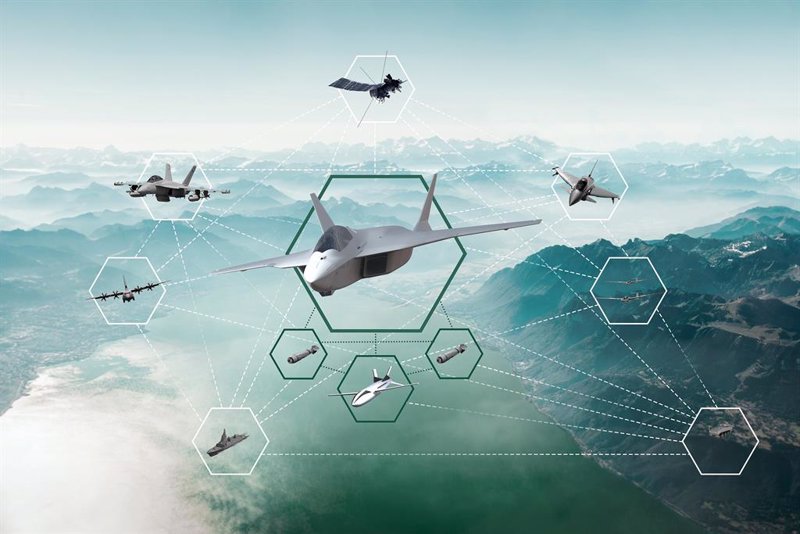
Indra falls with gusto on the stock market this Tuesday. Specifically, its shares lose more than 5%, after the project to build a European fighter failedin which precisely the Spanish woman participated. France and Germany have decided to cancel the project Future Combat Air System (FCAS) for the discrepancies that have occurred and that have been insurmountable. As confirmed this Monday at the last minute by various European media, the German Chancellor Friedrich Merz and the French president Emmanuel Macron have decided to put an end to this historical projectwhich sought to develop and build a new generation combat aircraft, since there are serious difficulties in maintaining the current collaboration scheme between the companies involved.
Dassault Aviation (fighter design) and Airbus (systems and platforms), who were in charge of leading the project on behalf of France and Germany, respectively, have been unable to reach an agreement on the distribution of tasks or patent rights, which has blown up the project, in which also Spain participated through Indrawhich was in charge of the industrial part (sensors and electronics). Other companies involved in the project, valued at about 100,000 million euroswere Thales (incorporating flight systems) and safran along with MTU Aero Engines (engine development), among others. The parties have decided to definitively abandon the development of the sixth generation fighter, which was planned for the 2040salthough the first flight was estimated for 2029, after the program had already been paralyzed precisely by the confrontation between Airbus and Dassault. And the friction has been constant since the launch of the project, back in 2017. It should be noted that although the FCAS has partners other systems such as sensors –which were carried out by Indra, the third partner of the program– or the combat cloud Made up of drones, the fighter was the main part, and it is the one that has been cancelled. However, despite this failure, the parties intend to continue moving forward with the so-called combat cloud, which is the nervous system that would serve to connect aircraft, weapons systems, platforms, sensors and other components into an integrated whole. Merz has proposed that countries work together to continue developing it, but as Bankinter experts say, «it is not clear if other components of the FCAS, including drones, sensors and engines, can be developed viably without the fighter aircraft as a central element«. The failure of the fighter project is «negative news for the European defense sector» and «casts certain doubts about Franco-German collaboration in other European consortia,» these analysts add. For the strategists of the orange bank, it is important to remember that «France is inclined to strengthen its industrial autonomyrelying on the integrated capabilities of Dassault, Thales and Safran – partly replicating the model followed with the Rafale -, while Germany and Spain defend a more balanced approach in industrial distribution«. However, they add, «Germany and Spain present relative limitations to autonomously develop a complete sixth generation system.» Therefore, the exclusion or repositioning of Germany and Spain in this area «poses relevant uncertainties about its role in future advanced air defense programs.» In his opinion, «The development of this type of capabilities is strategic for Europeto the extent that it would reduce dependence on the US F-35 and close the technological gap compared to the US.» And in this context, «the GCAP (Global Combat Air Programme) – an alliance between the United Kingdom (BAE Systems), Italy (Leonardo) and Japan (Mitsubishi Heavy Industries) – continues to advance in a more cohesive way and could gain relevance as an alternative platform.» Banco Sabadell analysts also describe the cancellation of the fighter as «negative news», although they believe that the impact «It should be limited since of the entire project only the combat aircraft part would have been cancelled.» Indra’s income from FCAS in 2026 «represents approximately 3% of total sales». In the case of Airbus, analysts do not expect any impact, «since the difficulties in carrying out this project due to disputes with Dassault were known,» and its cancellation does not affect their estimates for the company. They remember, in any case, that the Defense area represents around 11% of the group’s EBIT.