Google warned that the arrival of quantum computing will force an urgent transition to post-quantum cryptography, as current encryption systems could become vulnerable in the coming years. The company released a document on February 6, signed by Kent Walker, president of Global Affairs at Google and Alphabet, and Hartmut Neven, founder and leader of Google Quantum AI, in which he raises a call to action for governments and companies.
In the text, Google points out that quantum computers promise advances in areas such as drug discovery, materials science and energy, but they also represent a direct threat to public key encryption systems that Today they protect bank transfers, private communications and sensitive data.
“The encryption that currently keeps your information safe could be easily broken by a large-scale quantum computer in the coming years,” the company warns.
Google has been working on post-quantum algorithms since 2016
Google emphasizes that the risk is not only future. Malicious actors could already be executing “store now, decrypt later” attacks. saving encrypted data waiting for a quantum computer with enough capacity to breach it. Faced with this scenario, the company recalls that the security community has been working on post-quantum cryptography (PQC) for years, that is, algorithms designed to resist attacks from quantum computers. In 2024, the United States National Institute of Standards and Technology (NIST) published the first set of standards in this area. Google states that it has been preparing for this scenario since 2016, with pioneering experiments, gradual implementation of post-quantum algorithms in its products and a strategy based on cryptographic agility, that allows algorithms to be updated or replaced without interrupting services. The document also proposes five lines of action for public policy makers, including accelerating the adoption of NIST standards, reducing regulatory fragmentation, prioritizing technological modernization, and relying on experts to avoid “strategic surprises.” For Google, quantum computing “is not always a decade away,” so delaying preparation increases the risks.
Bitcoin could suffer the risks that Google warns
From the perspective of Bitcoin, the quantum advance is relevant because its security is based on public key cryptography, the same type of systems that Google considers vulnerable in the long term, as reported by BitcoinDynamic.
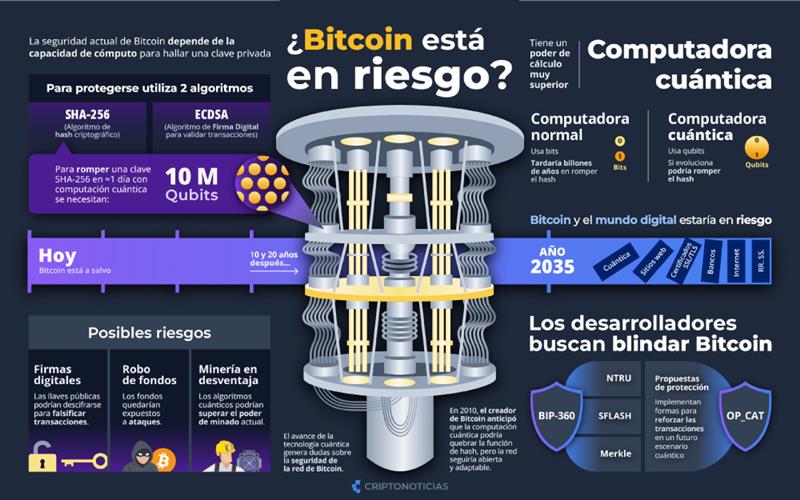 A quantum attacker could theoretically break Bitcoin’s security. Source: BitcoinDynamic. This is because if quantum computers capable of breaking this encryption existed in the future, the security and privacy of the system could be compromised. However, there is no public evidence that there are quantum computers with the practical ability to compromise Bitcoin today. Debate within the ecosystem focuses on future scenarios and how to prepare, including the possible adoption of quantum-resistant cryptography and transition mechanisms to new standards.