The closure of a business that has played some role in our lives is a small disappointment, but, perhaps, the feeling is heightened when the establishment in question is a bar. In big cities, the closure or transformation of traditional bars is happening at full speed. According to data from the National Institute of Statistics (INE), between 2010 and 2023 almost 35,000 bars were closed in Spain. And this process, which is part of the general homogenization of the urban landscape, is ending something that goes far beyond a way of eating, drinking or hanging out. According to urban anthropologist José Mansilla, known on the internet as @antroperplejo, the bar was a key cog in the social structure for decades. «In Fordist societies, bars had the role of being a meeting place after the work day. The place to share how your day had gone or talk about projects,» he explains. “Before and during the Republic, they were also spaces of hidden discourse: places where political or union ideas were hatched in a discreet manner.” This function of civic refuge has been diluted over time, Mansilla maintains, in a “much more fragmented and individualistic society, where cities no longer play that role of urban conflict linked to the old union actions of the industry.” The bars, therefore, have lost that centrality and have become something else.More informationThe gastronomic journalist and philosopher Anna Torrents analyzes this phenomenon: “The disappearance of traditional bars reveals a double loss: that of the real and that of the common.” In his diagnosis, what was once a refuge from everyday life, a space where time could stop, is today governed by “the logic of visibility and productivity.” «The bar is no longer inhabited, it is consumed as another experience. As anthropologist Marc Augé would point out, what occupies its place is not another type of bar, but a non-place: neutral, functional, interchangeable spaces, where no one leaves a mark. The usual bar no longer fits into the accelerated ecosystem of the contemporary city,» he continues. Torrents recalls that there are also material reasons: «Many of these bars survived thanks to family or underground economies. Today, rents, taxation and regulations have made this romantic precariousness unviable. It is not just that they lack soul; it is that it is increasingly difficult to make a living from a bar.»The function of a bar as a civic refuge has been diluted over time in a “much more fragmented and individualistic” society. skynesher (Getty Images)
The bar as a moral and emotional institution
The writer and tavern owner Carles Armengol (Barcelona, 44 years old) talks about that disappearance in his new book Matar un bar, published by Col&Col. «Cities change and so do their businesses, this has been happening for centuries. What worries me is the urban homogenization and the lack of soul in the businesses that open. We all watch the same series and listen to the same artists while the cities are full of franchises, dirty money laundering businesses and soulless bars,» he says. For Armengol, having a bar was never just a matter of business. «The bar, by tradition, plays an indispensable socializing role. It is a day (and night) center for people who feel alone, a place of meeting and exchange, where the social fabric is strengthened. It is where the neighbor can leave a copy of their keys in case anything happens.» He grew up around tables and slot machines, observing the best and worst of the human condition that was represented every day. “Growing up in a neighborhood bar made me learn to understand and not judge the darkness of others; to humanize other people’s misfortunes without believing that yours is better,” he remembers. In his speech an idea is expressed that goes beyond romanticism: the bar as resistance to accelerated capitalism. “Deciding where we are going to eat is a political act,” he maintains. «Knowing if the owners are the ones behind the bar, if they take care of their workers… Taking care of your neighborhood and the people who live in it by working from within is a beautiful act in a globalized context.»
An impostered authenticity
In the places that leave the usual bars empty, sometimes other hospitality establishments are installed that disguise themselves as “authentic” without being so, further multiplying the sensation of falsehood, of scenery, of a theme park. For Mansilla, this transformation of the bar into a setting is also a symptom of the times: «They no longer seek to be meeting points, but rather places to search for symbolic capital. The new bars disguised as classic taverns are a place to posturing. They are like those recreations of the Eiffel Tower or the Taj Mahal that can be visited in Las Vegas.» 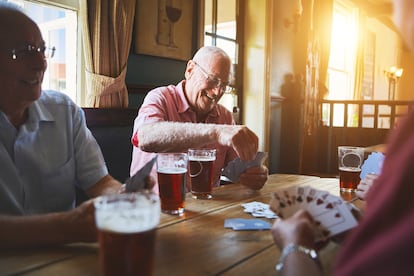 The bar plays an indispensable socializing role: it is a day (and night) center for people who feel alone, a place of meeting and exchange where the social fabric is strengthened. DMP (Getty Images) The parallelism with what the sociologist Guy Debord called “the society of the spectacle” is inevitable. «We relate through images. There is no longer a collective spirit or common project; only the need to reaffirm our personal brand. That is why these bars change the decoration from time to time: so that you can come back and take another different photo.» The transformation is also noticeable in the kitchen. Torrents summarizes it like this: «The traditional bar gastronomy and the current one do not speak the same language, although both interpret the everyday. The first was functional: it was born from scarcity, ingenuity and time. Few ingredients, recipes without an author, learned by repetition. It did not seek to innovate, only to feed.» And he adds: «Today, however, the menu has become a manifesto. Each dish tells a story: of product, technique or identity. Where before there was consistency, now there is experience. Then trust mattered; now, surprise. People ate without thinking, now they eat to tell.»
The bar as a job and as a life
The precariousness of the sector is another symptom of this crisis. «Traditionally, bars have been temples of (male) hedonism to satisfy customers at any time. If you didn’t open on a Sunday, the next day you’d get the ‘how well you’re living, Mariano,'» Armengol recalls. «Commerce and hospitality are the most slave trades,» it has always been repeated in the neighborhoods like a mantra full of reality, but things are changing: «There are more and more restaurants that do not open on weekends or only in the mornings. Conciliation is essential for bars to endure,» he adds, and insists that the dignity of the trade is not at odds with its popular essence: «The essence of a bar is that whoever pays the bills is the one who gets his hands dirty. When not You are there, the business becomes Excel tables and protocols. It loses freshness, essence.” In this sense, Mansilla highlights that there is a sector of the population that has managed to maintain this old way of “having a bar”, often suffering the same precariousness of the original owners. The anthropologist declares himself a defender of the traditional bars that members of the Chinese community have kept open. “Even though they barely speak Spanish or Catalan, these businesses maintain the classic menu, inherited recipes and popular prices.” 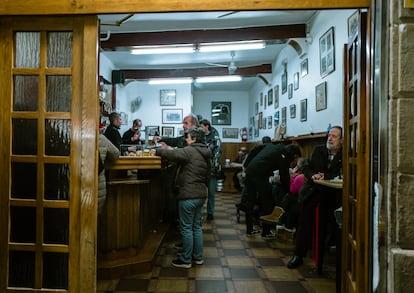 There are more and more restaurants that do not open on weekends or only in the mornings. Conciliation is essential for bars to endure. Chalffy (Getty Images) The usual bar «is not just an often limited and austere gastronomic model»: «It is a form of community based on repetition, closeness and trust. With its closure, not only a menu is lost, but a way of being in the world: a structure of time and coexistence,» Torrents points out. Although gastronomic criticism advocates not idealizing the past. “Many of those bars were noisy, with minimal cuisine,” he points out. But he does defend something deeper: «The possibility of being without purpose, of conversing without performance, of sharing without calculating. That bar culture, with all its imperfections, offered a refuge against the logic of optimization.» Therefore, for Armengol the future of the bar is not in having marble tables or nostalgic elements of the past as decoration, but in the host, in the human factor: «Taking care of your clients, remembering what they like to drink, picking up a package for them if they are not at home or wish them good morning when you pass them while setting up the terrace and they go to work.”