
Chef Miguel Orts in a client’s kitchen. Dining in Hong Kong and traveling by private jet to eat the next day in Cuba seems like a scene from the Succession series, but it was the reality for several years of Pablo Albuerne, better known as @gipsychef. Albuerne traveled side by side with an important Chinese businessman for almost five years around the world and ended up becoming his gastronomic guru: he prepared his meals, yes, but he also managed restaurant reservations, advised him what to order or bought him the best acorn-fed ham on the market if he felt like it. He is one of the many examples of how the job of a private chef goes far beyond the kitchen: his tasks include managing expectations, acting as an improvised nutritionist and even a confidant. in the shadow
Who hires a private chef and why
Having a personal chef is not within the reach of many. Even so, there are various types of clients and, within the sector, also hierarchies. There are professionals who work seasonally in villas or boats – especially in destinations such as the Balearic Islands or the Costa Azul – whose role is to guarantee a complete gastronomic experience during the holidays. At an intermediate level are those who cook for families with several residences: they know their tastes, plan menus and manage suppliers throughout the year, although only in some cases do they accompany them on their trips. And at the top end are the private chefs to UHNWIs, —Ultra High-Net-Worth Individuals, that is, people with assets exceeding $30 million—, who travel with their employers around the world and are in charge of everything related to their food: from cooking and shopping to reserving tables or supervising local teams wherever they are. 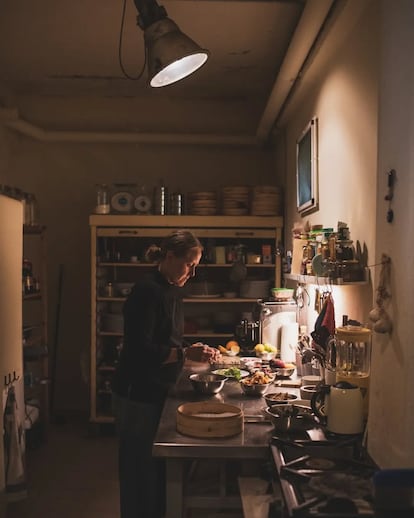 Chef Sarah Stothart working in the kitchen. About 25 years ago, Sarah Stothart was in charge of the private kitchen of one of the great media magnates, at a time when his media empire dictated much of what the world read, watched or thought. «Most people were afraid of him, but I had nothing to lose; I was young and I applied for the position out of curiosity. He made me cook something for him and I prepared him an entrecôte with fries. He loved it.» For six months, Stothart was his private chef in the Sydney office, an impressive 40-plus-storey building with spectacular views of Hyde Park. There was no budget limit, I could buy whatever I wanted and anywhere in the world: the first salmon to come up the river from a farm in Scotland or the most exquisite caviar from a Russian supplier. «But honestly, he had tastes as a child: he loved sandwiches, hamburgers, pasta. And at corporate meetings he would make simple Mediterranean-inspired dishes but with the best ingredients. Nothing too crazy.»
When luxury is fresh fish seasoned with salt
Contrary to what we might imagine, the simplicity of the food is a constant in customer demands. Raúl Moreno, 23 years old, finished his studies at the Hofmann school in Barcelona and began working in the summer in villas and mansions in Ibiza cooking for families during their holidays. «What they are mainly looking for is comfort: that you take care of everything and not have to think,» he explains. «I usually prepare fresh, Mediterranean cuisine for them, including grilled meats and dishes to share; they don’t want avant-garde things. They are on vacation, in a relaxed atmosphere and they crave delicious but casual things.» 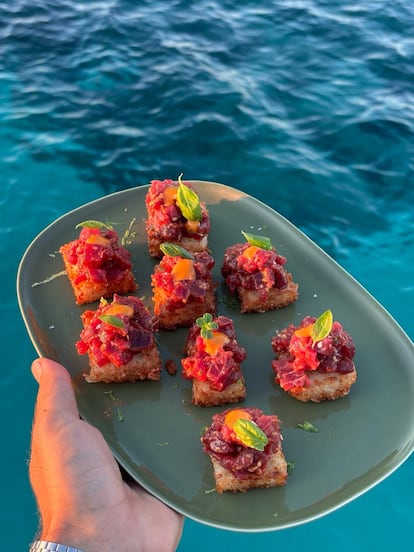 Fried rice bites with spicy tuna tartar from Miguel Orts, made on the boat of one of his clients. Of course, the demand always includes that the products are fresh and of the highest quality, which is why private chefs take great care of their relationship with suppliers such as trusted fishmongers or butcher shops or local farms and farms. «I worked for a week with a Russian couple who asked me for grilled chicken with salad and scrambled eggs for breakfast. And even so, I spent more than seven thousand euros on shopping that week,» explains Miguel Orts, alias «the mermaid chef,» who has been a private chef on luxury catamarans for four years. “They wanted very exquisite things: Tuscan water bottled in glass, bottles of Chablis wine for 400 euros a bottle, lobster, filet mignon and caviar, a lot of caviar.” Pablo Albuerne confirms that there is an important cultural difference between his Spanish clients – he was a private chef for two national families – and his Chinese client: “Chinese culture places a lot of value on things based on how expensive they are and with my client there was a lot of improvisation capricious: I went to Alba, in Piedmont, for a white truffle weighing more than half a kilo because he wanted the spectacle of having a large truffle in his hands. With Spanish families there were no such eccentricities.
Organization, key to improvisation
Private chefs don’t just cook: they are in charge of purchasing ingredients, managing menus, looking for the best suppliers and adapting to different culinary scenarios: preparing a last-minute business dinner, designing a banquet for 50 people or facing a demanding request «such as ensuring that in less than three days a huge almadraba bluefin tuna, caught in Cádiz, arrives very fresh to Bordeaux,» says Albuerne, remembering this episode with his Chinese client. «Impossible? No. Difficult? Quite a bit. But hey, I was known for my ability to resolve his whims. At the end of the day, what is impossible, in many cases, money makes it possible.» These chefs usually work with unlimited budgets and creative freedom within the framework agreed with their clients. «Sometimes I miss cooking more avant-garde dishes,» admits Orts, «but then I remember the conditions of the restaurants I’ve been to and I forget. I prefer the quality of life that this job gives me to the technical creativity that I may be missing.»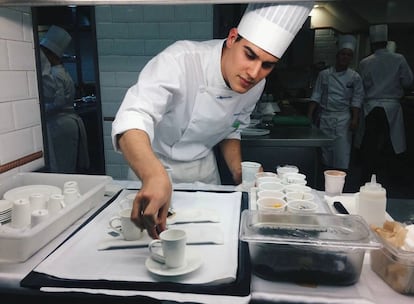 Miguel Orts in the middle of a service. But that freedom also redefines the job. The job of a private chef is far from that of a restaurant, not only because it escapes the repetition of millimeter dishes, but because of the difference in the level of stress. «In a restaurant kitchen we can be seen overwhelmed, in a bad mood… In a house you can’t allow it. You have to see yourself smiling and confident,» says Moreno. Even so, it makes up for it: «There are many hours and you have to be very disciplined and organized, but in a restaurant I have also spent up to sixteen hours non-stop and with extremely high stress. At least here I depend only on myself and I organize myself in my own way.» Miguel Orts agrees: “It is not a stressful job like in a restaurant, but it is difficult to live in a small space with the crew and with different customers every week.”
The rich shout too
The first thing Sarah had to do when she started working for the tycoon was sign a confidentiality clause. In those offices, million-dollar deals were closed and everything had to be protected. Private chefs work for very wealthy people and often with a lot of media exposure, so discretion is essential. Pablo Albuerne believes that this quality must be innate: «Discretion is a matter of personal nature. Being a gossip is unfavorable in any job, it has to go hand in hand with human quality.» Living together 24/7 exposes you to uncomfortable situations. «On the boat where I work, they don’t force me to sign anything, but there are complicated moments,» says Orts, «from arguments in front of you to clients bringing prostitutes to the boat. Even so, that happens rarely; most of the time everything goes normally.» Albuerne, who worked for three different families, puts the emphasis on the human relationship: «For me it was important to be treated as one of their own and to establish a relationship of mutual respect with my client, just like with any person you appreciate. I did not want to feel part of the service, and with all my clients I have established a real bond and we still maintain friendships.» In the shorter jobs, however, the relationship changes: «Sometimes they treat you haughtily, especially women,» says Orts. “Of my colleagues they treat them worse than me; it is a sexist world where some feel entitled to treat them as if they were their service.”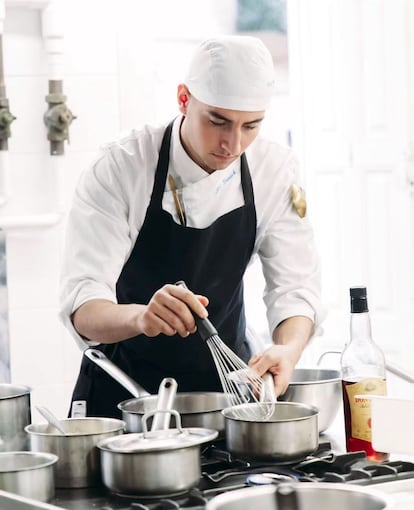 The cook Raúl Moreno working.
So is it worth it to be a private chef?
Despite everything, there is an obvious advantage to the job of private chef: the salary. “In the restaurants the conditions are terrible, and this job allows me to travel, meet people, work at sea and earn four times more,” Orts confesses. Raúl Moreno corroborates this. After a demanding stage at the three-star Copenhagen restaurant Noma, he prefers to continue as a private chef: «It is a grateful and better paid world. There is no possible comparison.» To give us an idea, a traveling private chef can earn between five thousand and six thousand euros per month without counting tips, which in a good month can round up the figure to eight thousand euros. In the case of a permanent private chef, it will depend on how much the employer wants to pay, and in the case of very high purchasing power, the rates can range between six hundred and one thousand euros per day. Of course, everyone agrees: it cannot be done just for money. “They pay you a lot not only because they are rich, but because they expect excellence,” explains Moreno. Along the same lines, Albuerne warns: «The economic difference is abysmal, but I do not recommend doing it just for the money. In reality you also earn in experiences, and that must be valued.»The salary may be high, but it is not a life for everyone, adds Pablo Albuerne. «It is a job that requires sacrifice. In the end, you are in a golden prison living someone else’s life. I have traveled all over the world by private jet, I have been to incredible places, but I go where my client wants to go and I cook what he wants to eat. There is a part of emotional kidnapping, with Stockholm syndrome included.»All these conditions make the job of private chef a temporary rather than a vital option. “Working on a boat is interesting, but you detach yourself from your personal life and end up living another reality,” says Orts. «Being a private chef is lonely: you will earn money, but it is not very compatible with your private life.» For Albuerne, however, the hardest thing was not the loneliness: «The loneliness did not weigh on me because I felt close to my clients. What I missed most was the freedom: being able to decide what I wanted to do at any given moment.» Perhaps that is why, for many, being a private chef ends up being exactly that: a golden cage.
