
Bitcoin (BTC) exchange-traded funds (ETFs) experienced their most challenging period on Wall Street so far in 2026, recording capital outflows that amounted to $1.3 billion. This financial movement, concentrated between Tuesday, January 20 and Friday, January 23 (due to the Monday holiday in the United States), marks the highest volume of weekly withdrawals since last November. The daily breakdown of these operations shows a persistent trend of disinvestment, beginning last Tuesday with a withdrawal of 483 million dollars, followed by the highest figure on Wednesday with 708 million dollars. Although the pace of exits decreased towards the end of the week, with USD 32 million on Thursday, it closed yesterday Friday with exits of USD 103 million. The graph below shows, week by week, how the capital flows to or from the BTC ETFs have been:
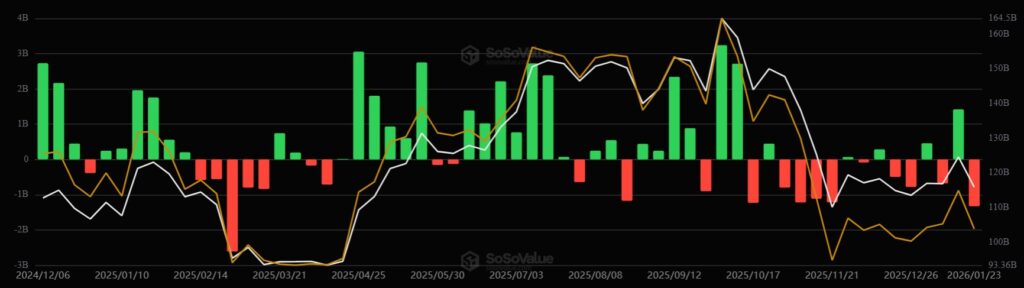 ETFs suffered their largest weekly outflow so far in 2026. Source: SosoValue. This level of outputs was sufficient to generate a 5% drop in the price of BTC in that period. Currently, the price of bitcoin is oscillating in a technical range between $89,000 and $90,000.
Bitcoin continues in a corrective period
It’s worth remembering that spot ETFs work by buying and holding bitcoin to back your shares, making them a key factor. in price dynamics of digital currency. When investors withdraw their capital, managers may need to sell part of their bitcoin holdings to cover those redemptions. This increase in supply, without demand to counteract it, exerts direct downward pressure on the value of the asset. This correlation between the behavior of ETFs and the price of bitcoin derives, therefore, from the operational structure of ETF issuers, who must adjust their physical reserves to support shares outstanding. Historically, similar periods of mass outflows have preceded phases of reaccumulation. However, bitcoin currently remains in a corrective period from the all-time high of $126,000, reported by BitcoinDynamic in October. In this cautious scenario, bulls expect that, in the long term, BTC will gain traction as digital gold.
