León believes that USDT took on the role of “marker” in Venezuela because the market is distorted. “We could see a reduction in the gap and greater exchange rate unification,” he says. The exchange rate distortion that the Venezuelan economy is going through, where the stablecoin linked to the dollar, USD Tether (USDT), functions as the main reference for the parallel market, could find a point of convergence as more dollars enter the economy. According to the economist and president of the socioeconomic analysis firm Datanalisis, Luis Vicente León, the increase in the flow of foreign currency from the oil industry will provide the Central Bank of Venezuela (BCV) with the necessary liquidity to intervene with greater force. seeking to reduce the exchange gap to a margin of less than 10%.
In statements to BitcoinDynamic this Wednesday, April 8, León explained that the current role of the stablecoin issued by Tether Limited as a price marker It is a direct response to the inefficiencies of the formal system.
“That market is still there as long as there are not enough dollars or enough offers to cover in the official markets or in the permitted markets,” said the analyst, highlighting that the prevalence of this alternative exchange rate is proportional to the difficulty of economic actors in accessing foreign currency through banking channels. The main basis for this projection of exchange rate unification lies in the State’s cash flow. León estimates that Venezuela could multiply its oil income by 10 this 2026going from about 2.5 billion dollars in the previous year to a figure close to 25 billion dollars. This increase would be attributed to the elimination of discounts on crude oil sales, the increase in oil production due to agreements with the US, and the sale of inventories accumulated during the first months of the current year. With this capital, The BCV would have greater room for maneuver to feed the exchange tables and auctions, reducing pressure on the free market where the digital asset is traded, suggests León. “If you have the possibility of allocating enough currency to calm the market, then we could see a reduction in the exchange gap and a greater tendency towards unification,” he stated. For the economist, the objective of the issuing entity is regain control over the price of the dollar and prevent external factors or unregulated markets from dictating the inflationary pattern.
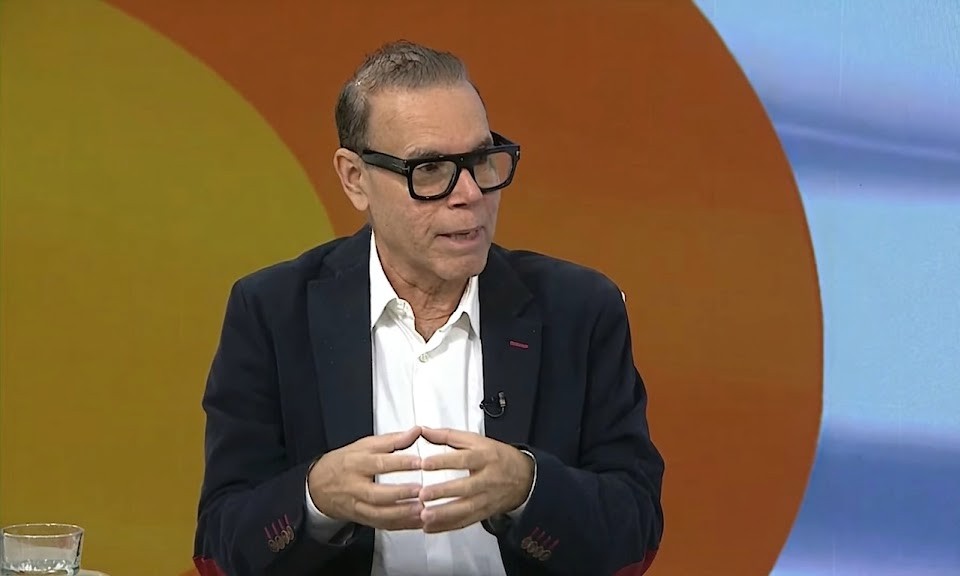 León points out that cryptocurrencies took on a function in Venezuela that does not correspond to them. Source: Globovisión – YouTube.
The distortion of USDT as a market marker in Venezuela
Currently, USDT is not used in Venezuela exclusively for its technological properties of value transfer, but as a refuge from the shortage of physical tickets or electronic currencies in banking. León is emphatic when pointing out that this is not the nature of digital currency: «Cryptocurrencies are not for that. That is not their function. They have simply taken on a market marker function because this market [el venezolano] It’s distorted.» From this perspective, it is considered that the massive use of digital assets in the country to set prices for goods and services It is a symptom of an economic pathology. Now, the economist predicts that, to the extent that the distortion is resolved and the official market absorbs demand, cryptoassets will resume their original role. «Cryptocurrencies are for what they are in the world: to make operations comfortable, easy, with less costs,» he explained, suggesting that transactional volume in Venezuela will be normalized to align with global adoption standards.
An artificial phenomenon resulting from the exchange gap
However, the vision of an organic unification is questioned by other specialists who see the current dynamics as a scenario of forced control. Alexis Lugo, professor and specialist in the digital asset industry, warned in contact with BitcoinDynamic that any recent reduction in the price of USDT against the bolivar does not respond to an improvement in economic confidence. but rather an «artificial phenomenon» caused by the coexistence of multiple rates.
Lugo highlighted that the Venezuelan market operates under three different realities: the official BCV rate, the bank auction rate — which acts as an intervention mechanism — and the value of USDT in peer-to-peer (P2P) markets. According to market data, The distance between the official exchange rate and the digital asset has exceeded 32.6%which shows severe structural resistance to achieve the convergence that León projects. For Lugo, economic actors are temporarily abandoning the USDT market to seek foreign currency in banks due to price distortions that encourage arbitrage. and not for a real stabilization of the system.
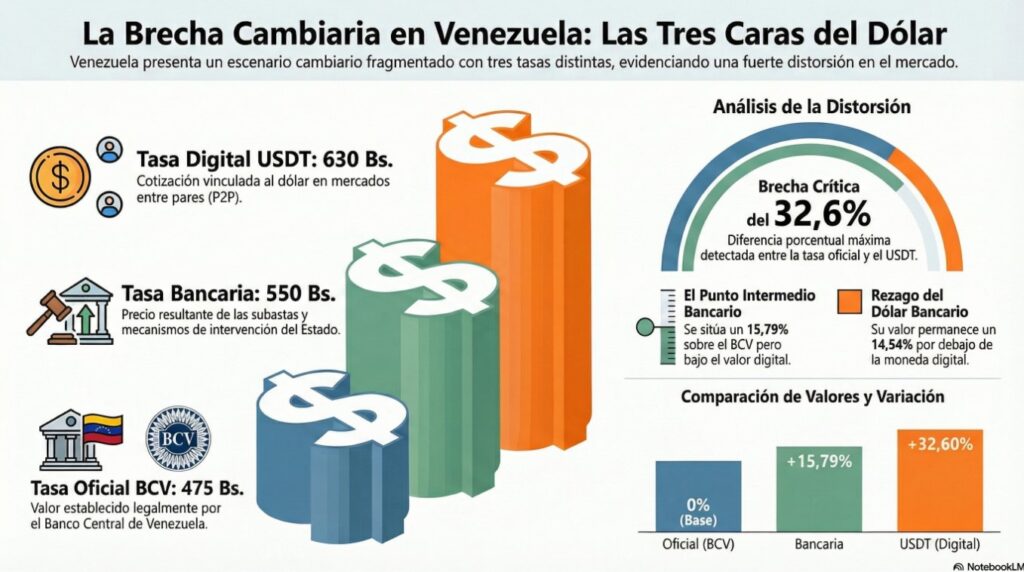 In Venezuela, economic distortion has led to the emergence of three exchange rates. Source: NotebookLM.
Future outlook for digital assets in Venezuela
Despite contrasting views on the health of the Venezuelan market, there is a consensus that State intervention will be the determining factor in the coming months.
Luis Vicente León maintains his position that the end of the year will mark a milestone in reducing the gap. «We hope in the future that this will close. A gap that the BCV estimates that at the end of the year should be less than 10%. But how long it will take is not clear,» the economist reiterated. If this scenario comes true, the digital asset ecosystem in Venezuela will undergo a transformation. From being an exchange survival tool and a thermometer of the parallel dollar, USDT will be integrated as financial efficiency instruments in a market that, according to León, should be solid and interesting, but far from the magnitudes inflated by internal distortion.