The report distinguishes between encryption and digital signatures, both with different urgencies. Bitcoin faces governance and migration challenges, not an imminent quantum collapse. A report published by the a16z crypto developer group cast doubt on the urgency raised by part of the cryptocurrency ecosystem on an immediate transition to post-quantum cryptography. According to the report, «the timelines towards a cryptographically relevant quantum computer «They are frequently exaggerated.»leading to “calls for urgent and widespread migrations.” All these requests, as indicated in the document published on January 24, do not always consider important items such as: Implementation risks. The fundamental differences between the different types of cryptographic primitives. As Criptonoticias has been reporting, these differences between analysts have meant that Bitcoin’s relationship with quantum computing is between reality and FUD. The situation leads us to have to analyze whether the potential danger that this technology represents will impact the price of the currency.
What quantum means (and doesn’t) for Bitcoin
For a16z crypto, the quantum threat to Bitcoin would not manifest itself as a sudden collapse, but as «a selective and progressive process.» Shor’s (quantum) algorithm can theoretically break the elliptic curve cryptography used in Bitcoin, called ECDSA. It is this that secures digital signatures of transactions. That quantum algorithm, as detailed in the a16z report, would have to be applied key by key. A process that would make first attacks “extremely expensive and slow”. The report also clarifies that, a significant portion of users is relatively protected. «Even without immediate protocol changes.» Who prevent address reuseand do not employ outputs that directly expose the public key, they keep their funds protected behind hash functions. In those cases, the risk only appears when the funds are spent. However, in the present situation, around 7 million bitcoins (BTC) would be vulnerable to quantumdue to the reuse of addresses, as reported earlier this month by the Project Eleven site.
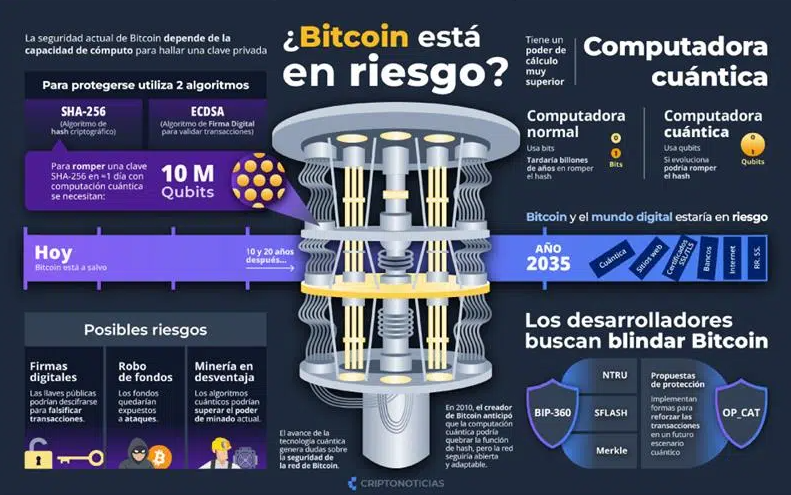 Infographic created by BitcoinDynamic.
Bitcon’s weakest link against a quantum computer
The a16z crypto report takes this vulnerability into account. Note that the biggest problem is represented by these potentially abandoned coins, with public keys already exposed. «Some estimates place these bitcoins in millions of units.» Which introduces technical, economic and legal dilemmas of great magnitude. The document mentions theoretical options: declare those coins burned or leave them vulnerable to being claimed. Although it warns that this last alternative «raises serious legal and security problems.» Added to this issue of abandoned coins are Bitcoin’s own limitations: slow governance, low transaction capacity, and the impossibility of passive migration. In the words of the report, «time pressure does not come from impending quantum computers, but of the social and technical logistics of coordinating a transition».
«There is an exaggeration in quantum risk»
The report highlights that one of the main errors that arise in the current debate is treating all cryptography as a homogeneous block.
Not all cryptographic tools fulfill the same function or face the same level of exposure to quantum computing. a16z crypto report.
With this, the developers warn, applying a uniform urgency distorts the risk analysis. In particular, the document distinguishes between encryption, used to protect the confidentiality of information; and digital signatures. These serve to authenticate messages and authorize transactions, as occurs in Bitcoin and Ethereum. Both components (encryption and signatures) react very differently to the eventual arrival of the functional quantum computer.
Encryption, signatures and the key difference
‘Harvest now, decrypt later’ (HNDL) practices they are already underway«says the report. This refers to adversaries who store encrypted communications today to decrypt them in the future, when a sufficiently powerful quantum computer exists. For that reason, for a16z crypto, “post-quantum encryption requires immediate deployment”. Even assuming cost overruns and implementation risks. On the other hand, «digital signatures face a different calculation and are not susceptible to HNDL attacks”. This is because they do not contain secrets that can be deciphered retroactively. If a signature was created before the existence of a relevant quantum computer, it cannot be considered false a posteriori. As the document explains, both Bitcoin and Ethereum “use non-post-quantum cryptography primarily for transaction authorization, not encryption.” This eliminates the immediate urgency associated with HNDL.
The true quantum horizon
The study also defines precisely what is meant by cryptographically relevant quantum computer (CRQC): a fault-tolerant, error-correcting machine capable of running Shor’s algorithm at sufficient scale to break schemes such as ECDSA or RSA-2048 in reasonable timeframes.
A CRQC in the 2020s is highly unlikely. a16z crypto report.
That is why from a16z crypto they question corporate ads about “quantum advantage” or “thousands of logical qubits.” They warn that «the raw qubit count is misleading.» Without sustained error correction, such systems are useless for cryptanalysis. In summary, the expectation of a machine capable of breaking ECDSA or RSA-2048 in the next five years «is not supported by known public progress»and in a ten-year horizon «it remains ambitious.» In conclusion, it is emphasized that the greatest immediate risk for blockchains it’s not quantumbut operational. «For years, implementation vulnerabilities will be a much bigger threat than a CRQC.»