A few days before the presidential elections on January 14 in Uganda, the country is going through a climate of strong political tension. The authorities denied that they planned to cut off internet access during the vote, although the main opposition candidate publicly reiterated that the government could block the network to prevent the mobilization and dissemination of results. Concerns grew after Elon Musk’s Starlink restricted its service in the country following an order from the local regulator. In this scenario, President Yoweri Museveni seeks to extend a mandate of more than 40 years, while his main rival, Robert Kyagulanyi, known as Bobi Wine, repeatedly urged from his X account the population to use BitChata messaging application designed to work without internet and inspired by Bitcoin.
HAVE YOU DOWNLOADED BITCHAT YET? As we all know, the regime is plotting an internet shutdown in the coming days, like they have done in all previous elections. They switch off the internet in order to block communication and ensure that citizens do not organize, verify their… pic.twitter.com/KPVyc0ZW4H— BOBI WINE (@HEBobiwine) December 30, 2025
Whether because of the calls of the opponent or because he understood the potential of Bitchat on his own, the Ugandan population massively adopted the bitcoiner application.
According to a report from a local media in that African country, the number of Bitchat downloads in its territory reached around 500,000 users from the end of December to the present. This activity led to the number of active users in that app worldwide being approximately 1.5 million active users at the beginning of January 2026.
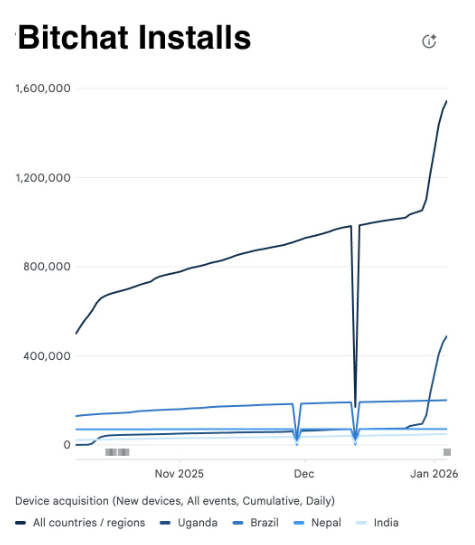
The following data confirms the trend exposed by that Ugandan media: in the last week, almost 500,000 people downloaded Bitchataccording to Chrome Stats. This fact coincides with the requests of the opponent in the Ugandan presidential race.
What is Bitchat and why did it gain relevance in Uganda?
As explained by BitcoinDynamic, BitChat is a messaging application created by Jack Dorsey, focused on privacy, decentralization and resilience against censorship.
Unlike traditional platforms, it does not depend on central servers or an internet connection to operate. Its operation is based on peer-to-peer networks, using local communication technologies (such as Bluetooth or direct connections between nearby devices) to create a mesh network. Each phone acts as a node that relays messages, allowing information to spread even when there is no access to the global network.
In practice, this means that users can chat, share messages and coordinate locally, even if internet access is interrupted.
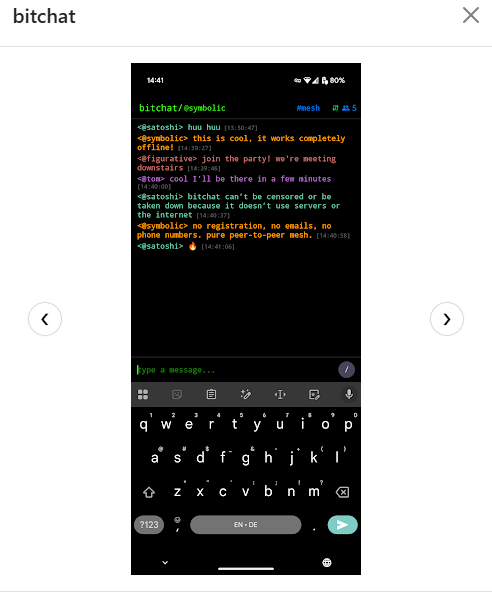 User conversation through Bitchat. Source: Chrome Stats. Finally, in addition to messaging, Bitchat integrates the possibility of send bitcoin (BTC) without internet. This is possible because the application connects with wallets and allows transactions to be signed locally and transmitted through the peer-to-peer network. Once any of the connected devices regain access to the internet, the transaction can be broadcast to the Bitcoin network for confirmation. In this way, sending value does not require a direct connection at the time of the operation. This design prioritizes self-custody and avoids intermediaries. Users maintain control of their private keys and do not rely on external servers to move funds or communicate, reducing single points of failure.