In 2025, major economies created standards for stablecoins, tokenized assets, and exchanges. Regulation of the sector is no longer a merely reactive resource. In 2025 the world of cryptocurrencies entered a new era, one that is not only driven by innovation and the market. During this last year, global regulatory dynamics are also charting the path. Gone is the era in which governments They ignored the bitcoin (BTC) ecosystem. The first years of the digital currency’s life are also moving away, when it was seen – by the majority of regulators – as something marginal, associated with the criminal world. In those times, many rulers were satisfied with the central banks issuing statements. In them they warned «the risks of investing in cryptocurrencies» and They warned about scams and money laundering. This position, which oscillated between indifference and rejection, stoked fears for more than 10 years, after the creation of Bitcoin. The fear was that a total ban will be reached. A threat that is being forgotten, to the rhythm of a kind of «political whiplash.»
A leap in bitcoin regulation
As the year-end report of the blockchain intelligence company, TRM Labs, points out, the cryptocurrency ecosystem, and digital assets in general, closes 2025 with a triumphant entry into global finance. The impulse gained strength with the arrival of Donald Trump to the White House.
2025 was the year regulatory clarity coincided with market momentum. As the United States under the Trump administration reshaped the tone of global politics, cryptocurrency regulation entered a period of acceleration in its implementation. TRM Labs.
The relationship of regulators with Bitcoin has been the subject of study by several academics. One of the most prominent is Jan Lansky, from the University of Finance and Management in Prague, Czech Republic. In 2018, the teacher delved into the levels of regulation that were being used in the world for cryptocurrencies. For that date, he developed a scale that ranges from 0 to 5, as shown in the following table:
BITCOIN REGULATION LEVELDESCRIPTION0The government does not pay attention to digital assets.1Some official body has issued a statement, recognizing the existence of cryptocurrencies. But it does not present any approach to deal with them.2Some body has published a statement proposing an approach to deal with cryptoassets.3Some body has issued guidance and standards to regulate digital assets.4There are predefined conditions that, once met, could lead to regulations. There is authorization to provide products and services related to cryptoassets.5There is a total or partial prohibition or the total adoption and use of cryptoassets is promoted.
The regulatory landscape expands
At the time Lansky did the study, most countries’ bitcoin regulation hovered between levels 0 and 3 on the scale. More than 50% had no regulatory focus and 14% of jurisdictions were considering prohibiting its use. The landscape began to change towards 2022, with the rise of institutional adoption. By 2025 it can be said that the majority of jurisdictions are between levels 4 and 5: promoting the use of bitcoinand not banning it as feared. The location on the highest scale is evident in the TRM Labs study. The firm evaluated the progress made in 30 jurisdictions that concentrate more than 70% of the world’s exposure to cryptoassets. The research concludes that almost 80% of the jurisdictions analyzed created new regulatory frameworks this year. They all incorporate cryptocurrencies into their financial systems. Analysts mention initiatives from the main economies, mostly focused on stablecoins, tokenized assets and the operation of exchanges. The advances are notable in the United States, in the European Union (with the so-called MiCA Law), and in Asian countries (highlighting the United Arab Emirates, South Korea and Japan). In Latin America, attention is drawn to the proposals of Brazil and El Salvador.
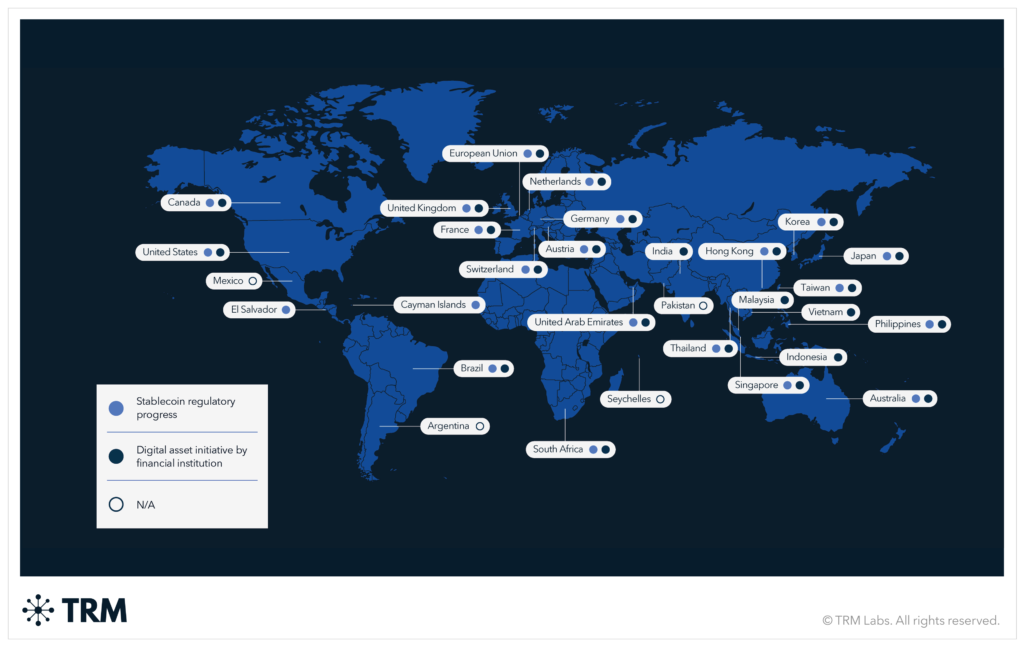 The graph shows the jurisdictions where the most regulatory advances have been made in 2025. The light blue circle indicates regulations for stablecoins and the dark blue circle indicates integration initiatives with banks. Source: TRM Labs.
The US leads the regulatory turn
The influence of the United States in global politics and economy has been the driving force behind the regulatory advance of 2025. The new vision of politicians and authorities takes shape after Trump’s turn in favor of the ecosystem. The president’s influence became tangible in the US through the new stance of the Securities and Exchange Commission (SEC), with the approval of laws (with GENIUS at the helm); and with the regulations that allow banks to offer services with BTC. All this, together with government guidelines and initiatives to create bitcoin treasuries.
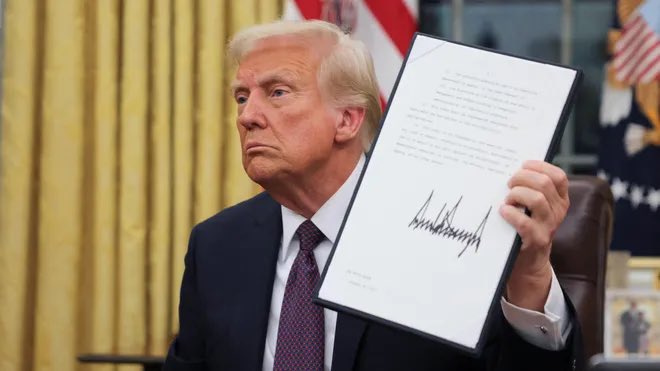 Trump took office at the beginning of the year and signed several executive orders related to bitcoin. Source: a central place in the economic agenda of the States. And there are several indicators that prove it. One of the most important turning points in this regulatory dynamic is the relationship of cryptocurrencies with the financial system. a link previously non-existent. A yellow line drawn by regulators told banks “don’t pass.” The situation now is different. More and more banks are looking to offer services with bitcoin, and in 2025 the barriers will finally fall. The banking authorities remove the restrictions on these entities to operate with cryptocurrencies.
Changes bitcoin’s bond with banks
A key signal is the change in stance of the Financial Stability Oversight Council (FSOC). In its 2025 annual report, it removed cryptocurrencies from the list of vulnerabilities that weaken the financial system. For a long time this body, which brings together the main US financial regulators, described cryptoassets as a source of risk. Their 2024 report still cited them as a “potential danger.” By 2025, it highlights them as «a growing sector.»
YEARFSOC STANCE ON BITCOIN2022It is an explicit risk for financial stability and a “priority area to monitor”.2023A “vulnerability for financial stability” due to price volatility.2024A potential systemic risk whose market is growing and must be monitored. 2025 is no longer a «vulnerability.» There are no alerts, concerns, or explicit recommendations. Cryptocurrency warnings withdrawn. Something similar happens with the Basel Committee on Banking Supervision (BCBS). The international organization, which sets standards for banking regulation worldwide, announced last November “an accelerated review” of its prudential standards. for bank exposure to cryptocurrencies. After years of calling bitcoin and stablecoins threats, new rules expected to be announced in 2026 be more flexible and open with the sector.
A new historical cycle opens
For most experts, all these changes are not just an update, but a recognition of the maturation of the ecosystem. Thus a new panorama emerges that inserts bitcoin into state policy at a global level. “In 2025, the United States dismantled its restrictive approach to cryptocurrencies and opened a new historical cycle that could be consolidated globally,” observe Barclays analysts. Researchers anticipate a 2026 of “regulatory reality.” A trend that will gain ground with the implementation of laws and «governments that follow the American lead.» Next year would also be marked by the fight between States to attract investments with cryptocurrencies.
On a global scale, competition between jurisdictions will revolve around offering sophisticated legal frameworks capable of integrating innovation, financial stability and effective controls (…) Bitcoin regulation ceases to be reactive and begins to occupy the center of the politics of the world’s main economies. TRM Labs.