Sun, wind and space. Three factors that summarize the strategic advantage of Spain and Portugal in clean energy – 20-30% more competitive than the European average – and which served as the starting point for the Step up Now event, organized by McKinsey & Company in collaboration with EL PAÍS last Wednesday at the Ritz hotel in Madrid. Led by Aida Bao, journalist from Cadena SER, this event dedicated to the Iberian Industry and Energy Transition Initiative (IETI) brought together top executives from the energy and industrial sector to talk about industrial competitiveness and energy transition based on this “platform, not only for dialogue, but also for action,” as Maria João Ribeirinho, senior partner at McKinsey, described it. And there was (discursive) action, of course. In his presentation, Ribeirinho outlined an urgent scenario for Europe, because “China has multiplied its industrial weight by three” and energy prices in Europe “are two and three times higher than in China and the United States.” In return, it opened a front of opportunity: “Spain and Portugal are well positioned in the European context with respect to competitive energy, qualified workforce, critical structures, and with a greater weight with respect to the influx of international capital.” Under a prism of optimism, he invited the rest of the speakers to “discuss what has to happen to capture this opportunity.” 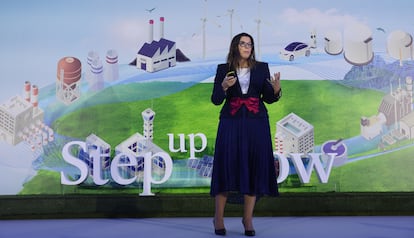 Maria João Ribeirinho, ‘senior partner’ of McKinsey & Company. Jaime Villanueva The gauntlet was picked up by Teresa Parejo, general director of Industrial Strategy and SMEs of the Ministry of Industry and Tourism, who, in the face of the complex reindustrialization facing Europe, “based on principles of sustainability, digitalization and autonomy”, wielded the competitive advantage of Spain and Portugal in the form of “abundant clean energy, institutional stability and qualified talent.” It involves overcoming structural challenges, such as «energy costs, technological dependence and the need to attract productive investment», and to this end it announced a new regulatory framework that will promote three axes of action towards 2030, «placing the ecological transition at the center of productive power; ensuring supply without falling into protectionism, and promoting innovation, productivity and investment.» Parejo highlighted the relocation of critical sectors (chemical, pharmaceutical, automotive), cooperation with companies through sectoral industrial plans, as well as public-private alliances through new Pertes.
 Teresa Parejo, general director of Industrial Strategy and Small and Medium Enterprises of the Ministry of Industry and Tourism. Jaime VillanuevaThat public-private collaboration, and especially the need for more ideal conditions for it to bear fruit, marked the first of the debate panels, moderated by Juan Antonio Bahillo, partner at McKinsey, and which brought together Juan Lladó, CEO of Técnicas Reunidas, Begoña Villacís, executive director of Spain DC and Francisco J. Riberas, president of Gestamp. The latter claimed that, in the face of approaches that prioritize the green factor, “we have to be convinced that the industry is something good, that it generates wealth,” and in the face of the fierce battle that exists worldwide, he urged “to be able to put the knife in our mouths and fight.” He called for a plan that commits the industrial sector and the Administration, with “measures that may be more or less pleasing regarding tariffs or subsidies,” and “adequate financing and clear rules of the game,” that does not make us “envy environments that politically and in terms of freedoms do not interest us, but that draw up 20-year plans and execute them,” he commented. More informationLladó delved into the need to “get our act together”, since to take advantage of the Iberian opportunity “we must first decide what [tipo de industria] «we want to have», and do it «without complexes», in reference to the European regulatory excess in terms of sustainability. «There are technologies to decarbonize, without being orthodox, our traditional energies,» he recalled, and cited as an example the conversion that Saudi Arabia is making: from the leading oil producer to a leader in the export of ammonia and hydrogen «which is not green, it is blue, it is decarbonized to the 98%, but it already competes with the traditional ammonia that we have here.» Villacís, who recalled that «the Internet is physical, the cloud does not float, it is a data center», claiming a technology not exempt from controversy due to its water and electricity consumption, opted for a «calm energy transition», which contemplates «other energies that are also green», such as hydrogen or biomethane, and that is based on political consensus and regulations intended to last.
 From left to right, Juan Antonio Bahillo, partner at Mckinsey & Company, moderates the panel of Francisco J. Riberas, executive president of Gestamp; Juan Lladó, executive president of Técnicas Reunidas, and Begoña Villacís, Executive Director of Spain DC.Jaime Villanueva
Sensible decarbonization
Josu Jon Imaz, CEO of Repsol, embraced this call for common sense, “because in many moments we have had an orderly but very foolish transition,” during his speech in the second panel of the afternoon, together with Francisco Reynés, executive president of Naturgy; Maarten Wetselaar, CEO of Moeve, and Miguel Stilwell, CEO of EDP, moderated by David González, Senior Partner at McKinsey. With a provocative spirit, Imaz pointed out that «decarbonizing is not the objective, but an objective», and that the true goal is «the economic development of our society; that people have jobs, that there is industry, that we are an innovative country», suggesting decarbonizing what is compatible with these objectives, putting technology before ideology. More informationStilwell previously endorsed this need for technological investment in the peninsular electricity network, to meet the growing connection requests, «such as a 1.2 gigawatt data center in Sines, which represents 20% of Portugal’s consumption.» But “profitability must be ensured in this investment,” he added, in order to attract foreign capital and carry out these improvements.  From left, David González, senior partner at McKinsey & Company; Josu Jon Imaz, CEO of Repsol; Francisco Reynés, executive president of Naturgy; Maarten Wetselaar, CEO of Moeve, and Miguel Stilwell, CEO of EDP. Jaime VillanuevaTo achieve this, Reynés pointed to a reformulation of public-private collaboration, in which the public “facilitates” conditions of innovation, financing and tranquility, and the private “does”, committing to invest and improve. In a context in which “Europe has deindustrialized”, he insisted on generating a new reasonable framework so that people can choose to “invest here and not there”, which requires reasonable profitability, legal certainty and long-term stability. Maarten Wetselaar took advantage of this scope vision to highlight the importance of renewable molecules in the decarbonization of industrial areas and processes (mobility, cement, home heating) whose electrification is difficult or impossible. To boost this still “extremely small” market, Wetselaar called for more support – “there is no national plan for this” –, speed in the execution of European programs that already exist and greater Iberian ambition in the form of large-scale biofuel production, in the case of the projects already being developed by Repsol and Moeve in Spain, “for which we need more public-private collaboration.”
A paradise of stability
 António Leitão Amaro, Minister of the Presidency of Portugal. Álvaro GarcíaThe presentation of the Iberian Industry and Energy Transition Initiative (IETI) by McKinsey & Company was closed with the intervention of António Leitão Amaro, Minister of the Presidency of Portugal, who broke down the neighboring country’s roadmap in boosting its competitiveness based on various strategic strengths: abundant renewable production; 30% of European lithium reserves, largely untapped; an extensive offer of its own technological talent and attractive living conditions to also attract foreigners, as well as a geographical location, in the middle of the Atlantic, privileged in international connections.
Leitão Amaro especially highlighted as a “fundamental asset” the oasis of stability that Portugal represents in multiple areas (economic, financial, political, legal). In addition to having greatly reduced its national debt (by 40% of GDP) in the last five years, «we do not break contracts; we respect the rule of law and value private entrepreneurship,» he explained. From there, and guaranteeing his commitment to European sustainability, Leitão Amaro warned that his Government will reject «a decarbonization strategy that puts an end to companies; there is no decarbonization strategy at all costs.» And he announced that this will be aimed at supplying energy for reindustrialization aimed at developing digital services (such as data centers) and artificial intelligence.