Immigration is not only a fundamental part of the history of the United States, it is an inherent part of the social and economic fabric of the United States and is key to the future of the country. Change this fabric through «the greatest deportation in history» will have two prices: to carry out the operation of mass arrests and expulsions and that of the consequences of having done so. This is revealed by the census figures that suggest that this population is essential for the great accounts of the country. In 2023, according to the American Immigration Council (AIC), they paid a total of 651.9 billion dollars in federal, state and local taxes. Of the total amount of taxes, 89.9 billion (2.6% of federal revenues) were paid by undocumented, which are almost 25% of the total immigrants. The undocumented not only pay taxes – with iTin, without social security number – but also do not have access to many deductions and do not have it to most of the services they finance. For example, they have the EITC, the reimbursement for work yields for low -income families. The EITC is considered one of the most effective fiscal tools in the fight against poverty. «Immigrant contributions are much greater than the cost of public services they use,» describes the AIC.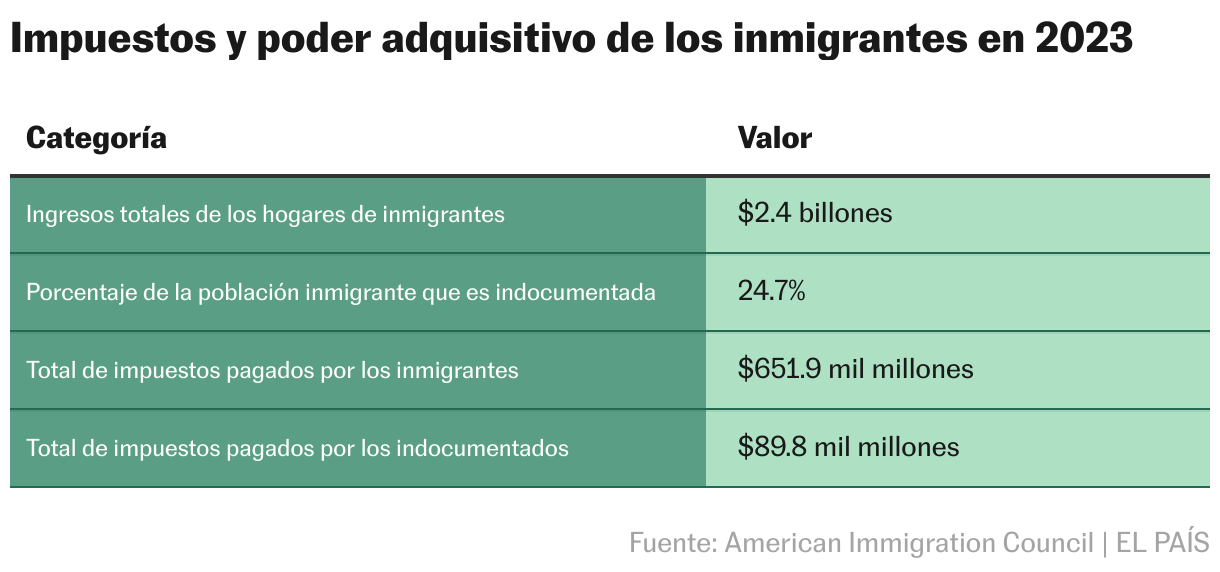 Moreover, according to the calculations of Americans for Tax Fairness, the undocumented paid in 40 of the 50 states a higher local state tax rate than 1% of households with higher income, who pay around 7.2% of their income on average. The undocumented pay 10.1%. In the case of federal taxes in 2022, and with data provided by Propublic on the taxation of corporations, undocumented immigrants paid an effective federal rate of 5.27% in 2022, higher than that of 55 large companies from the country of Fortune 500. Exxon Mobil and ATT, for example, they had an effective fiscal rate of 2.5% and 3.1% according to these data. Then a firm pillar for the finances of many states. In New York, about 74,800 million dollars were raised from an immigrant population that forms 23.1% of the total and had a purchase power of 160,500 million. In New Jersey, immigrants are 24.2% of the population and contributed two years ago with almost 40,000 million taxes and more than 94,500 million in consumption capacity. In California there are more, 27.3% of the population, and paid more than 168,000 million to public coffers. Virginia, Maryland, Washington, Pennsylvania, Texas and Vermont are some of the states in which the greatest tax contribution has this population. The deportations that the administration of Donald Trump seeks will not only separate families (4.1 million children who are citizens live with undicted parents) but also view the figures, will pass a bitter bill to the federal and local economies. “Immigrants help increase the wealth and prosperity of all Americans. And, nevertheless, both the White House and Congress are considering increasing the ICE budget in billions to stop and deport people when at the same time essential social services are cut such as the Medicaid or food assistance, says Nan Wu, director of research of the AIC.A Wu does not escape the irony that immigrants have paid taxes that will be used Massive, cruel and antieconomic. ”The immigrants, with or without papers, inject in the economy billions of dollars, according to the figures of the census tabulated by the AIC. Specifically, they have income of 2.4 billion dollars and a purchasing power of 1.7 billion. In 2023 they paid 167,000 million in the housing market and owned 6.6 billion in real estate -based wealth.

Population increase
Immigration is from 2023 basic for demography and with it for the labor and business market at a time of birth fall in the country. In full demographic deceleration between 2022 and 2023, immigration was responsible for the total growth of the United States population. It is the first time that has occurred since 1850, as the Migration Policy Institute has verified. Currently, the migrant population is the highest in absolute numbers with almost 47.8 million people (which includes three quarters legally as naturalized citizens, permanent residents or with temporary visas among other possibilities) but not in percentage terms, since with 14.3% it is still below the situation in 1910. As taxpayers and consumers, Steve Hubbard, AIC senior data analyst explained to El País in a telephone conversation that not only lost «tax base, we must not forget the important role of immigration in the workforce.» About 30.7 million are part of a workforce from which the Baby Boomers are being withdrawn. They are almost 18% of the labor mass with a mixed educational and professional training, many with higher education, others that do not, which «helps to close job deficits on both sides of the spectrum of skills.» engineering)». This data analyst explains that sectors such as health are critical. In particular in nursing and home care aid, although also doctors. «We have states that are losing population, communities with jobs for which there are no workers, especially in rural areas,» he explains. “Many of the immigration laws we have are from the sixties and reflect dynamics and careers of a world that no longer exists. There are more conversations about immigrants to have and one is how they are necessary for the economy to advance. ”
Risky to emigrate and undertake
One of the most entrenched myths in the narrative of many companies is that of the garage of the technology companies where the seed of a business giant was supposed to be sown. Reality is always somewhat more complex than a history of ingenuity and perseverance, but reality also indicates a fact that is indisputable: 230 of Fortune 500 companies have been founded by immigrants or children of immigrants. And this is not a time in history. According to the 2023 census figures that AIC handles there are almost 3.9 million entrepreneurs who are immigrants. In fact, more than one in five entrepreneurs are immigrants and manage annual income of 116.2 billion dollars while generating employment in the country. «The risk they have to emigrate is very similar to the risk to be taken to undertake,» explains the senior analyst of AIC, Steve Hubbard.