The Spanish economy reaps good results, and does so in an international context full of uncertainties. The progress of GDP, a robust 0.8% at the end of the year, contrasts with the European break. The differential keeps a certain relationship with the competitiveness plus contributed by energy prices, anchored below the community average; the lower exposure to global commercial turbulence – the exchanges of goods with non -community countries occupy 36% total, compared to almost half in Germany; and the impulse of immigration. Not everything is good news: there is also an inflection in the growth pattern, less balanced than in previous years. And it is that the atony of European markets makes a dent in exports. To the fall of the shipments of goods to the outside, which were already faltering, the moderation of exports of non -tourist services, breaking the path of strong growth, joins since the middle of the middle of the last year. Of course, tourism continues to throw, but without compensating the brake of the rest. As on the other hand, imports recover, the contribution to GDP growth of the foreign sector has become negative in the second part of last year.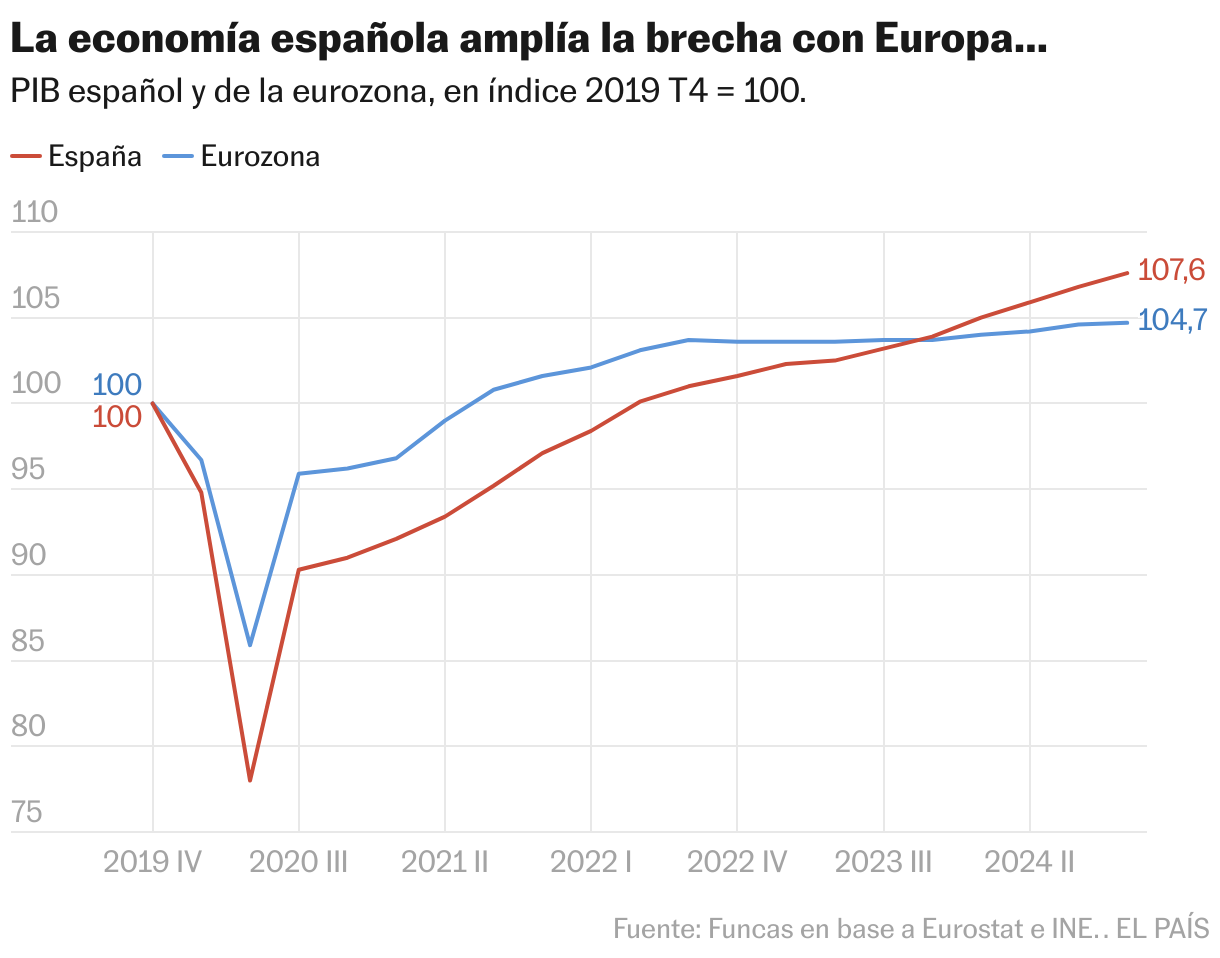
 Domestic demand takes over to the heat of both public consumption, which remains runaway and private. The families spend at a vigorous pace, explaining 77% of the progress of the GDP recorded in the second half of last year. Investment takes air, especially in the Team goods segment. But it is early to determine if it is a structural improvement with the indicators pointing in contradictory addresses. On the one hand, the increase in investment is due to transitory factors, since it is very concentrated in transport material, being able to reflect anticipated tax changes. On the other hand, the demand for credit and imports of equipment goods would be consistent with an upward trend. In any case, the investment in housing barely reacts to the succession of official ads, perpetuating the serious problem of scarcity. Face to the future, the foreign sector will continue to probably subtract activity, due to the persistent weakness of the European economy as due to increasing uncertainties that they loom over international trade. In addition, imports are normalizing (its elasticity with respect to demand is close to the historical average), something that in a context of strong thrust of the internal market tends to detract activity. If the external engine of the growth faltered, the inner does not fail . Private consumption will foreseeably maintain a strong expansive inertia, sustained by the creation of employment, the recovery of purchasing power of wages and the release of a part of the reservoir savings. However, the budget extension situation together with technical factors (lower deliveries on the account of the autonomous communities) point to some somewhat more channeled public consumption. The key will be in the investment. The stimuli come from the relaxation of monetary policy and the need to execute in a very short time the abundant remnant of European funds still available. The limiting factor comes from the climate of uncertainty, exacerbated, at least in the case of large corporations, Portrump insists that 25% tariffs will impose to Mexico and Canada this Saturday: the problem is not so much tariff threat as the questioning of the multilateral rules that govern international relations since World War II. The insecurity about the future of these rules that let the main global economic power plan is detrimental to investment. Nor does it help, in the internal level, the freezing of the budget policy, or the lack of consensus to undertake reforms in the housing market. In sum, the expansive cycle continues, without clearing doubts about its sustainability.
Immigration
The incorporation of foreign workers into the labor market remains one of the distinctive factors of the Spanish economy. In 2024, the national active population descended in 87,000 people, while the number of foreign or dual nationality assets increased by 391,000, according to the EPA. On the other hand, 79% of the new jobs created in the last year were occupied by foreign labor, an upward percentage in relation to the previous year (63%). It highlights the weight of immigration in the sectors linked to tourism and construction.