In principle, it seems that traditional craftsmanship and artificial intelligence (AI) inhabit different planets. But in the contemporary artisan vision they can be natural partners on Earth. This is demonstrated, for example, by the European-funded project Rrrmaker (the triple “r” stands for reuse, reduce and recycle) and its AI platform applied to the design and production of products made by hand, but supported by technology to accelerate prototyping and using reused or waste materials. AI can be used to identify alternative materials, including synthetic ones, to natural raw materials that are becoming scarce. The project coordinates “artisans, designers, makers and circular economy companies connected by a hybrid management model and knowledge communities”, explains Ana García López, its director in Spain and head of the Chair of Innovation in Crafts, Design and Contemporary Art at the University of Granada. “The strategy of co-creation is essential for the current review of craftsmanship,” understood as the evolution of traditional crafts towards the artistic creation of objects appreciated for their aesthetics beyond their function, with the highest possible quality in their workmanship and open to innovation not only in design, but also in work methods and business models. It would be the transition from the workshop that only sells face to face towards a brand with an international market. For the platform La Artesanía Contemporánea A Debate, this model establishes “the dialogue between tradition and innovation, natural materials and intelligent materials, manual techniques and new technologies, between local identity and global development. It is at the forefront of new cultural and market trends.”Let's land the concept in some companies. Inés Rodríguez, from RIR&Co, turns her workshop into a laboratory when she makes baby blankets with a fiber obtained from dairy protein (National Crafts Award 2023) or innovates a fiber optic fabric registered as a new industrial design. The artisan explains that her home blankets and pictorial tapestries, “although inspired by Galician nature, are designed for international markets and reference showcases such as the French fair Maison & Objet or BDNY. [Boutique Design New York]»Idoia Cuesta turns the helm from studying biology, with a doctoral thesis in marine research, to creating a limited basket-weaving company that supplies Loewe. Some of his creations test nylon fiber. Alfonso David Hidalgo, with training in archaeology, customizes his own glaze and crystallization formulas to export tableware from Qatar and the United Kingdom to the United States or Canada. Carlos Jiménez leaves his teaching position at the Bartlett School of Architecture in London to settle in Puente Tocino (Murcia) and create artistic ceramics, toys or clothing such as a jacket that makes breastfeeding easier. DelAmorYlaBelleza is their brand.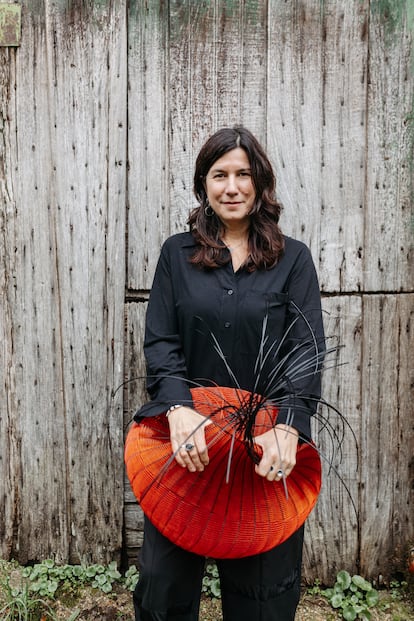 The basket maker Idoia Cuesta is a photograph provided. GrandioThe criteria of the new craftsmanship are not watertight, they present different degrees of integration in the workshops and hence the difficulty of specifying their share in the total turnover. However, several consulting firms consider their contribution, both qualitative and quantitative, to the resurgence of the sector to be decisive. Among them, Expert Market Research or Bain & Company predict that the global artisan market will at least double during this decade. The Spanish case would be a mid-table soccer team, but with some stars and a youth academy that promises a competitive leap. This makes it representative of other countries in that intermediate position, still lagging behind the benchmarks. Especially France and Italy due to their similarities with Spain, from the richness of their traditions to tourism with which craftsmanship is fed back. In 2022, the Spanish sector registered 6,629 million euros in gross value added (GVA, the value of the final product minus production costs), with a rebound of almost 9% compared to 2019, according to the latest KPMG report for the high-end brands association Círculo Fortuny. Both the number of companies (63,100) and direct jobs (208,600) decline, although by modest percentages. The situation can be considered stable in an economy particularly hard hit by the pandemic and with a slower than expected recovery. In contrast, the French craft industry generates twice as many jobs and triples the contribution to the gross domestic product (GDP). Even so, Xandra Falcó, president of Círculo Fortuny, defends that the country's potential and its growing endowment of resources aimed at making it profitable «is much higher than its current balance, sooner rather than later it will be reflected in the figures.» The strategy of their association is precisely to promote the avant-garde of “high craftsmanship that can permeate the rest, give prestige to handmade in Spain and define the levers for that leap.” In part it is about following in the footsteps of two other markets, wine and gastronomy, which share communicating vessels with crafts. Not in vain, the artisan specialty that contributes the most to turnover is food and beverages, with almost 50%.
 Making a bag in the Javier Menacho workshop in a photograph provided. If we talk about orientation towards excellence, we are talking about entrepreneurs who create high-end brands or produce for global icons such as Louis Vuitton, Dior or the aforementioned Loewe. Ángeles Espinar's Manila embroidery and shawls parade on the catwalks in Paris, Milan, London, Las Vegas and Tokyo. Javier Menacho, master of leather embossing, receives Afshan Sturdza, princess of a Romanian dynasty, attracted by his bags in his workshop in Castilblanco de los Arroyos (Seville). Santi Besteiro, also a leather master, adapts part of his designs to the German and Austrian markets. “Big brands look for more personalized and natural craftsmanship to give added value to their items. Sometimes they knock directly on your door; Other times, you have to make yourself known at fairs or with a good advertising strategy,” explains basket maker José Manuel Marcilla. As businesses move in that direction, the greater the carry-over effect of luxury will be. Because of its market value or “its resilience in the face of multiple crises,” as KPMG points out, and also because of its diversity. It attracts both brand-name clients who prioritize ostentation—a common profile in emerging Asia, especially China—as well as connoisseurs, the connoisseur linked to quiet luxury who seeks “sophistication and discretion, differentiation in personalized, the experience and emotional bond with exceptional objects as an expression of a lifestyle,” explains Falcó. The connoisseur will prefer what is unique, even if his brand is a minority, or precisely because of that. With another added value: these types of exclusive pieces, like the exceptional vintage in a small elite winery, can be similar to investing in art.
The value and price
But contemporary does not equal prohibitive. The turner Aitor Martínez, who founded his brand in the middle of the pandemic and just one year later, 2022, is already a finalist for the National Crafts Awards, maintains that the artisan business produces, to be viable, in all price ranges. “This type of product is neither expensive nor cheap, it depends on your priorities; I have clients with medium-low purchasing power who buy less quantity to choose pieces with more presence and personality in their home.”In this sense, the incorporation of new technologies improves productivity and helps contain prices. Antonio Suárez —director of the School of Training in Crafts, Restoration and Rehabilitation of the Historical, Artistic and Cultural Heritage, known as the Albayzín Center— mentions the case of Here they make saints, a traditional imagery company that “uses numerical control milling for the hollowing, a mechanical task with no added value.” Or Jesús Bellido, “the first of his trade to use laser cutting for guitar tops.” Portrait of the artisan Aitor Martínez in an image provided. Fuco ReyesIn addition, business models such as that of the furniture firm Hannun and its platform of designers, artists and wood craftsmen contribute to more affordable prices. Their coordination of the production chain and management resources “helps them grow, introduce new tools into their processes to reinvent craftsmanship and make it more scalable, more competitive, without losing its essence,” explains executive director Joan Álvarez. . “Cooperation reduces the gap between the industrial Goliath and the artisan David.” Another harmony of interests between sectors is cultural and experimental tourism destined for an inland workshop and not a crowded beach. Although modest at first, it would add to the cause of making the avalanche less seasonal. It organizes manual activities with its hands on the piece and can offer in local stores “quality souvenirs to consumers willing to pay more for Kilometer Zero, who value respect for the environment, its social contribution, a strong sign of identity and let captivate by the story,” says Ana García. “According to our studies,” says Falcó, “this long-distance traveler spends up to five times more than the classic tourist on goods and objects.” A reference to that immersive trip? The glass workshops on the island of Murano, next to Venice. In any case, the common denominator of all these fronts of evolution is, for Juan Pastor—an expert in creative economy and professor of creation and consolidation of craft companies—“professionalization.” not only artisan training, but also business training, which must also be continuous to adapt to changes in techniques and markets”, whether in Spain or in countries such as Mexico or Peru, where it also develops training projects. “Learning to manage a business as particular as the artisan provides a differential value, from accounting administration to preparing market studies, requesting specific loans or something as simple, but decisive, as setting prices with the appropriate margins.”
 View of one of the walls of Aitor Martínez's workshop in an image provided. Fuco ReyesIf something compromises the consolidation of future companies, it is “todologism,” says Pastor, “the tendency to do everything, when you can rely on value chains or associations where a specialist assumes, for example, marketing or channel management. digital”. When you decide to carry all the load, «you are the one who sweeps, the administrative one, the one who packs, the community manager, the boss and the union member,» says Aitor Martínez. No matter how much your productivity rebounds, could craftsmanship allow itself an aspiration, today in the political debate, such as reducing the working day? Maybe from the point of view of processes, but not so much in terms of competitive quality. Martínez, whose business was born after training in one of the best turning courses in the world – the French school JF Escoulen, for six months and with only eight places, «how to be a guitarist and have Metallica teach you» – assumes that the investment in Time is not negotiable. Remember the theory of the minimum 10,000 hours, the tireless repetition of gestures “until they become automatisms that allow your own language to emerge, grant you creative freedom and, as time, mastery. As children, we all make similar letters; As adults, everyone writes in a unique way.” “Work is more powerful than talent. And reinvesting in your company is worth as much as selling. That's why my cars are always a chestnut.»
 Piece turned by Aitor Martínez in an image provided. Fuco ReyesTendencias is a project of EL PAÍS, with which the newspaper aspires to open a permanent conversation about the great future challenges facing our society. The initiative is sponsored by Abertis, Enagás, EY, GroupM, Iberdrola, Iberia, Mapfre, the Organization of Ibero-American States (OEI), Redeia, and Santander and the strategic partner Oliver Wyman. You can sign up here to receive the weekly newsletter from EL PAÍS Trends, every Tuesday, from the hand of journalist Javier Sampedro.