Financial analyst Mandela Amoussou has raised high expectations by stating that XRP, the cryptocurrency developed and issued by the payment company Ripple, could become the next digital asset offered through a cash exchange-traded fund (ETF). Amoussou bases his claim on the Greater regulatory clarity surrounding XRP since the court ruling that was released last week. “The SEC-Ripple case has become a kind of ‘proxy war’ between the cryptocurrency community and regulators, and this latest outcome is a fundamental step towards regulatory clarity,” says the specialist. Last week, the United States justice system fined Ripple $125 million and prohibited it from continuing to violate the country's securities laws. The ruling came after four years of litigation between the Securities and Exchange Commission (SEC) and the company. This, while it is a ruling against Ripple, means that the company now has clear indications about what it can and cannot do with XRP. In addition, It has become clear that the XRP cryptocurrency, by itself, is not a securityas reported by BitcoinDynamic. According to the analyst, the regulatory classification (whether it is a commodity or a security) of a digital asset is a “main criterion for possible consideration of a spot ETF.” The biggest obstacle to institutional acceptance of XRP was the asset’s unclear regulatory classification. With the latest regulatory decision obtained by the cryptocurrency, “XRP is a candidate for a future spot ETF,” the analyst explains.
Amoussou is “cautiously optimistic” about the future of XRP
However, Amoussou notes that he is “cautiously optimistic” about such a possibility, given that “so far no issuer has shown interest in filing for an XRP ETF.” Indeed, Mathew Sigel, head of Digital Asset Research at VanEck, a firm that has funds based on ether and bitcoin, sees it “unlikely” to issue an ETF based on XRP. Sigel explained that the issuer You must have the conviction that the asset is a good investment and consider who its creators are, which exchanges it is present on, and which custodians support this asset. “We noticed that there is a lack of conviction and customer demand,” he added. In contrast, Ripple CEO Brad Garlinghouse noted that, in a matter of time, there will be an XRP ETF, as well as other cryptocurrencies such as solana (SOL) and cardano (ADA), as reported by this newspaper.
Ripple's financial products show no strength
According to data from digital asset manager CoinShares, XRP has seen much less flow into its ETPs compared to peers like solana (SOL-USD). Last year's flows report shows that XRP had just $18 million in flows, while Solana recorded $167 million. In terms of assets under management, SOL outperformed XRP by $762 million. Year-to-date, XRP has recorded $21 million in flows to datewith $93 million in assets under management. Meanwhile, SOL has recorded $70 million in net flows and $1.292 billion in assets under management, as seen in the image below from CoinShares.
XRP and SOL ETP flows. Source: CoinShares. The comparison between both assets is established Because Solana is also among the top cryptocurrencies that could have an ETFand both are among the top ten cryptocurrencies ranked by market capitalization. Last June, digital asset investment firms VanEck and 21Shares filed applications with the SEC to launch a solana spot ETF. On solana ETFs, Samara Cohen, CIO of ETFs at BlackRock, said that Cryptocurrency does not yet meet the company's standards to be included in an exchange-traded fund. Taking this into account, the analyst believes that XRP “does not yet meet the standard in terms of client demand, judging by the flow records and the size of assets under management in its existing ETPs.” Amoussou adds that XRP’s lengthy legal process and the ambiguity around its regulatory status could have contributed to “stifling the growth” of demand for the digital asset among traditional investors. Moreover, XRP's on-chain data does not reflect widespread enthusiasm, at least for now. Various data on Ripple's network, called the «XRP Ledger», indicate some skepticism or apathy towards the project. One of these data is the number of active accounts which has registered a 91% decrease from January 1 to August 12. These They went from 49,851 in January to 4,397 yesterday, as seen below.
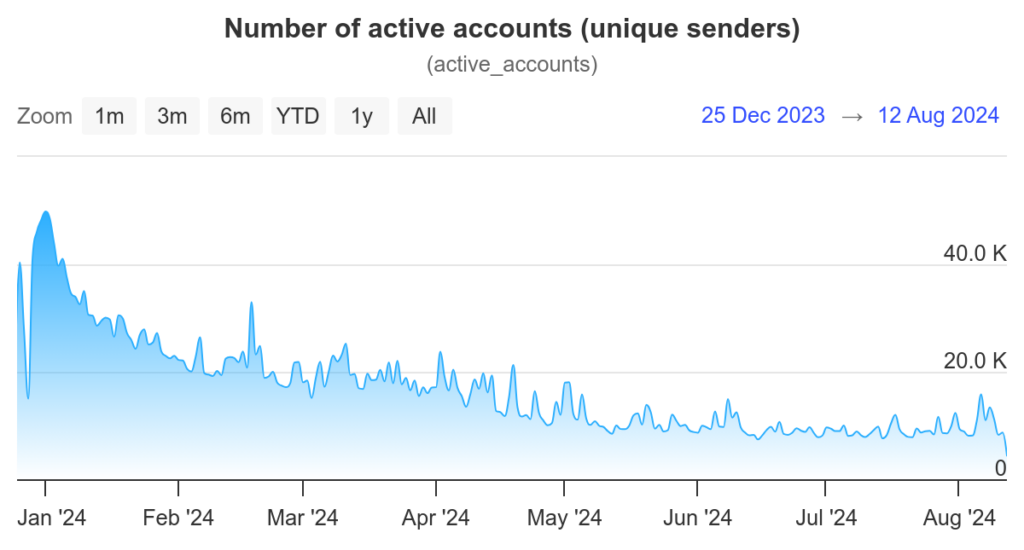
Active accounts on the XRP network. Source: xrpscan. Regarding the number of payments between accounts, there is also shows a 94% decrease in less than a month. This is a significant sign of a drastic reduction in network activity.
Ripple hopes for more regulatory clarity
If the SEC does not appeal (it has 60 days to do so) and the litigation between Ripple and the regulator is indeed concluded, A process that has been long and complex will be completedwith significant implications for the company and, of course, the XRP cryptocurrency. Additionally, precise clarity is expected regarding the use of XRP in Ripple's On-Demand Liquidity (ODL) service, Amoussou notes. ODL is an instant liquidity solution provided by Ripple for the settlement of cross-border transactionsfacilitated through the XRP network, where the asset serves as an instant source of liquidity and a bridge currency. In early April, Ripple discontinued the use of XRP for ODL transactions with the United States as part of regulatory compliance. Ripple replaced XRP with the stablecoin Tether (USDT) as the ODL bridge currency.
A stablecoin is Ripple's plan
This marked a setback for One of the main use cases of XRP in the Ripple ecosystemIn response, Ripple announced that it will launch a stablecoin later this year. Ripple USD (RLUSD) will launch on both the XRP Ledger and Ethereum, and early testing has already begun. The new stablecoin could replace the current use of USDT for US-based ODL settlements.
With these developments, it is important for XRP investors to monitor Ripple’s strategies and potential workarounds regarding the use of XRP on US-based ODL, staying informed about any changes in Ripple’s operational approach and their impact on the role and utility of XRP within the Ripple ecosystem. The long-term implication of these changes could influence the demand and price of XRP. Mandela Amoussou, financial analyst.
With the launch of the stablecoin, XRP's prominence in the Ripple ecosystem could recede, especially in US-based settlements, Amoussou says. The analyst also takes into account Ripple's expansion into other areas besides the stablecoin. In this regard, he points out that the tokenization of real-world assets (RWA) «presents new opportunities» for Ripple. Earlier this month, the company announced that it will collaborate with OpenEden, a platform that connects traditional finance with the world of decentralized finance (DeFi), to Tokenize US Treasury Bonds Worth $10 Billion
“In my opinion, its prospects as a potential reference platform for asset tokenization still hold,” the analyst added.