Pierre Rochard, CEO of The Bitcoin Bond Company, recently shared his vision of why, in his opinion, projects such as XRP, Solana (Sol) and Ether (ETH) have no chance of overcoming Bitcoin (BTC) in the market, which dominates more than 57% of the total capitalization of cryptoactive. According to Rochard, the background problem is in the approach that these projects adopted from the beginning: the so -called «utility thesis.» This argues that the native token of each network gains value as other actors used their infrastructure. However, for the entrepreneur, it is a reasoning with a structural failure. «The problem is that any successful company will end up launching its own blockchain,» he wrote in a publication in the social network X. Faced with this, the specialist makes a contrast to what he calls «the monetary thesis of Bitcoin,» and explains that, unlike other projects, The value of BTC does not depend on external companies to consume space in blocks to boost their tokenbut of a set of characteristics very difficult to replicate. In Rochard’s words, Bitcoin is sustained on «network effects anchored on a decentralized monetary policy, resistant to censorship and fixed supply.» These qualities, he affirms, are those that consolidate the asset as a unique instrument within the ecosystem and explain why their leadership is difficult to question. It is worth noting that There will only be 21 million BTCa limit established from its protocol that cannot be modified. Unlike Fíat money, which central banks can issue by government decision, as well as cryptocurrencies issued by centralized power, Bitcoin cannot be printed at will, which reinforces their deflationary character. Rochard shared his perspective by mentioning Stripe’s announcement – a global technology company specialized in providing online payment services to companies – about tempo, a new cryptocurrency network created to facilitate payments with Stablcoins. The mention of Stripe serves, according to Rochard, as an example of how large companies tend to create their own solutions instead of depending on existing cryptocurrency networks or tokens. This implies that the demand for cryptocurrencies such as XRP, Sun or ETH does not necessarily grow to the rhythm in which its applications multiply. Hence, Rochard concludes that The supposed competitive advantage of the so -called «utility networks» is fragile. In practice, the use cases they seek to resolve do not guarantee sustained growth in the value of their native tokens. On the contrary, its price is tied to the ability to attract and retain users in a highly competitive and fragmented environment. In contrast, Bitcoin gains attractive as a decentralized and scarce monetary asset, with clear and transparent rules that no actor can modify unilaterally. For many defenders, this makes it the digital equivalent of gold, with the advantage of being more portable, divisible and verifiable.
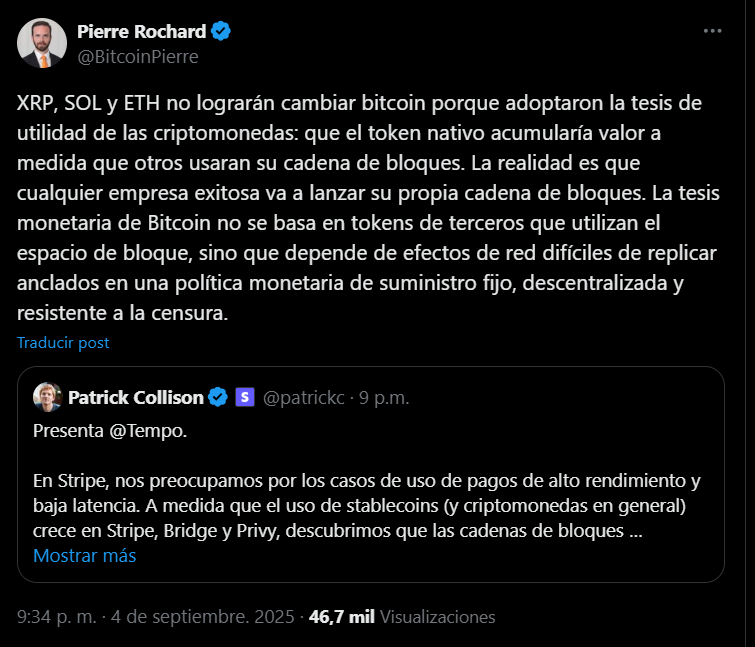
Rochard Bitcoin difference from the rest of cryptoactive. Source: x @bitcoinpierre.
Reactions and debates in the community
Rochard’s statements generated debate in the ecosystem. The software engineer, known in X under the pseudonym of Vincent Van Code, directly questioned the idea that a company should develop its own cryptocurrency network. He argued that, in many cases, it would be easier to use an economic database and that, for those who seek immutability, there are already safe storage solutions at the banking level. In your vision, The value does not reside so much in the tokens and the underlying technology: «The crown jewel is not the token, but the blockchain.» In addition, he highlighted the role of XRP as a liquidity tool, and even raised scenarios in which great custodians could broadcast BTC over other networks, such as XRPL, to ensure interoperability. On the other hand, a user criticized Rochard claiming that he does not apply their reasoning in a consistent manner. Although he acknowledges that the businessman values decentralization and resistance to censorship in BTC, he affirms that his attachment to certain investments prevents him from applying those same principles to other potentially useful platforms for the digital economy. Also, some Ethereum defenders stressed that this network also has difficult network effects to replicate, in addition to exclusive benefits. They point out that the project combines resistance to censorship and credible neutrality, while offering programability and «an inflation rate than Bitcoin», although it is worth mentioning that the latter depends that the network has high activity. On the other hand, in congruence with Rochard, Jack Mallers, CEO of Strike and Twenty One, who maintains a critical look on the Altcoins, has recently expressed: «Bitcoin is money, an opportunity of 500 billion dollars. Ethereum is technology, in the best case a new technological company. Comparing both is like comparing apples with the most solid money in the history of mankind ». Adding to the discussion, Bitcoin Maximalist Samson Mow has also questioned the Altcoins viability against BTC. As Cryptonotics reported, the developer warns that, despite the growing institutional investment in ETH – which exceeds 2.7 million currencies in the hands of corporations and funds – Ether remains, in his opinion, an instrument to which actors inflate before the enthusiasm of a bitcoin upward cycle and then take profits.