Although not everyone knows it, Bolivia is one of the countries that moves the most money in cryptocurrencies in Latin America. In fact, it receives three times more volume in these assets than El Salvador. Even though the latter’s government is famous for investing in bitcoin (BTC) and promoting its adoption and education. The reasons are several. Precisely, Bolivia is the seventh country in Latin America that receives the most money in cryptocurrenciesaccording to a recent Chainalysis report. The report indicates that it raised 14.8 billion dollars (USD) between July 2024 and June 2025, which places it 9 places above El Salvador. The country governed by Nayib Bukele is ranked 17th among the Latin American countries that received the greatest volume of cryptocurrencies in said period. The value raised was 3.5 billion dollars.
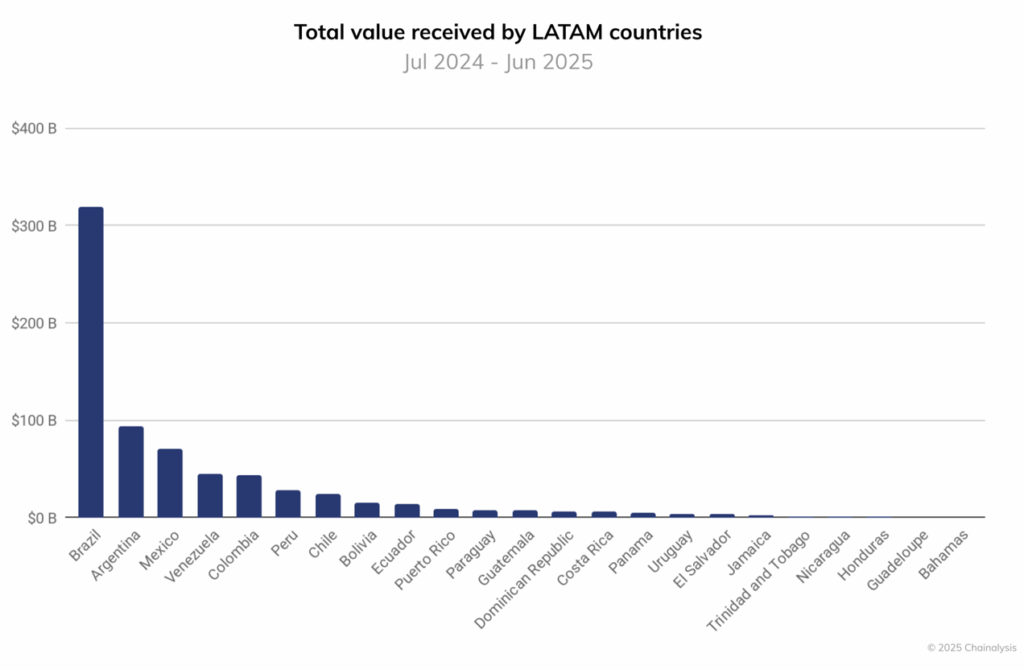 Bolivia is the country that receives the most volume in cryptocurrencies after Brazil, Argentina, Mexico, Venezuela, Colombia, Peru and Chile. Source: Chainalysis. Although Bolivia has almost twice the population of El Salvador (11 million vs. 6 million inhabitants), which may explain its greater use of cryptocurrencies, this is not the only thing that supports it. There is an organic use of these assets due to their economic and regulatory situation.
Inflation and lack of dollars: the perfect combo for USDT
Annual inflation in Bolivia reached 24.86% in July of this year, a level not seen in almost four decades. And, although it has been declining since then, it is still above 20% heading into 2026.
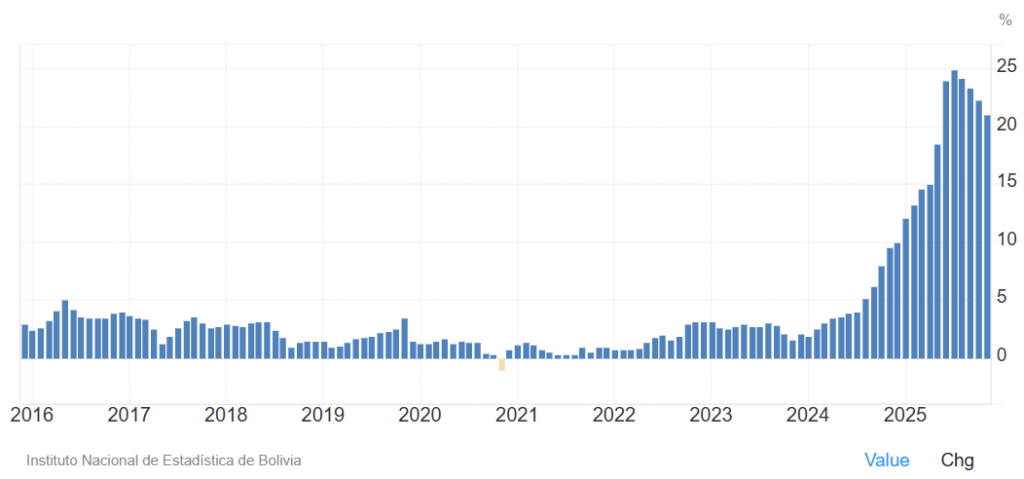 The citizens of Bolivia are going through difficult financial times due to inflation. Source: TradingEconomics. This inflationary context causes Bolivians to seek support in harder currencies such as stablecoins that maintain the same price as the dollar. Although the US currency is not exempt from devaluation due to its increasing issuance, it works as a practical tool to avoid losing value on a day-to-day basis compared to the local currency. This is why these cryptoassets are so widely used in countries with inflation problems like Bolivia. This trend in the nation It is also reinforced by the illiquidity of dollars and capital control that result in a currency crisis. Fernando Romero Torrejón, president of the Departmental College of Economists of Tarija, explains that this is why alternative financial assets are being sought, such as the stablecoin tether (USDT). “In Bolivia, from 2023 to the present, there was an acute and significant shortage of dollars, meaning that not only was there no availability of foreign currency, but there was also a restriction with a kind of banking corralito for savers in the Bolivian financial system,” he said in dialogue with BitcoinDynamic. To put the magnitude of the panorama into perspective, according to Romero, “the official exchange rate has simply remained an anecdote.” “In any case, the parallel exchange rate, which is based on a large part of the USDT price, has made it more official than the official one,” he said. «This has meant that the situation has become like a river course, seeking its own channel. Well, the different economic actors, companies, families and people have looked for alternatives to access financial or other assets that are substitutes in part for the American dollar, which is scarce and very difficult to find in the Bolivian economy,» he added.
Bolivia surfs the waves of the economy with Latin America
What the country is experiencing is not something isolated; in different sizes resonates with widespread realities throughout Latin America. “A regional preference has been evident, and also in Bolivia, for stablecoins, especially for USDT as coverage and means of payment.” This was highlighted by Romero, as also broken down by Chainalysis in its report: «The dominance of stablecoins in Latin America reflects persistent inflation, currency volatility and capital controls, which drive households and businesses to seek stability linked to the US dollar for savings, remittances and commerce. In effect, stablecoins function as a parallel financial system, offering both a hedge and a practical payment tool where local currencies often fail to provide stability.» There is also a key element that the Bolivian specialist highlights: “Crypto assets are faster and cheaper channels for remittances and international payments.” “They reduce time costs compared to formal or traditional banking systems,” he said. Therefore, They are frequently used, he indicates, for remittances and payments of suppliers, importers and other actors who carry out economic, financial and commercial activities. Thus, its use has increased in recent years, something also caused by the change in the regulatory framework.
Although each country faces unique challenges and opportunities, the region’s overall trajectory suggests that cryptocurrencies, and especially stablecoins, have evolved beyond their early adoption to become an integral part of Latin America’s financial landscape. As stablecoins continue to serve as a crucial hedge against local currency volatility and an efficient means of cross-border transfers, the key to maintaining this momentum will lie in finding the right balance between innovation and regulation. Chainalysis, blockchain analysis company.
Bolivia moved to pro-cryptocurrency regulation
A year and a half ago, in June 2024, the Central Bank of Bolivia (BCB) issued a resolution that allows the purchase and sale operations, use, marketing and payments of crypto assets by regulated financial entities. Until now, that was something that was restricted in the formal system. “With the lifting of the ban, different initiatives have come to light that – at least in the past – were carried out with a low profile so as not to raise personal risks,” said lawyer Ismael Franco just two months later. Among the consequences, it mentioned, first of all, an increase in peer-to-peer (P2P) transactions enabled by exchanges between people residing in Bolivia. This is especially true for the purchase and sale of stablecoins such as tether (USDT). Secondly, it detailed the presence of reference web pages on parallel exchange rates for the dollar, based on cryptocurrencies. And, thirdly, multiple offers on social networks on courses to manage these assets, as well as advice and advertising from virtual wallets, brokers and traders. As is currently notable, such a situation continued to become exasperated. According to a statement from the Central Bank of Bolivia, operations in cryptoassets increased 650% in one year: The volume of these transactions rose from 46.5 million dollars in the first half of 2024 to 294 million in the same period of 2025.
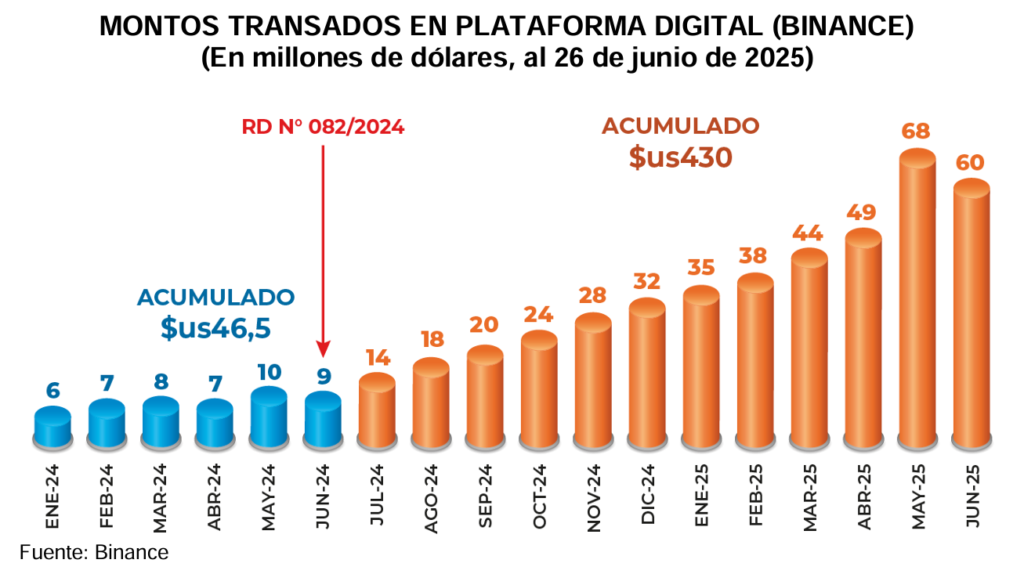 Regulation in favor of cryptocurrencies in Bolivia promoted the use of digital assets. Source: Central Bank of Bolivia. “This notable performance demonstrates the wide use of these digital securities in the country, reflecting the effectiveness of the Issuing Entity’s policies in its objective of generating alternatives so that Bolivians can continue carrying out their transactions with foreign currencies,” the BCB said at the time.
2026 will be a year of greater use of cryptocurrencies in Bolivia
For Romero, such data reflects a little more the optimal situation of the cryptocurrency market, with great room to grow. However, he clarified that at the regulatory level there is still no clear framework regarding issues such as evasion, money laundering or the financing of illicit activities, such as terrorism or drug trafficking. “A clear and proportional regulatory framework is very important,” he noted as a task for the incoming government. He also considered it advisable to allow controlled public pilots to exist and a macro policy that reduces distorted incentives in the industry. The economist predicts “that the digital economy will open.” «Because, whether you like it or not, it is not the future; the use of crypto assets is the present and especially in Bolivia.» This is something that is in keeping with the new president of Bolivia, Rodrigo Paz. Last month, days after the president took office, the Minister of Economy, José Gabriel Espinoza, announced that will allow banks to offer digital asset services. In this sense, the supply and adoption of cryptocurrencies is expected to continue increasing in 2026.