Political and partisan pressure is holding back the key law for the bitcoin and cryptocurrency sector. From the White House they point out that the proposals presented by Democrats are «outrageous.» On Reddit, users are discussing using USD Coin (USDC) on Coinbase as a savings account because it gives 4 or 5% interest. Some propose it as an alternative to cover emergencies or combat inflation. Although they warn of clear risks: «don’t invest what you can’t lose.» For millions of Americans, and citizens around the world, the returns, offered by Decentralized Finance (DeFi) platforms or cryptocurrency exchanges, which range between 4% and 15%, they are attractive. They represent an accessible and necessary cushion to protect against inflation and face unexpected emergencies, giving access to financial opportunities that traditional banking rarely matches. However, this performance, which is an attractive alternative for users, also has ignited an economic conflictwith the cryptocurrency law proposal as a trigger. On one side of this contest there are the bankswhich hold nearly $18.61 trillion in commercial deposits in the US (based on Federal Reserve data from January 2026). These deposits are your main cheap financing sourcewhich invest in Treasury bonds or reserves at the FED to generate substantial profits. This, through the net interest margin (the difference between income from loans/investments and interest expenses paid to depositors). By paying very low (or no) returns on traditional savings accounts (often 0.5%, compared to 4-15% on stablecoins), banks retain a vast difference as their primary income.
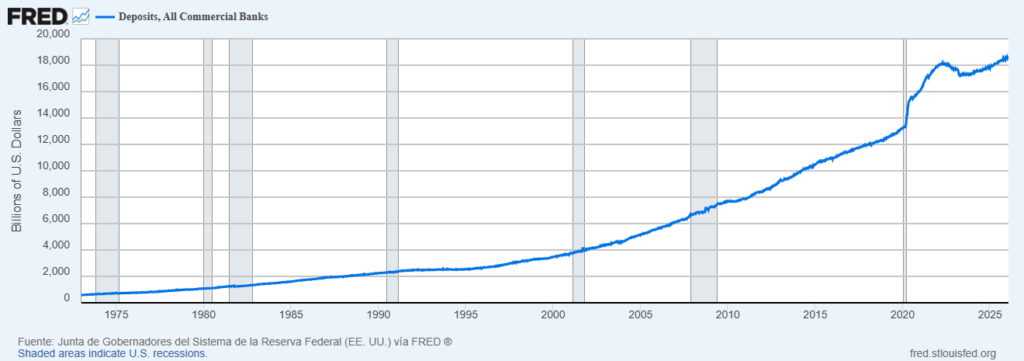 The graph shows the evolution of total deposits in US commercial banks, reaching approximately USD 18.61 trillion at the end of January 2026. Source: fred.stlouisfed.org. Stablecoins with yields therefore represent a direct threat to this banking model. They could catalyze a massive flight of deposits towards assets that offer returns direct to users, eroding the structural advantage of banks and reducing their ability to grant local loans, essential for mortgages, as well as for small and medium-sized businesses. Given this scenario, the influential banking lobby, led by the American Bankers Association (ABA), is pushing hard for the implementation of restrictions on stablecoin rewards, arguing systemic risks for the economy.
The growing power of crypto companies
On the other front of the conflict, the cryptocurrency industry defends these returns or rewards of stablecoins, as a fundamental pillar to attract users and encourage growth of the ecosystem. Brian Armstrong, CEO of Coinbase, has been explicit that limiting these returns would prevent the industry from competing effectively with traditional banks. Ultimately, it would slow down the development of the digital asset ecosystem. The deep gap between both parties was evident in a tense meeting at the White House on February 2, 2026, where representatives from the ABA, Coinbase, Circle and other entities debated for hours about stablecoin rewards without reaching any agreement, as reported by BitcoinDynamic. But the cryptocurrency industry not only argueshas also consolidated significant political influence in Washington. The Fairshake PAC, backed by giants such as Coinbase, Ripple, a16z and ARK Invest, closed 2025 with $193 million aimed at boosting pro-bitcoin and cryptocurrency candidates in the 2026 midterm elections. Its strategy focuses on key committees, such as Agriculture and Banking. They seek to ensure a favorable regulatory framework.
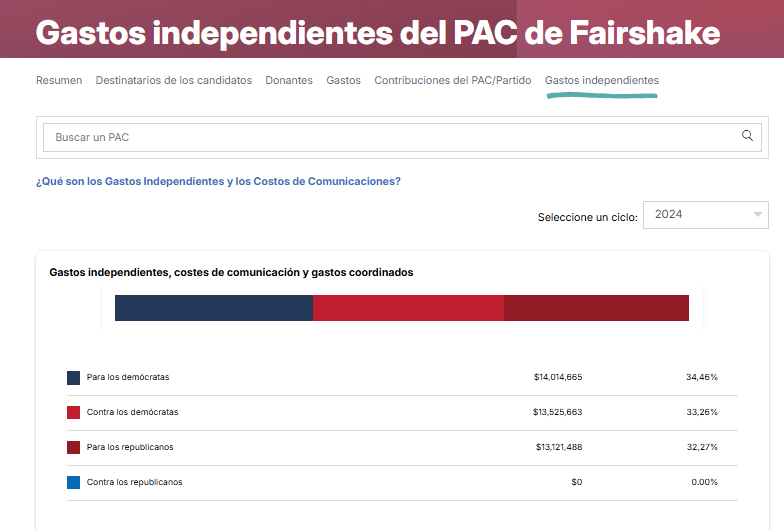 In recent years, the Fairshake PAC shows bipartisan financial preparedness, but with an emphasis on Republican support, contributing to a strengthened pro-cryptocurrency influence in the current Senate. Source: opensecrets.org.
A conflict that seeks control of the system
This entire impasse is the reflection of a conflict for control of the financial system, directly linked to the debate on the CLARITY Law. A project that seeks to clarify regulatory roles between the Securities and Exchange Commission (SEC) and the Commodity Futures Trading Commission (CFTC). In this struggle, banks cling to their traditional model, while the cryptocurrency industry seeks to open the doors to innovation and more direct competition. Without consensus, regulation will not come to fruition, leaving millions of everyday users in a state of constant uncertainty about their digital finances. Despite these tensions, the legislative effort shows recent progress since on February 4, 2026, Democratic senators met, in a closed-door session, to resume discussions on the structure of the digital asset market. The meeting was held after “constructive” conversations at the White House about stablecoin rewards. Democratic staff sources described it as “the most productive to date,” with leader Chuck Schumer emphasizing the need to involve industry.
Political impasse: ethics and control of the financial system
Beyond pressure from the banks, partisan political interests further deepen the legislative stalemate. Republicans, many of them aligned with President Donald Trump’s vision of turning the US into the «crypto capital of the world,» have been steadfastly reluctant to incorporate ethics clauses limiting public officials’ personal investments in digital assets. Patrick Witt, executive director of the President’s Council of Digital Asset Advisors, said on February 3, 2026 during an interview: «we will not allow attacks on the president or his family.» With this, he described the Democratic proposals for the Clarity Act as “completely outrageous.” He added that they turn regulation into a political weapon. The Democratic proposals criticized by Witt were mainly promoted by Senator Adam Schiff. These include prohibitions on senior public officials, such as president, vice presidentmembers of Congress and senior executive officials, issue, sponsor, endorse or invest in digital assets such as memecoins, non-fungible tokens (NFTs), or stablecoins during their term and for a period thereafter (generally 180 days before and two years after service). The approach also includes extensions of these restrictions to immediate family members (spouses and children). The idea is to prevent conflicts of interest and mercantilism in the industry they regulate. They also contemplate broader measures against personal gains in crypto assets, such as prohibitions on executive roles or investments for spouses of officials. This back-and-forth between tactical advances and structural obstacles leaves several questions in the air: will Washington be able to find a balance between promoting financial innovation, protecting banking stability and guaranteeing ethical transparency, or will intersecting interests continue to leave millions of users who see cryptocurrencies as a real tool for their daily economy in uncertainty?