In the icy summits of Davos, where the financial order is often tightened, a disruptive idea is beginning to gain traction. This was presented by analyst Paul Barron, who predicts that the 2026 World Economic Forum could be the scene of the end of financial multilateralism and the birth of a dollar backed by tangible and digital assets such as bitcoin (BTC). If the scenario that Barron anticipates materializes, the largest earthquake in international finance since the 1970s would be unleashed. According to what he comments, Donald Trump is preparing to present a “new bilateral Bretton Woods” plana strategy designed to dismantle the global debt system that has prevailed for the last 80 years. Barron argues that the Trump administration is seeking to abandon the current “faith and credit” model—based purely on trust in the state—to anchor the dollar to a basket of real commodities. This “basket of commodities” would not only include traditional gold, but also oil—reinforced by the hemisphere’s new energy independence—and, in a 21st-century twist, bitcoin, along with other digital assets such as XRP. «Could [Trump] raise the idea of backing the dollar with hard assets instead of simple promises,” Barron said on January 11, 2026. For the analyst, this is a “declaration of direct war” on the central banking model led by the Federal Reserve and the Bank of England.
 Barron suspects that commodities, including bitcoin, will be considered the new global standard. Source: X/paulbarron.
The end of the debt trap?
The objective of this movement would be, according to Barron, to free the allied countries from what he defines as the «British imperial system.» From this perspective, the institutions born in the middle of the 20th century, such as the International Monetary Fund (IMF) and the World Bank, would have functioned as perpetual debt tools to confiscate national assets when countries cannot pay. Trump’s vision, according to speculation, moves away from traditional multilateralism to embrace one-on-one agreements. By withdrawing the United States from various global organizations, the president would seek to shield economic sovereignty from the directives of the financial elites of Washington and Brussels. To understand the magnitude of the change, it is necessary to look back. In July 1944, in a New Hampshire hotel, delegates from 44 nations designed the original Bretton Woods system. That agreement linked the dollar to gold (at $35 per ounce) and the other currencies to the dollar, providing the world with stability that lasted until Richard Nixon broke the bond in 1971.
Since then, the world has lived in what some call «Bretton Woods II,» a system of floating exchange rates backed by Treasury bonds and capital flows. However, the rise of new powers and the debt crisis in countries like Argentina – which continues to fight against the IMF’s debt cycles – have fueled the desire for a “Bretton Woods III”, oriented towards real assets.
Gold, oil and bitcoin
Far from being an aspiration of digital enthusiasts, the strategic reserve of bitcoin has been consolidated as an axis of the new American economic doctrine. Donald Trump’s administration has refocused its priority on a triad of assets defined by scarcity: gold, oil and bitcoin. This strategic shift, supported by the approval of the BITCOIN Act of 2025, directs the Treasury towards the acquisition of one million BTC and marks the beginning of a historic revaluation of national reserves.
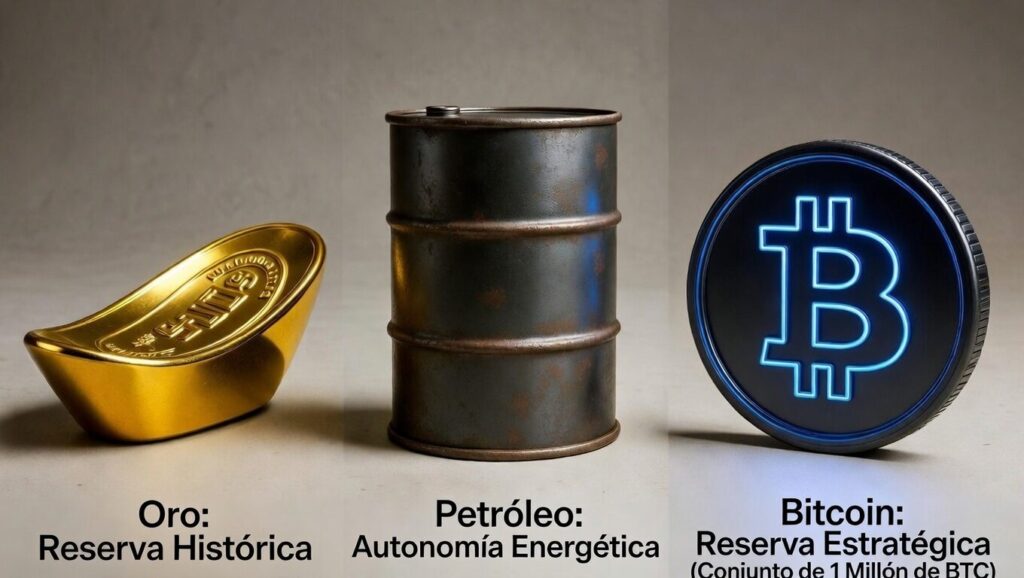 Barron suspects that the new pillars of the US national reserve represent a shift towards limited supply assets where gold, oil and bitcoin form the basis of Trump’s plan. Source: BitcoinDynamic/Grok. Despite the uproar caused by Barron’s publications, the White House has maintained a hermetic silence. There is, as yet, no official confirmation that this ambitious plan will be formally presented to world leaders in Switzerland. Although the United States opened a criminal investigation against the president of the FED, Jerome Powell. This perspective is shared by other analysts who agree with Barron’s diagnosis. As BitcoinDynamic has reported, the creation of a strategic bitcoin reserve in the United States is emerging as the catalyst for a new global financial order, similar to a modern Bretton Woods. In this sense, bitcoiner Jack Mallers maintains that Donald Trump’s strategy seeks to deliberately weaken the dollar to facilitate the reconstruction of the national economy.
With the World Economic Forum in Davos taking place between January 19 and 23, 2026, the question remains whether nations are really prepared to transition from the current fiat model to an order supported by the scarcity of physical resources. If Barron’s projections come true, the international financial framework is approaching its most decisive challenge in decades.