
Blockchain explorers have become indispensable tools for understanding and verifying what is happening within a network like Bitcoin or Ethereum. Thanks to them, anyone can consult transactions, blocks, smart contracts or even the movement of tokens and NFTs in real time. However, not all explorers They offer the same functionalities: While some focus on a single network at a high level of detail, others allow access to multiple networks from a single interface. In this article we review which are the most prominent explorers and what characteristics make them references within the ecosystem.
Table of contents
Criteria to consider when choosing a blockchain explorer
Depth and diversity of information
A good explorer should offer not only basic block, transaction, and address data, but also additional metrics that provide context: average fees, mining difficulty, mempool, smart contracts, and validator or miner distribution. Scanners specialized in a single network—such as Etherscan on Ethereum—tend to excel in this regard due to their level of technical detail.
User interface
Ease of use is essentialespecially for those who are not used to interacting with on-chain data. A clear interface, with accessible search engines and well-organized menus, makes it easy to navigate through transactions, blocks and addresses. Explorers like Blockchain.com or BscScan stand out for offering experiences adapted to both beginners and advanced users.
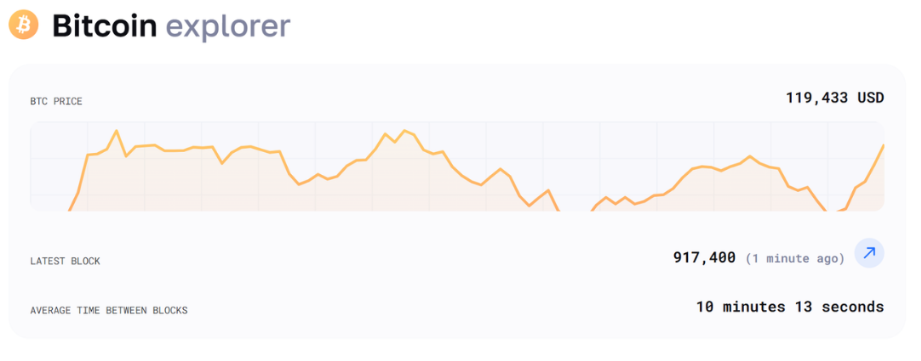
Bitcoin explorer overview on Blockchair: current price, most recent block, and average time between blocks.
Statistics and tools
Some browsers go beyond spot transaction verification and provide dashboards with network statistics, historical graphs and analytical tools. These resources are valuable for researchers, developers, or institutions that require a broader view of network behavior. Blockchair, for example, offers advanced filters to analyze transactions and blocks with specific criteria.
Viewing NFTs
In networks that support non-fungible tokens, such as Ethereum or Polygon, it has become relevant for the browser to clearly display NFT information: collections, metadata, transfer history, and contract address. Tools like Etherscan have incorporated specific sections for NFTs, making it easier for collectors and developers to review digital assets without resorting to external platforms.
Connections between transactions
A more advanced criterion is the ability to display links between addresses and transactionssomething useful in capital flow investigations or to track funds in hacking cases. Some explorers offer graphical representations or detailed listings that help you follow the path of coins on the network. Arkham Intelligence, for example, includes an interactive viewer that allows you to track relationships between wallets and show how they connect to each other through transfers. This feature is valuable to both market analysts tracking large capital movements and researchers looking to map entities on the blockchain.
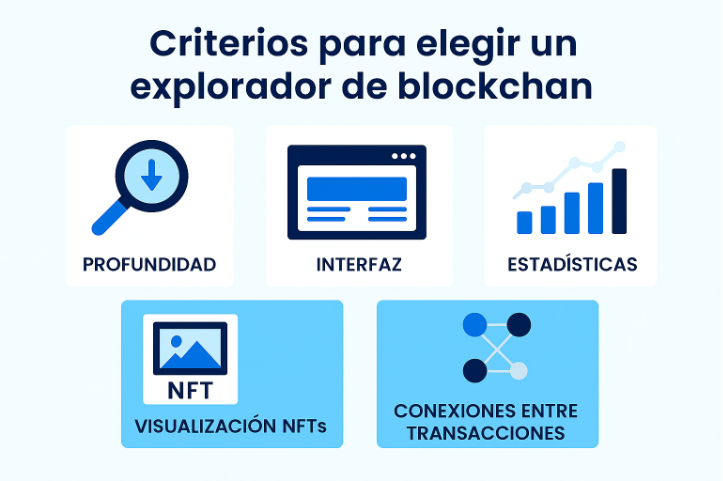
Criteria for evaluating blockchain explorers: data depth, interface, statistics, visualization of NFTs and connections between transactions. Source: infographic generated with Copilot.
Top 5 Blockchain Explorers
1. Mempool.space (bitcoin)
Mempool.space has established itself as one of the most important tools for the Bitcoin ecosystem. Allows you to view the network status in real timeincluding pending transactions in the mempool, recent blocks, and fee estimates required for different priority levels. This is especially useful for users who need to decide what fee to pay to have their transaction included in the next block. Additionally, it offers mining dashboards and visualizations on how future blocks could be formed, incorporating block usage and SegWit weight metrics. A distinctive feature of Mempool.space is that it is an open-source project, without invasive advertising and with a clear focus on transparency. Although its main functions are free, it offers premium services such as the transaction accelerator, designed to prioritize operations by paying additional fees.
Limitations: Mempool.space is dedicated solely to Bitcoin and, although it is outstanding on that network, it does not offer functionalities applicable to Ethereum, NFTs or smart contracts. However, it is still one of the most efficient explorers.
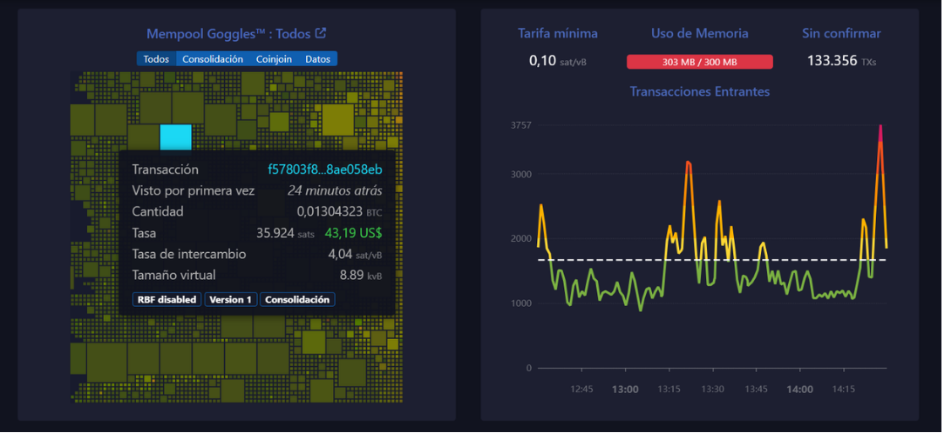
Real-time visualization of the Bitcoin mempool (mempool.space) showing unconfirmed transactions, fees per virtual byte, and network congestion.
2. Arkham Intelligence
Arkham Intelligence focuses on the Advanced transaction analysis and identification of relationships between addresses. Its platform allows you to view and plot transactions on interactive graphs, track recognized entities, detect significant capital movements (“whale movements”) and analyze financial flows between addresses. Unlike more traditional blockchain explorers, Arkham is committed to offering on-chain intelligence, which makes it a key tool for those investigating the behavior of institutional actors or large investors. In recent years, it has expanded its coverage beyond Ethereum and Bitcoin, adding support for BNB Chain and Polygon. This multichain capability allows you connect information from wallets that operate on various networkswhich is valuable to understand the transversal behavior of users and entities.
Limitations: although its multichain orientation is an advantage, the level of detail in each network may vary and doesn’t always offer the same depth as dedicated explorers like Etherscan or Mempool.space. Additionally, some of its advanced features require a subscription, which positions it more as a professional analysis tool than for everyday use.
3. Etherscan (Ethereum)
Etherscan is the leading blockchain explorer in the Ethereum ecosystem. It allows you to consult information about transactions, blocks, addresses and smart contracts, offering a level of detail that has made it the de facto standard for users, developers and researchers. Among its most notable functions is the possibility of verifying smart contracts, which provides transparency to the ecosystem, and its ERC-20, ERC-721 and ERC-1155 token coveragewhich ranges from stablecoins to NFTs. Its interface not only makes it easy to explore basic data, but also integrates network statistics, gas fee tracking, block times, token trackers, and robust APIs that allow developers to build applications on top of Ethereum. This versatility makes it an essential tool for any online interaction.
Limitations: Its greatest strength, specialization in Ethereum, is also its limitation. For those working with multiple blockchains, relying exclusively on Etherscan is not enough and requires supplementing with other explorers.
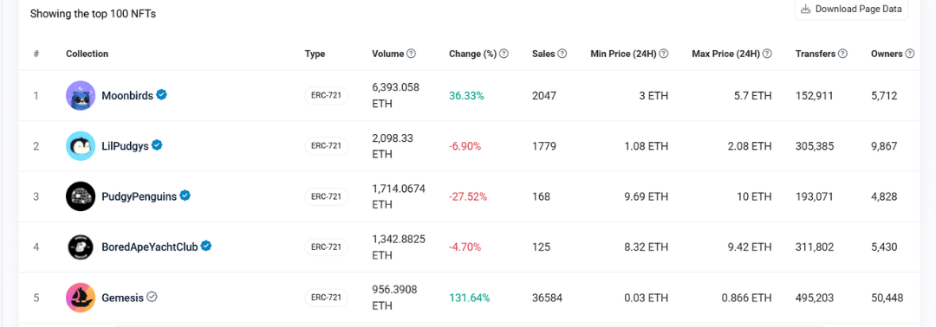
Top 5 NFT collections by volume in ETH, with prices, transfers and percentage change. Etherscan platform.
4. Ethplorer (Ethereum)
Ethplorer is another specialized Ethereum explorer, but with a different focus. Its greatest strength is tracking ERC-20 tokensoffering users the possibility of consulting balances, movements and historical performance in USD. In addition, it has a “Watching Service” that allows you to configure real-time alerts about the activity of specific wallets or tokens, available via email or Telegram. One of its most notable innovations is the “Bulk API Monitor”, a tool that allows you to follow millions of addresses in real time or token portfolio. This is particularly useful for exchanges or services that need to monitor large volumes of information without overwhelming their systems with multiple independent API requests. It also includes widgets and graphs for more user-friendly visualization of token and wallet activity.
Limitations: Although very powerful for token analysis, it does not cover complex smart contract activity in the same depth nor offer on-chain intelligence functions comparable to Arkham or Etherscan.

Ethplorer interface showing an Ethereum token explorer with top token activity and market cap.
5. Blockchair (Multichain)
Blockchair is distinguished by its multichain approach, as it supports more than 40 blockchainsincluding Bitcoin, Ethereum, Solana and Polygon. Through its API, users can query data on addresses, transactions, blocks, and comparative metrics across networks, making it a valuable resource for those seeking a panoramic view of the ecosystem.
In addition to basic exploration, Blockchair offers data export tools, comparative dashboards and the ability to access transactions in raw format, making it useful for both curious users and analysts who require a higher level of technical detail.
Limitations: its greatest virtue, breadth, is also its weakness. Does not always achieve the same depth of analysis as dedicated blockchain explorersespecially in the case of Ethereum and Bitcoin, where competitors such as Etherscan or Mempool.space offer richer and more specialized information. If you want to learn more about topics related to blockchain explorers, We also invite you to read and share these articles from our Cryptopedia:
