
Bitcoin is “awaiting liquidity,” says Glassnode. For Glassnode, «the structure seems more constructive than overtly bullish.» The price of bitcoin (BTC) is being convulsed by the international context that includes the war in Iran, the rise in the price of oil, the refusal of the US Federal Reserve (FED) to cut interest rates and a private credit crisis in full expansion. Despite all this, bitcoin remains relatively strong near $70,000. At the time of this writing it is trading at $69,500. The following chart, provided by CoinGecko, shows how the digital currency has performed over the last 7 days:
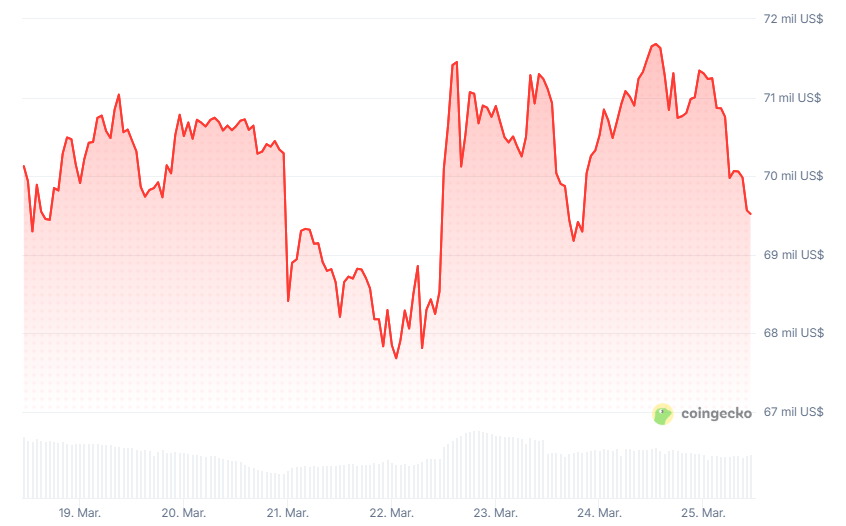 Bitcoin (BTC) price for the last 7 days. Source: CoinGecko. In the midst of this context that combines bitcoin strength with a delicate environment, the on-chain analysis firm Glassnode detects that the market shows constructive signs, but still «needs stronger participation to become something more lasting».
Accumulation zone and a difficult ceiling for bitcoin to pass
One of the central findings of the most recent Glassnode report, published on March 25, 2026, has to do with where recent bitcoin purchases are concentrated.
According to the analysis of the distribution of costs of the so-called short-term holders, a new accumulation point is forming within the range of $60,000 to $70,000. This buying zone is, according to Glassnode, “modest in size, but sufficient to explain the recent bullish price momentum.” Specifically, what Glassnode says is that purchases of bitcoin increased at current prices by investors who are not usually in a hurry to sell their coins. However, the problem is above. Between 93,000 and 97,000 dollars there is a very dense concentration of bitcoin that was bought at those prices and that today it is in loss. The analysts reported here detail that these investors, as soon as the price approaches their entry cost, will have incentives to sell and recover what they lost. Glassnode identifies them as “a cohort that could amplify selling pressure if the price attempts to recover those levels.”
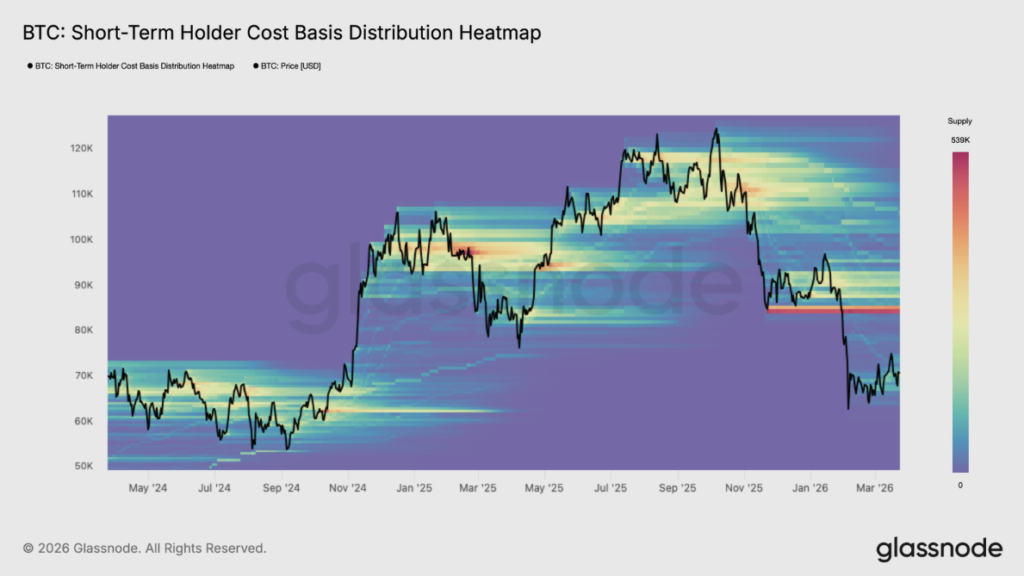 If bitcoin were to rise in price, it would encounter resistance near $90,000. Source: Glassnode.
There is high fear, but no mass capitulation (for now)
Another key indicator in the report measures unrealized losses for the market as a whole as a percentage of total capitalization. In simple terms: how much money investors who haven’t sold yet are losing. That number has been stable for two months above 15% of the market capitalization, an area that Glassnode compares with the conditions of the second quarter of 2022, months before the collapse of Terra-Luna. The firm clarifies that this «positions the current sentiment as one of elevated fear, although significantly below the levels of extreme capitulation seen during acute stress events such as the FTX collapse.» In other words: There is pain, but investors are not yet throwing in the towel en masse. That’s both good news and bad news: There’s no panic, but there’s also no generalized euphoria that historically precedes the most powerful rebounds. On the side of realized profits – what those who did sell at a profit actually pocketed in fiat money – the outlook is more worrying. That indicator collapsed from a peak of about $3 billion a day in July 2025 to less than $100 million a day today, a drop of more than 96%. For Glassnode, “contractions of this magnitude are a textbook characteristic of a bear market moving into its final stages, where the pool of profitable sellers has largely been exhausted.”
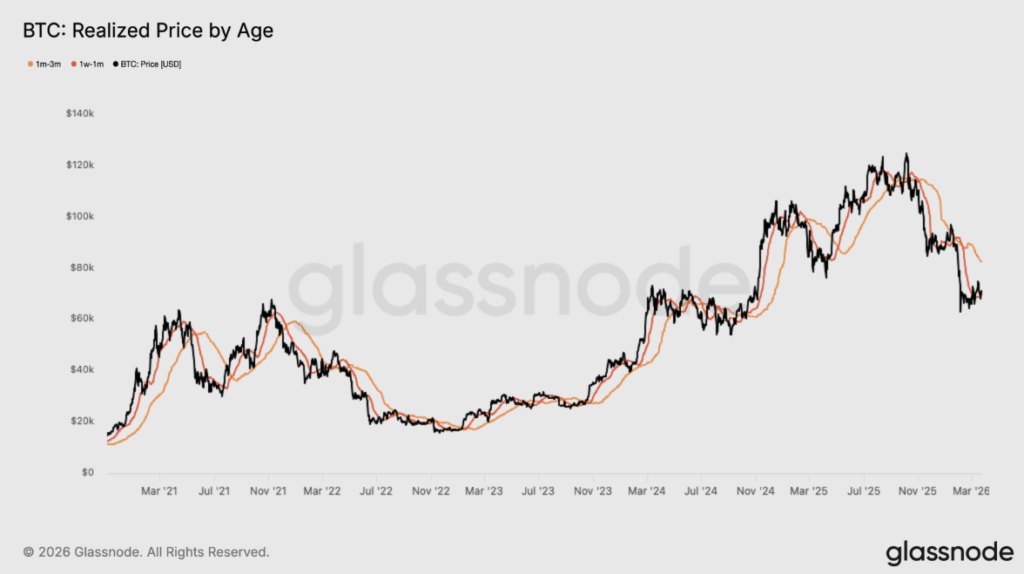 Bitcoin price and majority purchase levels by various investors. Source: Glassnode.
Bitcoin ETFs and derivatives give mixed signals
In the institutional market, there is relatively encouraging news: Flows into bitcoin ETFs in the United States turned into positive territory in recent days, after weeks of net outflows.
Glassnode describes this as “early signs that institutional demand could be starting to return” and warns that “a sustained move back into positive territory would suggest institutional buyers are regaining confidence.” Still, as can be seen in the following image provided by CoinGlass, the picture remains mixed: with red days (of net capital outflows) and green days (of net capital inflows) alternating.
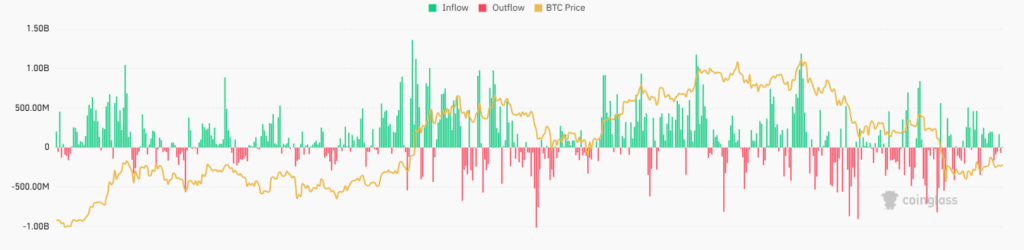 Capital flows to and from bitcoin ETFs, day by day. Source: CoinGlass. However, in the perpetual futures market – the instrument Glassnode describes as “a favorite of short-term traders” – funding rates remain negative. This means that those who bet on the downside are paying a premium to maintain their positions, reflecting that the bearish bias in derivatives persists. For Glassnode, This “signals that conviction in the recovery remains limited, particularly among leveraged traders”.
The counterpoint: Willy Woo and the unfinished bear market
Glassnode’s analysis is not the most pessimistic circulating in the market. As BitcoinDynamic reported, in mid-March, trader and analyst Willy Woo warned in his X account that the recovery towards $75,000 could be a «bullish trap»: a misleading signal of strength that ends up trapping buyers before a new fall. For Woo, the recent momentum was driven primarily by short-term traders and the futures market, players whose liquidity is, in his own words, “volatile and dangerous.” His harshest diagnosis: «Based on the liquidity picture I’m seeing, we’re about a third of the way through the bear market.» If that’s true, Bitcoin would still have a considerable correction ahead before finding a solid structural floor.
 Analyst Willy Woo casts a pessimistic look at what lies ahead for bitcoin. Source: @BitcoinArchive – YouTube. Glassnode doesn’t go that far in its characterization. The report does not speak of an ongoing bear market, but of a «rebalancing phase» with constructive signals that are not yet enough to speak of a bullish breakout. The difference is not minor: Woo projects further decline, Glassnode projects lateralization with downside risk if fresh demand does not appear.
A market without bullish or bearish definition for bitcoin
Glassnode’s summary is precise: «The structure appears more constructive than decidedly bullish.» The indicators point, according to Glassnode’s interpretation, to The worst of the selling panic is over, but the market is still waiting for the missing ingredient: sustained purchase volume and capital inflows that give thickness to the rebound. Until that appears, any recovery will be fragile, and Woo’s warning will remain a hypothesis that the market cannot rule out.
