This article has been published jointly by bridge News Collaborative. Puente News Collaborative is a non -profit organization dedicated to information, organization and financing of quality news and informative rigor focused on the border between the United States and Mexico. A growing wave of uncertainty is freezing investment plans in Mexico, the main commercial partner of the United States, shaking both national and foreign business leaders. Investors evaluate the decision of President Donald Trump to impose, as of August 1 – according to the current plan – cars, steel, aluminum, metal parts and tomatoes produced in Mexico. At the same time, they reflect on the impulse of the Mexican president, Claudia Sheinbaum, to reform the judiciary of the country through elections – the first ones were held this June – that will renew the entire judicial eighteenth and that, according to critics, undermine legal certainty and could reverse democratic advances. It is not surprising that there are more and more doubts about how to proceed. The plans to launch new operations in Mexico – or expand the existing ones – are being reconsidered, postponed or discreetly filed. Economic effects are increasingly affecting commercial and investment decisions along the border between the United States and Mexico, undermining investor confidence and potential employment growth. Long -term planning has become almost impossible, according to business leaders and economic experts. «Foreign investment is probably less than what would have been at this point of the year,» says Tom Fullerton, professor of economy and finance at the University of Texas in El Paso. «It is not yet clear if the Trump administration will allow the United States to remain in the TMEC. It is not clear how the judicial landscape in Mexico will change.» With many closely linked American and Mexican companies, the effects of policy changes resonate along the border. The bilateral trade between the United States and Mexico reached an estimated 840 billion dollars in 2024. About 65,000 jobs have been lost only in Juarez, due to a variety of factors, including greater automation in the factories, says Jerry Pacheco, president and general director of the Border Industrial Association. That this creates an uncertain business environment, ”says Pacheco. «The US and Mexico economies are so intertwined and depend both one on the other that, if US companies are suffering from steel and aluminum tariffs, Mexico will also suffer.»Works in a steel plant in Tlaxcala, Mexico, in February 2025. Hector Lorenzo (Reuters) Paralysis in decision making threatens to seriously affect Mexico's growth prospects – and the legacy of Sheinbaum as the first president of the country. The economy has already shown unequivocal signs of a marked deceleration since the end of last year. There is no clear recovery, neither at the border nor further. “Everything has been put in pause,” says Víctor González, owner of Solinda, a company manufacturing company with headquarters with headquarters in the Mexican state of Aguascalientes, referring to what he listens to colleagues and business associations. «One of the reasons is the reform of the judicial system. The other is the tariffs.» Initially, Trump's threats to impose tariffs on all imports from Mexico and Canada forced entrepreneurs to recalibrate their investment strategies to the south of the border. The economic rise that Mexico was expected to enjoy – impulsed by Trump's hard position against Chinese imports – quickly vanished. Instead of promoting business relocation (Nearshoring), Trump decided to use tariffs as a tool to press both neighbors to stop the flow of migrants and drugs, especially fentanyl. A sign of the possible impacts was the announcement in June of General Motors (GM) on an investment of 4,000 million dollars in factories in the United States, located in Michigan, Kansas and Tennessee. This fits with the company's strategy to reactivate its manufacturing presence in the US, a constant requirement of Trump.GM revealed that the Blazer and Equinox, two sports utilitarian vehicles of great prestige that have been assembled in Mexico for years, will be manufactured in Tennessee and Kansas plants from 2027. GM has produced vehicles in Mexico since the 1930 Expansion in the country was interpreted as one of the first victories of the Free Trade Agreement between the United States, Mexico and Canada in the 1990s. The manufacturer's decision was held by the Trump administration as an important victory. «No president has shown so much interest in reliving the once a great American automotive industry as President Trump,» said White House spokesman Kush Desai, in a statement. The message of the US administration was clear for many observers: the loss of Mexico is the gain of the United States, even if GM must assume greater production costs, which could translate into higher prices for consumers. They have decreased throughout the year – after the announcement of border task forces and the deployment of more security personnel by Canada and Mexico -, the trust of investors has already been affected.
The consequences of judicial reform
Sheinbaum has realized the dream of his predecessor to radically transform the Judicial Power of Mexico, thanks to the large majority in both Chambers of Morena, something that Andrés Manuel López Obrador did not count. An election in June with little participation – it was of just 11% – replaced career judges, magistrates and ministers of the Supreme Court with people chosen by popular vote. Many fear that the consolidation of control over the courts weakens institutional counterweights. With judicial charges dominated by loyal to the ruling party, critics warn that arbitrary or ideologically motivated decisions could proliferate. The nine new ministers of the Supreme Court have links with Sheinbaum, former president Andrés Manuel López Obrador or his leftist party. “What investors are looking for is certainty and rule of law,” says Tony Garza, former US former ambassador to the US in Mexico during the administration of George W. Bush, who now works on commercial issues and other issues in the Case and White law firm. «What they are receiving with threats of tariffs and judicial elections is chaos and incompetence.» Many businessmen, economists and qualifying agencies fear that the country will be returning to the domain of a single party, such as the one that marked Mexican politics during much of the twentieth century. Mexican policy has been tumbos since the end of the hegemony of the PRI in 2000.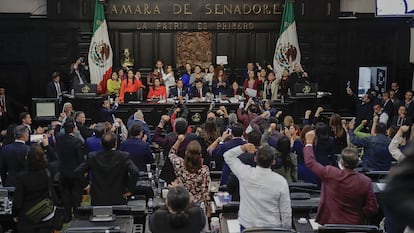 Session in the old house of Xicoténcatl where the judicial reform was approved. Judicial reform senior could «negatively affect the investment appetite and the business environment,» said Fitch Ratings in a report last year. This reflects similar concerns expressed by S&P Global and Moody's, the other two largest rating agencies in the world. The economic winds against them are already being felt, with alarm signs on the border. Fullerton said that unemployment rose 2.2% in 2022 to 3.3% in 2024. In all of Mexico, with an annualized economic contraction of 2.7% in the last quarter of 2024 and a weak growth of 0.8% during this winter, labor and social perception indicators also paint a worrying panorama. The private sector generated just over 85,000 new jobs between January and June. which represents a fall of more than two thirds compared to the same period of the previous year. It is the lowest employment creation figure since 2009, without counting the effects of the Covid pandemic, according to the Mexican Social Security Institute. Consumer confidence in June fell to its lowest level in two years, while business confidence fell by fourteent It has practically stopped. Of the 21.3 billion dollars in FDI that Mexico received in the first quarter of 2025, only 1,580 million – that is 7.4% – corresponded to new investment projects. “The truth is that, with the current situation – and with recent events such as judicial reform – many are saying that this will not be good,” adds González, the owner of the factory. «That is more or less the sensation everywhere. For now, it is a perception, not a reality.» This new foreign investment is well below the average of 29% registered during the six years of the López Obrador administration, and pales compared to the 60% capital participation that the country recorded at the beginning of this century. In a recent meeting with entrepreneurs and politicians of Texas Lyceum, a non -profit organization, a non -profit organization, a non -profit organization, State leadership, the newcomer US ambassador, Ron Johnson, was directly questioned with the following question: «What is the purpose of Trump's tariffs?» After a long pause, Johnson replied that Trump «is a businessman.» Solo in the state of Texas, trade with Mexico reached 540,000 million dollars in 2024. «I honestly believe … that he just wants things to be fair, reciprocal,» said Johnson, who described himself as a «good friend» of the president. «He wants there to be competition in equitable conditions.» In the middle of an uncomfortable silence, the moderator intervened to thank the ambassador. It followed a Cortes applause …… García reported from Mexico City. Corchado reported from Mexico City and La Frontera, and Muela from El Paso. Eduardo García established the Bloomberg office in Mexico in 1992 and directed it until 2001, supervising the award -winning coverage of the agency in the country. In 2001, he undertook a new adventure by founding his own media, common sense. He is the author of Midnight in Mexico and Homelands. It was Nieman Fellow in 2009 in Harvard. @ajcorchadoalyda Muela is a journalist independent of El Paso, Texas. He is a last year student in multimedia journalism, with a minor specialization in general businesses, at the University of Texas in El Paso. He currently performs a scholarship in Puente News Collaborative, where he will work in research, economic and cultural reports. @alydamueladudley Althaus has reported on Mexico, Latin America and other regions for more than three decades as a correspondent. He began his career in a small newspaper at the border between Texas and Mexico, and had a successful 22 -year -old stage as head of the Mexico City of the Houston Chronicle, during which he received several awards. It was also correspondent for Mexico in The Wall Street Journal. @dqalthaus