Playmobil to recreate processions; socks with step size images; stickers to complete guild albums; t-shirts with calls from foremen to the crew of costaleros; football kits from brotherhoods and music bands; brotherly games such as Trivial, Who’s Who, Party or Uno… Andalusian Holy Week is going through a phenomenon of desacralization that, hand in hand with social networks, has turned the brotherhood into a mainstream phenomenon, as a logical response to the demands of the Millennial generation – or muffin generation, in the words of political scientist Jesús Jurado -, who lives the traditions in a natural way and who claims this festival, the Carnivals, the Rocío or the stew recipe as a form of social cohesion that is absolutely self-conscious and void of prejudices, which has been strengthened and spread thanks to social networks. This explains this brotherly marketing boom, assumed almost innately by the Andalusians, but which is also beginning to catch on in provinces with strong roots in Holy Week, such as Valladolid, Palencia or Zaragoza, which have already asked many of the businessmen to They have specialized in this sector that replicate their products and adapt them to their respective idiosyncrasies and traditions. «The brotherhoods have reached the level of popular culture. Although there is still some social stratum that considers the brotherhoods as something rancid, it has transcended the idea that they are something forbidden to ultra-Catholic right-wing gentlemen, and in Andalusia it is already a social movement, which moves many people,» says Francisco Cristófol, a consultant specialized in corporate communication and author of various research papers on the phenomenon of marketing strategies and brotherhoods. Behind every social phenomenon there is always an economic phenomenon. A link that Juan Carlos Ramos Picchi clearly perceived from the counter of a souvenir store in the Triana neighborhood. “Because of their passion, people don’t care about spending money and traditions are a passion, here with Holy Week, the Cádiz Carnivals, the Seville Fair, El Rocío…, but also in Valencia with the Fallas,» says Javier Ayala, who together with Ramos founded Pepe Pinreles, a brand that designs socks with motifs, images and symbols of those Andalusian festivals, of soccer teams – especially Sevilla, Betis and Cádiz – or with winks to the present, with a point of irreverent humor that has consolidated them. Several of the brotherhood games created by the company Korecontact, in the Sevillian town of Mairena del Aljarafe. PACO PUENTES Pepe Pinreles demonstrated eight years ago that the desacralization of the brotherhood – “always with respect, because we know our audience,” Ayala points out – far from causing rejection, it generated demand, to the point that his socks are sold through the web throughout Spain. They later released the Holy Cards albums, stickers with images of Holy Week, which were initially intended for a children’s audience, but which began to be consumed by that muffin generation. “Parents who were 40 or 50 years old bought it, because it had a collectible point.” In Seville, Holy Cards are a phenomenon that causes meetups on weekends to exchange cards. But not only in the Andalusian capital. The partners have already launched specific albums in Zaragoza, Salamanca, Zamora and Toledo. “In all places it is having a lot of impact,” says Ayala. Adría Selma, CEO of Aesta.es – the very brothers will recognize in the name the call from the foremen to the costaleros inside the pass to prepare before lifting it: ‘This is it!’ – has also noted this democratization of the world of brotherhood. They started selling badges with the brotherhoods’ shields through their website – especially from Jerez (Cádiz), where they are based – and they already sell 3D Nazarenes, t-shirts with a point of humor about the costaleros, pins with Fair lanterns or Rocio hats… «We do commercial work for the brotherhoods, but through our website we reach the whole world,» he explains. And in that world, again, is Palencia, Valladolid or Madrid. Pablo Cañete is 42 years old and is part of that muffin generation that grew up longing that the board games with which he spent the afternoons did not incorporate themes close to his fondness for the Sevillian brotherhoods. As an adult, he transformed that frustration into a Trivial, a Who’s Who and a Brotherly Goose; in a Party – which is called Reunión cofrade – and in the Ah quehó – also a term for costaleros – the UNO cofrade. His wife, who helps him with the design, and he take care of all the production that they sell in physical and online stores – where he receives orders from «Andalusians in exile in Logroño, Barcelona, the Canary Islands, Italy, France or Portugal» – and, in addition to adapting the games to Holy Week in Málaga and Huelva, he has also translated them to León and Valladolid. He is already working on four new releases for Christmas – the season when sales are concentrated -, one of them a Choose Your Own Adventure type book. “When I was a kid there was nothing and now we have gone to the other extreme,” he says, laughing.
‘Brotherhood brand’
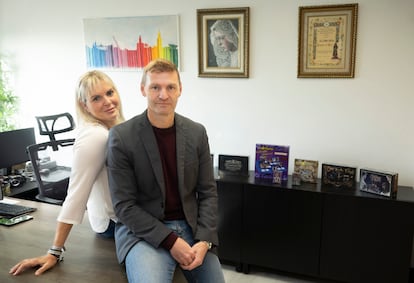 Rosa Marín and Pablo Cañete, creators of brother board games, which are displayed behind PACO PUENTES Something that Fran Martín and his three partners have verified, lovers of sports equipment, but also “Holy Week geeks.” «We would see a football shirt and because of the colors we would say: ‘that could be from such and such a Brotherhood’; ‘and if such and such another one came out, what would it be like?…’. So they decided to put their hobby into practice and opened SPQRT – a play on words between Sport and SPQR, the acronym of the motto of the Republic and the Roman Empire, which appear on the banners of processions, again culture for many brotherhood members -, a website of football shirts inspired by the Sevillian brotherhoods. They played it safe and started with those that, as if they were soccer teams, had the most members: La Macarena and Esperanza de Triana. Now they ‘dress’ 17 brotherhoods in Seville, but also several in Malaga, Jerez, Granada or Almería and have spread to another brotherhood phenomenon: music bands. “It is word of mouth that works so much in the brotherhood world,” explains Marín. “The brotherhood brand is a way to develop a feeling of belonging: identifying with La Macarena is like identifying yourself, bridging the gap, with a social club, because now the brotherhoods do social, cultural work… beyond Holy Week,” highlights Cristófol. That is why the brotherhoods have been the ones that have best known how to perceive and attack the niche of the fraternal consumer. Before Pepe Pinreles, at the beginning of the 20th century, La Macarena was already selling decks of cards with the images of their headlines. “Now with the exploitation of its trademark it has a turnover of more than three million euros,” recalls Cristófol. The brotherhoods are becoming professional. «Now there are people specifically dedicated to networks, to ‘merchandising’ and there is a lot of level that, in addition, they usually do voluntarily,» adds Selma. In Seville alone there are around 240,000 people who belong to a brotherhood – more than all the members of Sevilla and Betis combined (113,000) -; In Malaga, with more than 72,000 brothers, the same thing happens if we add those of its soccer team and the Unicaja basketball team. According to a survey that Cristófol carried out in collaboration with the Malaga Provincial Council, the profile of a brother – in Malaga – is that of a man, 40 years old, moderate center-right, «which implies that he has the purchasing power to consume brother things and when there is a brother consumer profile, private companies also attack that market.» This year, Pepe Pinreles’ partners have released Playmóbil figures through Artabán to make brotherhoods – with clicks with the figures of the steps, the costaleros, nazarenos, acolytes, women with mantillas. The Esperanza de Triana website also sells its own.