Strategy is the firm that holds the most bitcoin (BTC) in its corporate reserve. For Saylor, the risk is ideas that cause “iatrogenic changes in the protocol.” Michael Saylor, CEO of Strategy, stated today, April 4, 2026, that bitcoin’s four-year cycle is no longer the main framework for understanding the price of the asset. In a message posted on
 Michael Saylor believes that the 4-year cycle is dead. Source: Michael Saylor-X. The phrase points directly to one of the most deeply rooted ideas within the bitcoin market: that its price responds to cycles of approximately four years, linked to the halving.
As explained in Cryptopedia, the educational section of BitcoinDynamic, this event occurs on a scheduled basis within the Bitcoin protocol and reduces the issuance of new bitcoins received by miners by half. Historically, this drop in new supply was followed by bullish cycles, which led many analysts and investors to consider the halving as the main price driver. The logic behind that approach is relatively simple. If fewer new BTC enter the market and demand remains the same or grows, bullish pressure tends to increase.
Previous halving cycles
This happened after the halvings of 2012, 2016 and 2020, which preceded the great rallies of 2013, 2017 and 2021. The most recent halving occurred in 2024, within the current cycle, and that is why the idea that BTC would continue to behave under that same pattern remained in force for a long time.
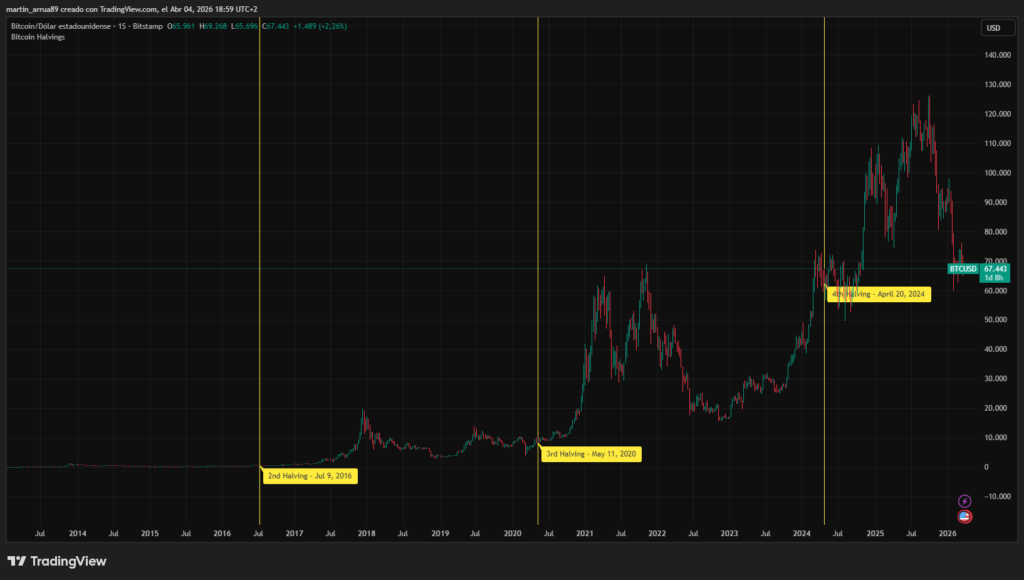 In 2024 the fourth bitcoin halving occurred. Source: TradingView. However, Michael Saylor maintains that this scheme lost strength in the face of a new dominant factor: capital flows. When he says that “the price is now driven by capital flows,” what he is suggesting is that BTC It no longer depends mainly on the programmed reduction in supply, but on the volume of money that enters and leaves the asset.
In other words, the central factor would no longer be the shortage generated by the halving, but the magnitude of the institutional, corporate and financial capital that decides to position itself in BTC.
Saylor further adds that “banking and digital credit will determine bitcoin’s growth trajectory.” This suggests that the expansion of the asset will increasingly depend on its integration within broader financial circuits, where access to credit, liquidity and financial products linked to BTC will have more weight than its internal issuance mechanics.
The position of Saylor and Strategy
That approach is not minor coming from Saylor. Strategy is the public company with the largest amount of bitcoin in corporate treasury, with 762,099 BTC, valued at $51.39 billion. From that position, his reading of the market is closely linked to a vision where BTC stopped being an asset driven only by its internal dynamics and began to be inserted into a broader financial system. In the same message, Saylor also warned about what he considers the biggest risk to bitcoin. As he wrote, “the biggest risk is bad ideas that generate iatrogenic changes in the protocol.” The term “iatrogenic” comes from the medical field and is used to describe damage caused by an intervention that, in theory, sought to improve a situation. Applied to BTC, the idea is clear: the greatest danger would not be a market crash or an external actor, but rather modifications to the protocol that, under the promise of improving it, end up weakening its essential properties.
This includes possible changes that affect limited issuance, network security, decentralization or system stability. Saylor’s warning points to Bitcoin It maintains its strength precisely because its fundamental rules are predictable, rigid, and difficult to alter.
From that perspective, introducing changes “to optimize it” could erode the trust that sustains its value proposition as digital capital.