Capital has found a new business opportunity in flexible and temporary rentals in Spain, a segment in which it has already invested more than 3.5 billion euros since 2020, according to CBRE data. And it has room for more: “There is a high level of investment interest, with more than 4,000 million euros available that could translate into up to 8,000 million of total investment in the next seven years,” says Stefano Somoggi, director of Flex Living at the consulting firm. The interest is explained, to a large extent, by the lack of supply in the rental market, where there are not apartments for everyone, much less for all needs, which has promoted an alternative market: institutional investors, family offices and real estate developers are They are focusing on short and medium-term leasing, a segment that is more expensive to operate than classic rentals, although it provides higher returns and allows large volumes to be invested in a single asset and to take advantage of tertiary land, which is cheaper than residential land. Giants such as BlackRock, JP Morgan or Banco Santander have already entered this format, which in professional jargon is called flex living. Anglicism defines buildings with new housing solutions (rooms, studios…), professionally managed and with services included, aimed at people who need to live in a city for a limited time without assuming the commitments of traditional rental. “It is the result of the revolution of the traditional rental market towards the hotel concept where the period of stay is flexible, there is a fixed price and concern about supplies and maintenance disappears,” summarizes Antonio de la Fuente, general director of Living at Colliers. Stays can be for days, weeks or months, although the average duration is between six and nine months. Along with the shortage of supply, “demographic change, labor mobility and the search for flexibility are transforming the way we live and redefining the residential offer in Spain,” details a JLL report. The consultant not only refers to the increase in population, but also to the fact that «the expansion of single-person households drives the demand for flexible and adapted housing.» However, this type of accommodation does not solve the housing crisis that Spain is suffering. “It responds to the mobility and temporality needs of a certain public and is a format that covers a demand similar to the hotel, but with greater autonomy for the user due to the typology of spaces,” says Antón de la Rica, co-CEO of Líbere Hospitality Group, a European operator specialized in flexible urban accommodation. However, it can provide some relief, in the opinion of Susana Rodríguez, executive director of Living at the consulting firm Savills: “It prevents temporary housing seekers from renting homes intended for long-term rental. That is, it frees up homes in the long-term rental market,” he points out. For its detractors, on the other hand, the rise of flex living and other formulas such as coliving – the traditional shared apartment with professional management, usually in the center of cities and on residential land – does not respond so much to a new way of living as to a new way of naming scarcity and precariousness: expensive rents, temporary stays and fewer rights. Beyond the debate, the Spanish flex living market has gone from being a niche to a consolidated institutional segment in five years, according to Atlas Real Estate Analytics. The big data consultancy identifies 17,441 operational units in 328 assets managed by professional operators and another 129 confirmed projects that add up to 19,854 additional units. Looking to 2028, it is expected that the stock will be close to 37,300 beds. Madrid absorbs 65% of the total —24,113 units in stock and in the portfolio—, with Valdebebas and Sanchinarro as epicenters. Valencia, Malaga and Barcelona complete the main markets. “These are locations with a strong tourist and business travel component, which allows occupancy to be complemented with high-rotation marketing strategies, thus optimizing income levels and the profitability of the asset,” says Rodríguez. Despite the striking figures and the feeling of oversupply, the truth is that they are occupied and that supply remains limited compared to potential demand. “Occupancy levels are around 95% on average,” says Somoggi. Antonio de la Fuente, from Colliers, places the Community of Madrid as an example of the need for a greater offer of this type. “In the region there are three million homes, which compared to the almost 28,000 flexible units means less than 1%.” And he continues: “This 1% provides service not only to the more than 100,000 people who move to Madrid each year, but also to those who move temporarily for work or studies, as well as the resident population itself that needs a temporary accommodation solution, such as moving, periods between changes of housing, renovations or separations.”Calido Valdebebas paddle tennis court, in Madrid, by Dazia Capital and Aermont Capital. PALOMA PACHECO TURNESThe model is far from traditional rental. To begin with, these are buildings that combine furnished living spaces with tenant services, such as cleaning or laundry. “Basically, it responds to something quite clear: today there is more and more personal and professional mobility in cities and many people are not looking for a traditional rental,” explains De la Rica. In addition, flex living projects are usually developed on tertiary land in suburban areas and in converted office buildings. Precisely this is being one of the great levers of the sector, with operations exceeding 70 million, highlighting the conversion of the Johnson & Johnson headquarters in Madrid, JLL sources indicate. «Generally, they are land intended for hotels or offices, where a building is designed with spaces oriented to this use. They are not residential buildings,» says De la Rica, who believes that this more flexible stay model has gone ahead of regulation and regulations in line with current realities are necessary. In addition, the properties are operated with a lodging license and are managed by professional operators.
Prices
The price of these accommodations is higher than a traditional rental, but so is the level of services it includes. According to Antonio de la Fuente, the most economical flex living starts at around 900 euros per month, an amount that, transferred to a traditional residential rental, would be equivalent to about 650 euros. According to CBRE, average rates range from 1,000 euros per month (studios) to 1,600 (two bedrooms). From an investor point of view, the market is driven by national and international institutional funds, with interest in both developments and turnkey assets or already in operation. “The first operations led by core investors (more conservative profile) are beginning to appear, who acquire assets once built and stabilized with the aim of keeping them in the long-term portfolio,” they explain in Savills. In recent years, several joint ventures have been established, such as those of BlackRock and Twin Peaks, Aermont and Dazia Capital, Momentum and Bain, Momentum and King Street, Grupo Lar and JP Morgan, or Stoneweg and BGO. There are also others, such as Santander AM, Greystar, Argis and GMP, that do not have agreements with specific developers, identifies the general director of Living in Colliers. The market is also in full readjustment. «On the property side, international capital – Greystar, Brookfield, CPPIB, Patron, M&G or Hines – today validates the existing stock, while the next projects are moving towards national capital – Stoneshield, Dazia & Aermont, Kategora, Twin Peaks or Metrovacesa,» they conclude in Atlas. All of them attracted by returns that vary depending on location. According to JLL, they are around 5.25% in prime areas. In Madrid, “from 7% on already stabilized projects,” says De la Fuente.
From the shared room to ‘coliving’
Some of these investors have also opted for coliving, another form of flexible rental. It is a formula closer to the classic shared rental and usually developed on residential land in urban centers. “It consists of having a private room, a studio or a small high-quality apartment in buildings with large common areas (swimming pool, gyms, work areas, terraces) and, most importantly, access to a community very similar to them,” details David Uriarte, co-founder and CEO of the operator Aticco Living. The main difference with respect to the classic rental is once again in flexibility. «The price includes all supplies, cleaning, maintenance and, of course, access to community activities and several days a month in coworking spaces. We went from an owner-tenant model to a host-community model», Users are usually digital nomads, entrepreneurs, remote workers or professionals who move for temporary projects to cities such as Barcelona, Madrid, Malaga, Bilbao or Palma. «There are more and more people who do not live in the city where they were born; societies are more liquid, much more flexibility is demanded in everything and, therefore, also in accommodation,» says Uriarte. 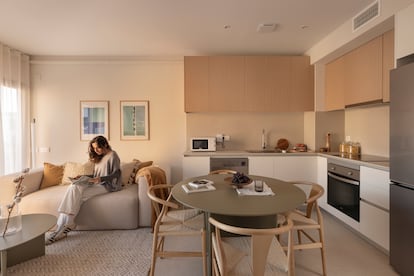 Interior of one of the accommodations in an Aticco coliving.mariapujolThe demand is very high and, today, it exceeds the supply. In cities with so much real estate pressure and economic dynamism like Madrid and Barcelona, waiting lists are common. “We work with 98% or 99% occupancy, normally stays of about six months, with contracts that adapt to your life and not the other way around,” says Uriarte. The price is all-inclusive and ranges from 700 to 1,250 euros, depending on the location, size, whether they have a bathroom or the building facilities.