
A mini ASIC has lower entry costs, but its chances of success are typically lower. Almost half of 2025’s solitary blocks were mined with rented hashrate. Mining Bitcoin alone is one of the toughest bets on the network: with a global hashrate now exceeding 1 zettahash per second (ZH/s), the chances of an individual miner finding a block are very low. Even so, more and more users are trying it. Since 2025, a practice has been gaining ground among them: renting hashrate instead of buying their own hardware. Almost half of solitary blocks found in 2025 were mined with rented hashrateand in 2026 the trend continues. The most recent case occurred on February 24 when a user found a block through the Hashpower platform of the Braiins mining pool, investing the equivalent of just $75 in rented hashrate. The milestone allowed him to receivea reward of almost USD 200,000, as reported by BitcoinDynamic.
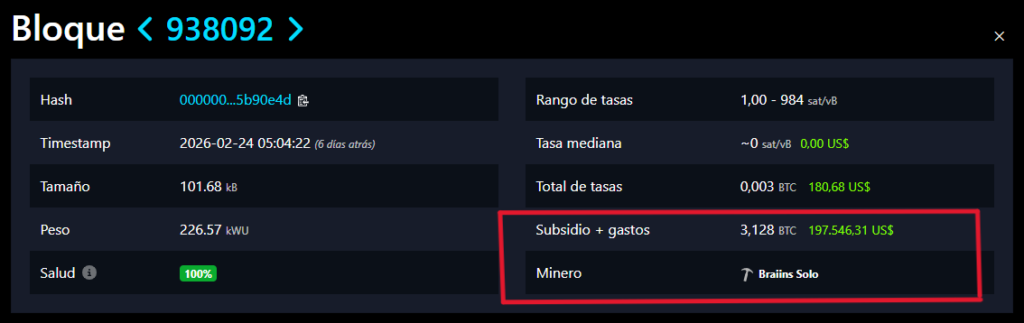 Block data found by a lone miner renting hashrate on Hashpower. Source: mempool.space. Likewise, last October, a miner using six NerdAxe mini ASICs and an Avalon Q rig from the company Canaan, obtained a profit of USD 342,000, given that the price of BTC at that time was around USD 110,000 per coin. These cases raise the following question: is it better to rent hashrate or buy a mini ASIC?
Hashrate and probabilities: the gap that defines everything
A mini ASIC, although there are different varieties, usually offers a computing power level of 1 terahash per second (TH/s), such as the Bitaxe Gamma 601 or the Braiins BMM 101. In contrast, a rental package such as the so-called ‘Gold L’ from NiceHash delivers approximately 0.1236 EH/s for 4 hours, i.e. 123,600 TH/s. In that case, the rented hashrate is about 123,600 times greater than that of a Bitaxe Gamma or the BMM 101 (There are also packages with lower hashrate levels on NiceHash).
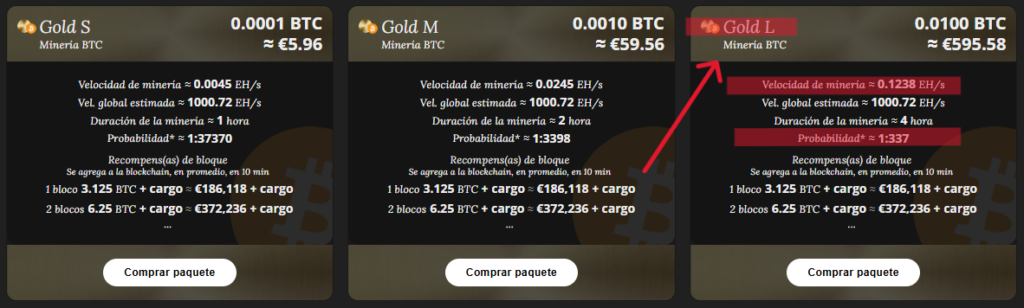 Different hashrate rental options at EasyMining, the solo mining section of NiceHash. Source: NiceHash. The hashrate difference translates directly into probabilities. NiceHash’s Gold L package, operating against a network estimated at 1 ZH/s, offers a probability of finding a block of 1 in 337 in those 4 hoursaccording to the same platform. That means that, statistically, a user would need to rent that package about 337 times, equivalent to about 56 days of continuous rental, to expect to find a block. A mini ASIC at 1 TH/s, on the other hand, would require on average about 18,000 years operating continuously to achieve the same result, according to estimates from the SoloChance site.
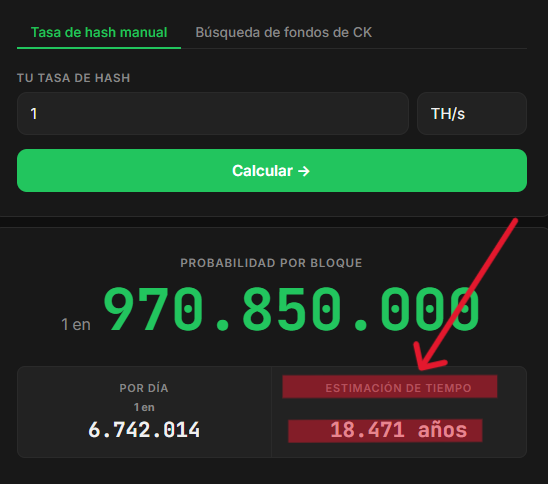 Calculation of the chances of finding a Bitcoin block using a hashrate of 1 TH/s. Source: SoloChance. In the latter case, the probability exists mathematically, but it is vastly lower than that of renting hashrate.
The cost: an equation that does not end at the entry price
Here the comparison is partially reversed. NiceHash Gold L package costs 0.01 BTC, about 690 dollars at the current price of $69,000 per BTC, for 4 hours of mining. Although platforms like NiceHash or Hashpower report how much each person and each miner spent to find a block, the data is opaque. This, given that It is not revealed how many previous attempts failed or how much money they invested in total before succeeding.which would allow us to have a better idea of the investment and definitive operating time. For its part, a Bitaxe Gamma 601 costs approximately $100 plus international shipping. With this, the user accesses the possibility of mine constantly (at lower hashrate rates). When choosing a mini ASIC, you must also consider the electrical cost, although they usually have very light consumption. For example, the Bitaxe Gamma operates continuously with an electrical consumption of just 18 wattsequivalent to that of an LED lamp. Additionally, using a mini ASIC also involves equipment maintenance. Whoever operates their own hardware assumes the rresponsibility to clean it, monitor it and manage possible overheating. Whoever rents hashrate delegates all that to the platform operator.
Beyond the odds: what each miner values
Mini ASICs have an argument that hashrate rental cannot offer: genuinely contribute to network decentralization Bitcoin. Each individual computer connected to the network (even if its hashrate is marginal) adds an independent miner that does not depend on intermediaries to participate in the validation process. Rent hashrate, on the other hand, concentrates computing power on large operators like NiceHash, which act as intermediaries between the miner and the network. For part of the bitcoin ecosystem, that distinction matters as much as profitability. Mining with your own hardware is a way to participate in the real governance of the network: not only for economic incentivebut out of conviction about how Bitcoin should work. The mini ASIC is not just a mining tool; It is a form of computational sovereignty. The final question, then, is not strictly technical. If the goal is to maximize the odds of finding a block in the short term with a purely economic incentive, hashrate rental clearly wins. If the objective is to participate continuously, sovereignly and aligned with the values of the network, without depending on third parties, contributing to its decentralization, the mini ASIC is the answer. Each user decides what they are actually purchasing when mining solo.
