Drake proposes that Ethereum be powered by simpler, more secure, and verifiable cryptography. The focus of Ethereum development would be the integration of “snarks” tests. Justin Drake, a member of the Ethereum Foundation (EF) and a key figure in the development of the protocol, published a message in which he addresses the factors he considers essential for the future of the network. Its approach revolves around snarks, a type of cryptographic proof that allows verify information without revealing its content and without the need to communicate with whoever generates it. According to Drake, those tests will be the core of Ethereum’s next leap for greater scalability and privacy.
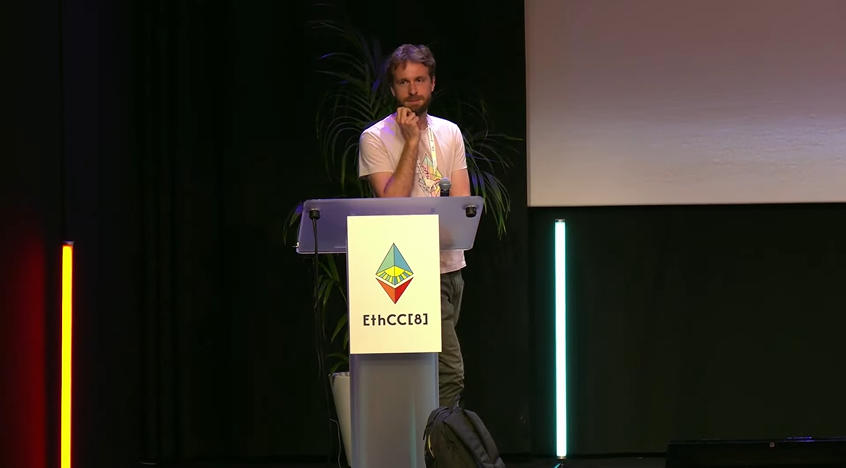
Justin Drake is one of the most relevant contributors to Ethereum. Source: Youtube.
Snarks as a technological base and the goal of simplifying the protocol
Drake maintains that technology matures when it leaves behind its complex technical name. In his message he noted that, just as terms like «laser» or «radar» began as long acronyms, «snarks» (for Succinct Non-interactive ARguments of Knowledge) will reach that state. when they are reliable, verifiable and widely used. Drake envisions a protocol that incorporates snarks as central and everyday technologysimply and reliably integrated into the main Ethereum layer. The developer proposes that post-quantum security, complete formal verification, deep cryptographic analysis and real-time demonstration are inevitable steps to reach that maturity. These tools seek to ensure that snark tests work even against attacks that could take advantage quantum computersa theoretical but relevant risk for systems that store value. Drake highlighted that Ethereum has managed to operate without crashes for «10 years» and with «1 trillion dollars secured with hashes and signatures», which he described as the current cryptographic «workhorses.» These hashes and digital signatures are mechanisms that protect transactions and authenticate keys, but their evolution has limits. However, he stated that, in the future, Ethereum would sustain “100 years of online time” and secure “1 quadrillion dollars” with snark tests.
The three focuses for Ethereum, according to Justin Drake
Among the technical objectives he mentioned three areas: scalability, security and privacy. For scalability, as BitcoinDynamic already reported, Drake reiterated that he aims to «10,000 transactions per second» using virtual machines compatible with real-time zkEVM (Ethereum virtual machines with zero-knowledge techniques) tests. zkEVMs are environments that allow you to execute transactions and smart contracts compressed into verifiable cryptographic proofs. In summary, they certify that all transactions and contracts executed were valid. Instead of each node in the system processing and verifying each operation one by one, the nodes only need to verify that compact proof. This verification is much lighter and faster, which reduces the workload and allows the network to process many more transactions in less time. In security, the Ethereum Foundation developer projects signatures resistant to quantum attacks. Lastly, in terms of privacy, aspires to a “Zcash-level” model with tools such as «wormholes», a concept present in the EIP-7503 proposal that introduces hidden channels for private transfers.
Finally, Drake stated the Ethereum Foundation intends “tens of millions” to initiatives such as formal verificationadvanced cryptographic analysis, real-time demonstration, privacy and framing zkEVMs within the main protocol.