The investment manager Apollo Global Management, which operates in the United States, has limited redemptions from its private credit fund, Apollo Debt Solutions (ADS), allowing retail investors to withdraw just 44.7% of their capital requests. The measure responds to a saturation in liquidity requests that exceeded the operating limits established by the entityleaving the remaining 55% of the funds held under restricted refund policies. Private credit consists of loans granted by non-bank entities, such as investment funds, directly to companies. Unlike traditional bank loans, these assets are not traded on open markets, making them difficult to convert quickly into cash. In a document filed with the United States Securities and Exchange Commission (SEC) yesterday, March 23, Apollo Debt Solutions reported that it received requests to withdraw $1.64 billion, representing 1.2% of the fund’s outstanding shares.
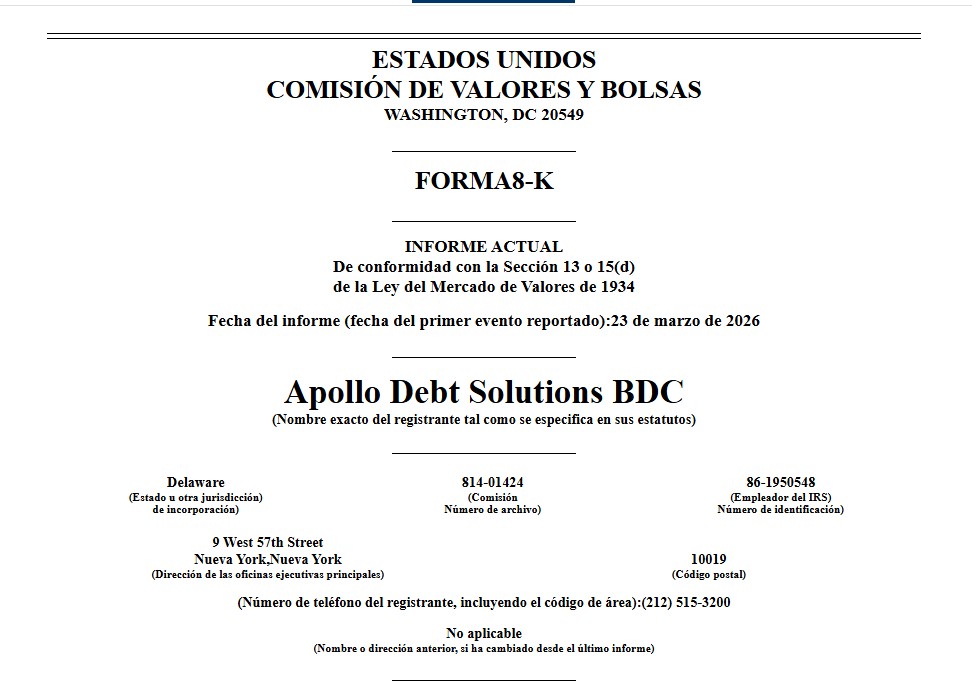 Apollo investors will access a portion of your funds. Source: SEC. This figure far exceeded the fund’s quarterly limit of 5% of net asset value for redemptions, representing $734 million. As a consequence, investors who requested their money will only receive a fraction of what was requested.. «Today’s decision reflects our continued commitment to creating long-term value for the Fund’s shareholders,» Apollo stated in its official statement. The firm added that: «As long-term capital managers, we have a fiduciary duty to act in the best interests of all Fund investors, balancing the interests of shareholders seeking liquidity with those who choose to maintain their investments.»
A gap between credit and the real economy
There is an obvious tension between investors’ need to get their money back and the company’s justification. As clients face lack of liquidity, Apollo argues that This restriction is necessary to preserve value creation and avoid hasty liquidation of assets that harms those who remain in the fund. The size of the private credit market already exceeds $2 trillion in assets under management globally and is expected to approach $4 trillion by 2030, according to estimates by the agency Moody’s. In this context, there are financial analysts such as Charles Hugh Smith who warn that the global financial system is sitting on a time bomb made with cheap credit. Smith maintains that credit can be created in virtually unlimited quantities with a few clicks, while productive investments grow incrementally, slowly and expensively, as reported by BitcoinDynamic. For Smith, this excess of cheap credit has overinflated the prices of many assets. «Building a new company takes time and is risky. “It is much easier to buy an existing asset,” says Smith. The analyst explains that the result is a spiral where more credit raises the price of shares, real estate investments, etc., and those more expensive assets serve as collateral to take out more credit. It’s a bubble that, according to Smith, is close to bursting.
There are precedents in capital restriction
The situation places Apollo as one of the new visible victims of instability in the private credit sector. It is not an isolated case; other large firms have resorted to similar blocking mechanisms or exit «doors.» Blackstone’s real estate fund, known as BREIT, and Starwood Capital’s fund (SREIT), for example, also imposed severe restrictions on redemptions in recent periods after facing waves of withdrawal requests that threatened their capital structure.