«Bruno», founder of Bitcoin Lab Bolivia, promotes a circular economy of the pioneering digital currency in the city of Santa Cruz, located in the eastern plains of the country. Your project seeks to convert to the currency created by Satoshi Nakamoto into an everyday tool for daily payments. The community it leads has been working since 2024 on practical education for residents to use in simple transactions, such as buying bread or paying for taxis. This Brazilian bitcoiner prefers to identify himself only by a pseudonym, aligned with the principle of anonymity that Nakamoto promoted. He began exploring the ecosystem eight years ago in his native country, motivated by his interest in privacy, cryptography, and decentralized networks. At that time, he operated under an alias in Reddit and Telegram groups, carried out small P2P transactions and tested tools like Tor. “We have the idea of educating in Bolivia so that people stop thinking about bitcoin as something strange or complicated,” Bruno explained in a recent conversation with BitcoinDynamic. «We want them to see it as digital cash that you can use every day, without intermediaries charging high commissions or waiting days for the money to arrive,» he added. The entrepreneur remembers that his beginnings were marked for the search for financial sovereignty.
In Brazil there is greater adoption of bitcoin, but here in Bolivia it was still prohibited. People made transfers secretly, without official exchanges that allowed open accounts. I started testing it as one more thing, and soon I understood that Bitcoin complements that perfectly, because it is pseudonymous. Bruno, founder of Bitcoin Lab Bolivia.
A game brings bitcoin closer to families
With the aim of spreading education about bitcoin. the community that leads develops a simple game aimed at families. The objective is show step by step how to open a bitcoin walletsend sats (the smallest unit of bitcoin) to a family member or pay at a nearby store.
We also give talks in which we explain basic things such as what a wallet is, how to store the key safely and how to transfer 100 satoshis to a child so they can buy something. We want kids and parents to try it together and see how it works. If you can get someone to send 50 boliviano cents in bitcoin to their mother and see that it arrives in seconds, the perception changes. From then on everything flows easier. Bruno, bitcoiner founder of the Bitcoin Lab Bolivia community.
Likewise, he talked about the Bitcoin Lab platform, which has an artificial intelligence (AI) community agent, designed to answer questions in real time. Take action as a virtual tutor available 24 hours a day. This development, previously reported by BitcoinDynamic, seeks to fill gaps in the traditional system.
This is not taught in school, at least not in Bolivia. The system prefers that we remain ignorant, but our idea is to be the reference school in the country, right now that the Central Bank no longer prohibits digital assets. Bruno, bitcoiner founder of the Bitcoin Lab Bolivia community.
In that sense, the bitcoiner says that the road has not been easy. Bolivia lifted the ban on crypto assets in 2024, but adoption remains slow in many regions. Still, Bruno sees real progress.
A bitcoin circular economy in full formation
The businesses that accept bitcoin are not large international chains; They are family businesses that decided to try because a customer asked them if they accepted BTC or because they saw that their neighbors did. The Bitcoin Lab leader explains that the circle expands organically.
When a merchant receives bitcoin and uses it to pay their supplier, the supplier tests it too. This is how the circular economy is being formed. We don’t need everyone using bitcoin tomorrow. We just need more and more people to take a small step and see that they do not lose anything, that on the contrary they gain speed and control. Bruno, founder of Bitcoin Lab Bolivia.
In Santa Cruz, approximately 30 businesses, neighborhood stores, cafes and workshops, They accept bitcoin as regular payment because facilitates transactions and attracts new customers.
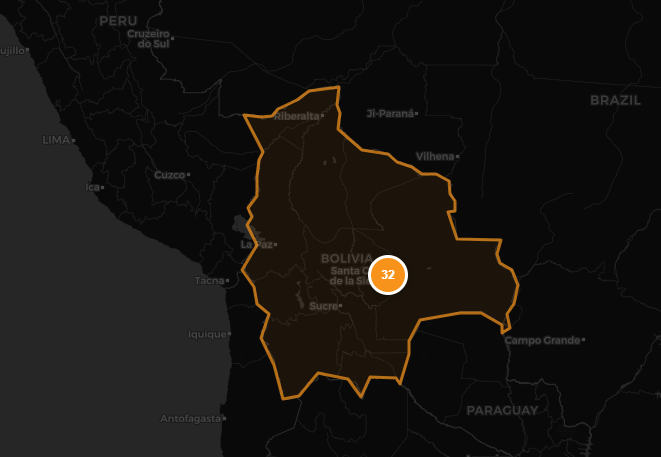 Neighborhood stores, cafes and workshops already accept bitcoin as a regular payment in Santa Cruz. Source: BTCMap. That is why, for Bruno, the real change is not in the price of bitcoin. The change is in the moment when A lady in the market receives a payment in satoshis for her salteñas (typical Bolivian baked empanadas) and decides to save a portion in your wallet instead of immediately exchanging everything into bolivianos. «There the cycle of constant devaluation is broken. There bitcoin stops being ‘something from the internet’ and becomes part of real life,» Bruno stated with conviction. Bruno and his team believe that what they are building with Bitcoin Lab in Santa Cruz, It is a different way of relating to money. One that prioritizes daily utility over speculation that leads to permanently thinking about the price. That, in a country where economic stability has not always been the norm, can be a valuable lesson for anyone who wants to look at the future with a little more control and hope.