
The steps of the Great Hall of the People, the mammoth building reserved for major political events in Beijing, left this Thursday morning one of those images that help understand an era. While the Chinese president, Xi Jinping, received his American counterpart, Donald Trump, with the pomposity that characterizes great state visits, on the steps of the main ceremonial stage of the Chinese Communist Party the most visible faces of American capitalism shared the frame with senior officials from the two main powers on the planet. Along with the secretaries of State, Treasury and Defense of the United States—Marco Rubio, Scott Bessent and Pete Hegseth—some of the most influential businessmen in the world observed the event: Jensen Huang, CEO of Nvidia; Elon Musk, of Tesla and SpaceX; Tim Cook, of Apple; Larry Fink, of BlackRock; Stephen Schwarzman, of Blackstone; David Solomon of Goldman Sachs; Jane Fraser of Citi; Kelly Ortberg, Boeing; Cristiano Amon, from Qualcomm; Sanjay Mehrotra of Micron; and Brian Sikes, of Cargill, among others. The entourage functions as a map of US economic interests in China: chips, electric cars, smartphones, airplanes, banking, investment, payments and agriculture.
More information
Trump, who has never separated politics from business or diplomacy from entertainment, has traveled to China accompanied by a large entourage that concentrates much of American corporate power. In the first minutes of his bilateral meeting with Xi, still with the cameras in front of him, he confided that the delegation is made up of «the best businessmen in the world», whom he described as «wonderful people» who «respect and value China.» The Xinhua agency has confirmed that Xi has met with business leaders after his meeting with Trump. The scene contains the paradox that defines the relationship between Washington and Beijing today: two powers facing each other over technological, military and commercial leadership, but whose common interests are too great to allow themselves the luxury of ignoring each other. The United States wants to stop China’s advance in strategic sectors, but its companies still need to sell, manufacture, finance, assemble and operate in the country that the White House points out as its main competitor. The presence that has caused the most talk is that of Jensen Huang, because his incorporation to the list of invited executives occurred practically in stoppage time. According to Reuters, the founder of Nvidia, the company that manufactures the most coveted processors for training artificial intelligence models, joined the delegation after receiving a call from Trump at the last minute, and he did so during the technical stop to refuel in Alaska.Nvidia executive Jensen Huang (right) and Apple executive Tim Cook arrive at the meeting between Chinese Prime Minister Li Qiang and American businessmen this Thursday in Beijing.GO NAKAMURA / POOL (EFE)
The chip ‘war’
The Nvidia case exemplifies the main technological dispute between the two powers. It was the company that dominated the chip market in the Asian giant for years (China represented 13% of its global income), until Washington imposed export restrictions alleging that its sale could pose a threat to national security. Currently, the focus is on its advanced H200 processors, which Chinese technology companies need to deploy more cutting-edge artificial intelligence models. The Trump Administration authorized its sale in January, but in such a conditional manner that shipments still have not materialized. Washington demands guarantees about the final destination of the chips, fearing that they will end up strengthening Beijing’s military capabilities. But the communist authorities refuse to accept conditions that would entail de facto American supervision over their companies. Nvidia, meanwhile, sees Huawei and other local competitors accelerating the development of their own alternatives.
Electric cars and smartphones
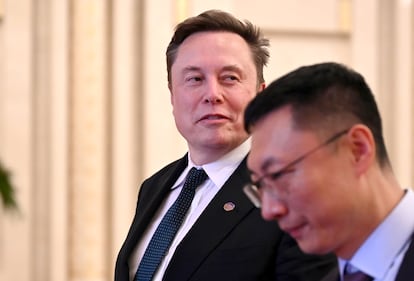 The billionaire and founder of Tesla, Elon Musk, this Thursday in the Great Hall of the People, in Beijing. DPA via Europa Press (DPA via Europa Press) The rest of the tycoons also travel with very specific interests. Musk, the richest man in the world, arrives with Tesla in the midst of a battle to retain ground in the world’s largest electric car market. The Shanghai gigafactory remains key to producing and exporting vehicles (its sales increased 36% year-on-year in April), but the company competes with increasingly aggressive and cheaper rivals, such as BYD. Cook, for his part, travels with the concern of protecting Apple’s industrial architecture. Although the company has accelerated its diversification into India and Vietnam, China remains a central cog in its supply chain and a difficult market to replace. In the first quarter, iPhone shipments to the country grew by 20%, despite the overall decline in the Chinese smartphone market. Among the financiers, Schwarzman is the one who arrives with the most history on his back. The founder of Blackstone has built over decades a personal relationship with the Chinese leadership that few Westerners can match. In 2013, he donated $100 million to create the Schwarzman Scholars, an elite master’s program at Tsinghua University (Xi’s alma mater) designed to train future generations of global leaders. Fink, Solomon and Fraser represent Wall Street’s commitment to not be left out of a financial market that Beijing opens in dribs and drabs and under close political surveillance. In 2021, BlackRock became the first foreign manager authorized to operate a wholly foreign-owned investment fund business in China. Eric Trump, executive vice president of the Trump Organization, and his wife Lara, as well as the director of the documentary about Melania Trump and the Rush Hour saga, Brett Ratner, have also traveled. These three have done so on a “personal” basis, according to Reuters.
The sanction to Rubio
Beyond the businessmen, there are two figures from the Trump Administration whose presence in Beijing deserves a detailed explanation. Marco Rubio, an old Republican hawk, has arrived with an unusual burden for a head of American diplomacy: China sanctioned him in 2020 for his criticism of the repression in Xinjiang and Hong Kong and, in theory, his entry into the country was banned. But the Chinese authorities have resolved the contradiction with pragmatism, stating that the sanctions affected “Senator Rubio”—the position he held at the time—and not “Secretary of State Rubio.” Trump passes in front of Marco Rubio (right), Scott Bessent and Pete Hegseth during the welcome ceremony in the Great Hall of the People, this Thursday. Maxim Shemetov (REUTERS) Pete Hegseth’s attendance is also striking, since Defense Secretaries do not usually accompany presidents on state visits to China, as they have their own channels of communication with their more discreet and technical military counterparts. Hegseth has thus become the first head of the Pentagon that has traveled with an American leader to Beijing since Richard Nixon’s visit in 1972. The last Secretary of Defense to set foot in the Asian giant was James Mattis, in 2018. Then, Taiwan was not the dominant axis of the bilateral military relationship. Compared to the American delegation, the Chinese table offered a much more concentrated image of power. During the meeting, Xi was flanked by Cai Qi and Wang Yi, two key figures in understanding how decision-making works in Beijing. Cai, director of the General Party Office, is one of the Chinese president’s closest collaborators. It controls the agenda, access, documents and flow of information around Xi, essential levers in a system increasingly organized around the Chinese leader.
  Chinese President Xi Jinping (left), sitting next to his Foreign Minister, Wang Yi, attends the bilateral meeting with US President Donald Trump in Beijing this Thursday. Maxim Shemetov / POOL (EFE) Wang Yi is the great veteran of Chinese diplomacy: he has been Foreign Minister for more than a decade (with a brief hiatus between 2022 and 2023) and also heads the Office of the Central Foreign Affairs Commission, the body that coordinates foreign policy within the Communist Party. Another of the most prominent representatives of the Chinese delegation is He Lifeng, vice prime minister and known in the international media as Xi’s economic czar. A personal confidant of the president since the 1990s, he is the main person in charge of economic negotiations with Washington and arrived at the summit after having led preparatory contacts with the US delegation in Seoul (South Korea).
