Unlike previous cycles, there were no «catastrophic» events to affect sentiment. Bitcoin (BTC) is following its usual bullish-bearish alternations. The fear and greed index of the bitcoin (BTC) and cryptocurrency market, prepared by the CryptoQuant explorer, fell to 5 points at the end of last week. This is the worst investor sentiment in four years, since crypto winter 2022. It is also one of the scariest states in market history, although it then rebounded slightly over the weekend to reach 8 points at the time of this publication, Monday, February 16, 2026.
Similar levels were only present during times of great tensionsuch as at the bottom of the 2018 bear market, the decline before the start of the pandemic in 2020 and the consequences of the closure of the FTX cryptocurrency exchange in 2022. On a scale of 0 to 100, levels above 80 on this index reflect extreme greed in the bitcoin market. On the other hand, numbers below 20 indicate extreme fear. “That tells you that this is not a light precaution. “It is the psychology of capitulation,” highlights George Tung, the investor best known on social networks as CryptosRus. “In terms of behavior, this corresponds to classic loss aversion,” he notes, in a post on February 15. What does this feeling consist of? «After sharp falls, investors prioritize safety, delay re-entry and wait for confirmation. Sentiment usually lags behind price. Confidence is slowly rebuilt, even after the markets stabilize,” says the analyst.
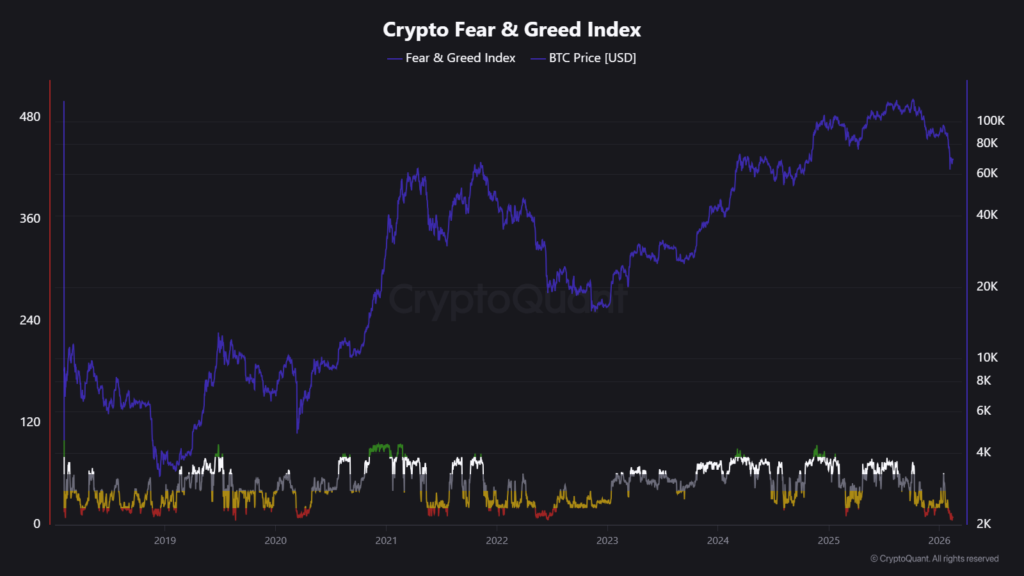 Moments of extreme fear are represented in red, while extreme greed is represented in green. Source: CryptoQuant. In this scenario, there are fear and greed indices that show extreme fear, but not at levels as low as in CryptoQuant. The one compiled by CoinMarketCap is at level 12 and that of Coinglass at 11, after both touching the score of 5 on different dates in February. Each of these indicators measures market sentiment based on different data, such as volatility, futures markets and messages on social networks. Although, in CryptoQuant, it is not clarified what factors exactly it takes to make the calculation.
High selling pressure despite the lack of «catastrophes»
The lowest points of the fear and greed index They usually coincide with times of massive sales and purchasing opportunities. These periods precede strong long-term bitcoin appreciation. Although “extreme fear does not guarantee an immediate rebound,” it has historically marked “the initial phase of a bottoming process,” explains CryptosRus. This concept refers to a readjustment in the position and expectations of investors. “When the crowd focuses on avoiding further pain rather than chasing upside potential, markets are often closer to exhaustion than expansion. The feeling fades and that is where new cycles silently begin,” he explains. Anyway, extreme fear doesn’t mean bitcoin can’t decline to lower prices. In fact, the market has hit the bottom of every crypto winter not necessarily when it is in this state, but sometimes later, at non-extreme fear levels. In other crypto winters, retail panic predominated due to catastrophic events, such as the FTX bankruptcy or the Covid-19 pandemic. The current extreme fear, on the other hand, does not occur in the face of a panorama of such magnitude. Instead, there is a readjustment of investors’ positioning in different circumstances. Among them, macroeconomic uncertainty and the four-year historical pattern that can influence market psychology stand out.
2026 would be bearish for bitcoin, according to history
If it continues its classic four-year pattern, bitcoin could have a bearish 2026. The currency always reached the end of an uptrend the year after each halving. This can be seen below.
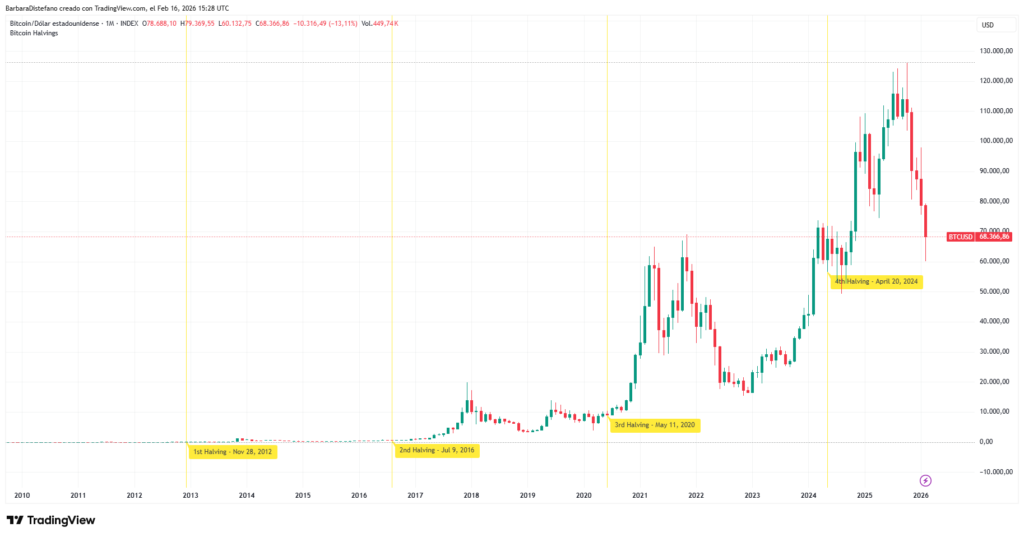 Bitcoin has historically maintained a pattern around halving. Source: TradingView. The most recent halving, which halves the issuance of BTC every four years, was in 2024. The price is now trading around 68,000 dollars (USD), 46% below its all-time high of 126,000 marked in October 2025. Historically, the price declined around 80% in each crypto winter. Although, in each one, it registered a slight minor correction. In this sense, BTC’s decline in this cycle might not be overbut be less severe than in the past. For James Foord, economist and director of the investment group The Pragmatic Investor, a 75% drop from its historical maximum is feasible. That would place its price at less than $40,000, as reported by BitcoinDynamic. However, it is crucial to keep in mind that past events are no guarantee that they will be repeated. In fact, different analysts argue that BTC could have a milder crypto winter, due to the presence of institutional investment that was not there before.