«The bottom of the downtrend is being forged right now,» says analyst. Despite good expectations, bitcoin remains in the capitulation zone. So far in 2026, bitcoin (BTC) has seen a drop of more than 45% from its all-time high of $126,000 marked on October 6, 2025. This period of strong bearish volatility highlights the fragility of current market sentiment. Although, at the same time, the possible approach of a historical accumulation phase is observed, which shows incipient symptoms. There are investors who They are reconciling this price zone to buy. A clear example of this was the 17% rally experienced on February 7, going from 60,000 to 70,000 dollars in less than 24 hours, due to the buying force. However, the inability to maintain this level returned the price to around $66,000. “This highly volatile move reinforces the importance of adaptive metrics to distinguish market noise from structural reversals,” says the technical analyst known as GugaOnChain. Therefore, it is proposed to observe the MVRV Adaptive Z-Score indicator with a 365-day window. The MVRV (market value to realized value) compares the market value of bitcoin with its realized value. In simple terms, it measures how much the current price deviates from the average cost at which the coins last moved. The Z-Score adapts this relationship to isolate the annual volatility and quantify the intensity of the deviation. Based on the combination of these metrics, A range between 0.0 and -3.0 on the MVRV Adaptive Z-Score reflects capitulation and supporting testing. On the other hand, lower levels indicate an area of accumulation and seller exhaustion.
Signs of imminent accumulation
At the moment, the Adaptive Z-Score stands at -2.66suggesting that bitcoin remains in a zone of capitulation. In other words, «the indicator suggests that we are approaching the historical accumulation phase,» explains the analyst.
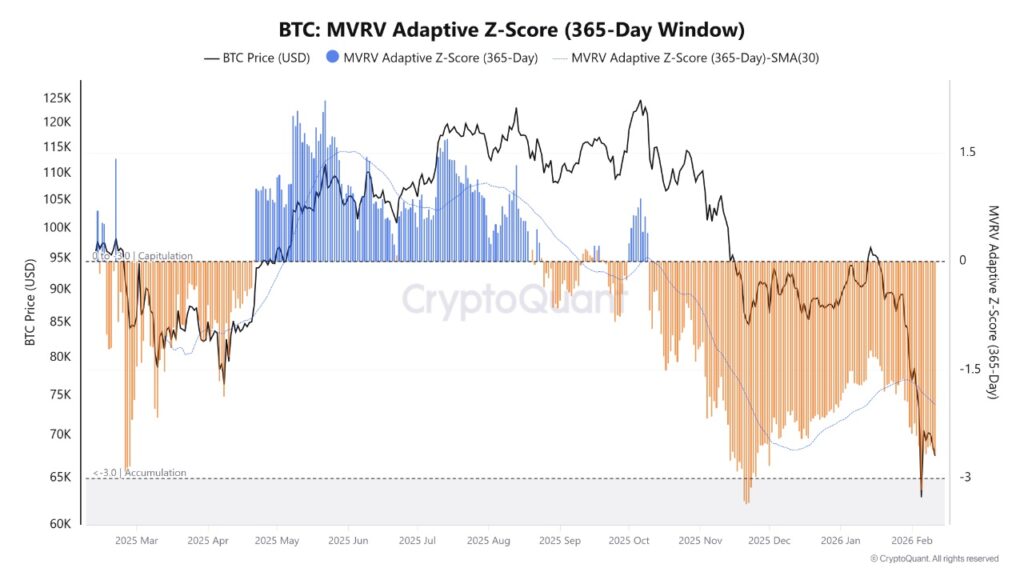 Bitcoin’s MVRV Adaptive Z-Score worsens its fall. Source: CryptoQuant. “The statistical deviation of the Z-Score screams opportunity, signaling that the bottom of this downtrend is being forged right now,” says GugaOnChain. The explanation behind it is that a capitulation tends to give rise to an accumulation zone that drives the price up. In markets, an accumulation zone is a phase where, following a price drop, multiple investors begin buying an asset while market sentiment remains negative. Consequently, at this stage, the price usually moves sideways because demand begins to absorb the available supply. Such a period usually precedes a bullish impulse, once the selling pressure ends and the buying force intensifies. At the same time, bitcoin buy signals are turning on in other indicators, such as the Mayer multiple. This fell to 0.6 points, a level that has rarely been touched in history and has coincided with minimum prices in bearish periods. Still, it is crucial for traders to take into account the risks of this scenario. These buy signals do not mean that the price cannot decline further in the short term.
Permanence of the capitulation
Based on bitcoin’s historical performance, the market could remain in a downtrend for around a year from its peak. Under that premise, the possibility of lower prices is not ruled out until the last quarter of 2026. In addition, bitcoin historically completed a bullish cycle the year after each halving. The most recent edition of this event, which halves the issuance of BTC, occurred in 2024. Therefore, if that pattern repeats, 2026 will be a bearish year and only then would begin a phase of strong accumulation. It is necessary, however, to remember that past events are no guarantee that they will be repeated. Everything will depend on the flow of supply and demand, depending on how the market evolves. Bitcoin’s decline occurs in an environment of increased risk aversion. The asset maintains correlation with the technology market which saw a slight decrease since October. Such a sector includes the Nasdaq 100 and stocks linked to artificial intelligence. This scenario is being fostered by geopolitical tariff threats and uncertainty due to the imminent change of president of the Federal Reserve. Consequently, the development of this panorama may be key to reviving investor appetite.