
«The elites are betting on Bitcoin,» says Sapir. Bitcoin (BTC) would reach prices from $ 120,000 to $ 150,000 in the coming months. Bitcoin (BTC) draws its way into a market full of fluctuations. During the last year, its price has been a roller coaster: in the last two months it fell 23%, but if they are considered the last six months, it achieved a rebound of 37%. This dance of numbers does not go unnoticed by analysts, and one of them, Motti Sapir, economist and specialist in financial markets, maintains a clear vision: Bitcoin is on a route to much higher prices in this same bullish cycle. For sapir, The key to understanding Bitcoin's behavior lies in its cyclical nature. «It moves in cycles and people usually get carried away by the latest price fluctuations instead of analyzing the general panorama,» explains the economist. In his opinion, The market tends to react to short -term movementsignoring background trends that are transforming Bitcoin into more than a speculative experiment. Bitcoin reached its historical maximum of $ 109,300 last January, but has faced a fall that keeps it between $ 78,000 and $ 87,000 so far in March, as seen in the following graph.
BTC price. Source: TrainingView. «Bitcoin is not just another asset; It is becoming a legitimate alternative to traditional financial reserves of value, ”he says. This transformation, according to the analyst, is due to two main factors: institutional adoption and growing interest of governments. While BTC companies and investment funds accumulate, some countries begin to see it as a viable component in their economic strategies. Therefore, Sapir considers that current price levels represent a purchase opportunity, projecting a trajectory to 120,000 or even $ 150,000 in the coming monthswith a long -term potential that could far exceed those figures.
You have to ignore «short -term noise»
The market, however, does not always share this optimistic vision. SAPIR points out that investors usually look at the «short -term noise» instead of the foundations. A clear example is Bitcoin -based ETFs, financial instruments that have played a crucial role in their price. When they were launched in January 2024, the massive capital entrance triggered the price of BTC. However, a year of their debut, money outputs generated a significant setbackespecially between February and what goes on March, as can be seen in the following graph.
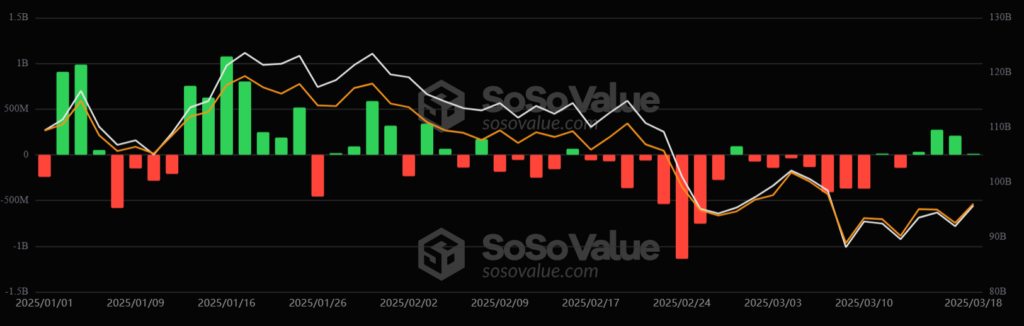
Bitcoin ETF departures and capital tickets between January and what is March. Source: Sosovalue. It should be taken into account that the performance of ETF has a direct impact on Bitcoin's price. The managers of these funds buy BTC to support their shares, which drives the price when the demand grows. But if investors withdraw their money, these firms sell part of their holdings, increasing the offer and pressing the downward value. Some interpreted the recent capital outputs as a negative signal, although Sapir sees it in another way: «These ignore the natural evolution of new financial products. The volatility in its early stages is expected ».
The biggest error of an investor
One of the most common mistakes among Bitcoin investors is to allow short -term volatility to expel the market, according to the specialist. The pronounced falls, such as those that have exceeded 25% in a matter of weeks or even daysThey generate a sense of restlessness that leads many to assume that the worst is yet to come, says the financial analyst. However, Motti Sapir emphasizes that the story tells a different narrative: «If something teaches us the past, it is that these sudden setbacks have been some of the best moments to buy.» Far from being collapse signsthese corrections have marked, repeatedly, the beginning of significant recoveries. A detailed Bitcoin behavior analysis supports this perspective. The attached graphic illustrates this phenomenon: Each red point indicates a drop of 25% or more in the price of BTC, events that are usually preceded by strong increases.
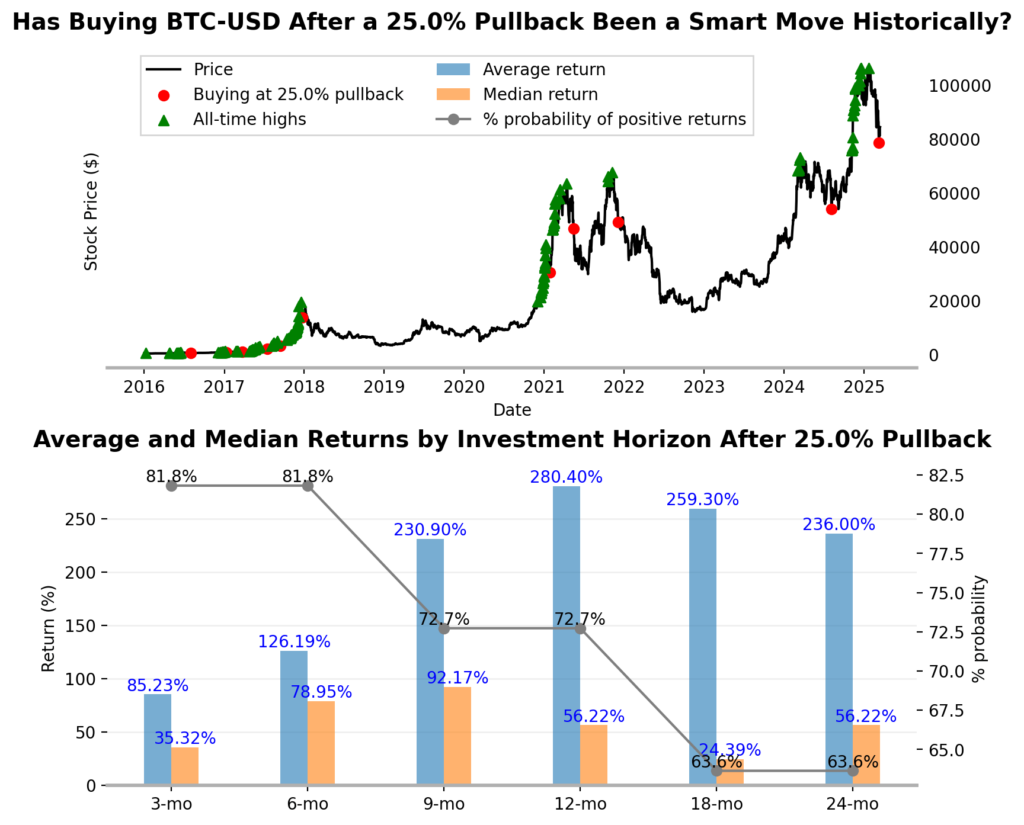
The bearish feeling shoots at that time, fear dominates and many investors choose to sell. However, the historical pattern reveals that these hurried outings are usually premature. The lower bar of the second graphic It shows that the returns after these falls have been consistently positivewith especially notable profits in periods of six months to two years. In addition, the gray line highlights another fact and that is that in most cases, the value of Bitcoin exceeded its level prior to collapse in different temporal horizons, evidencing its resilience.
«In the short term, it is easy to get carried away by fear. But, in general, these falls have been more purchase opportunities than alert signals. The market tends to react exaggeratedly, but the data makes something clear: buying from weakness has been a winning strategy for those who are willing to wait ». Motti Sapir, economist and financial analyst.
New chapter of uncertainty
To this is added another factor that feeds uncertainty: the costs of Bitcoin mining. The rise in the prices of electricity and commercial tensions between the United States and Canada, has generated fears about the profitability of miners. Canada, a key exporter of electricity to the United States, now faces a complicated commercial relationship after the policies of President Donald Trump, who since his arrival has intensified tariff disputes with Mexico, Canada and China. This is a factor that has also hit the price of Bitcoin and the rest of cryptocurrencies. Geopolitical conditions and global economic uncertainty They usually influence their priceespecially in moments of commercial tensions such as those triggered by Trump's policies, as reported by cryptoics. Although these challenges are real, Sapirates them as part of Bitcoin's natural economic cycle.
The role of governments and their influence on the price of Bitcoin
Beyond the fluctuations of the market, Sapir points to an element that considers underestimated: Bitcoin emerging role in global finances. «Governments are increasingly discussed on Bitcoin in unthinkable ways five years ago,» he says. An emblematic case is the United States, where President Trump has taken concrete steps to integrate the digital currency into the national strategy. Last January, he signed an executive order for the Creation of a strategic Bitcoin reserve and ordered to form a cryptocurrency advisory council in the White House.
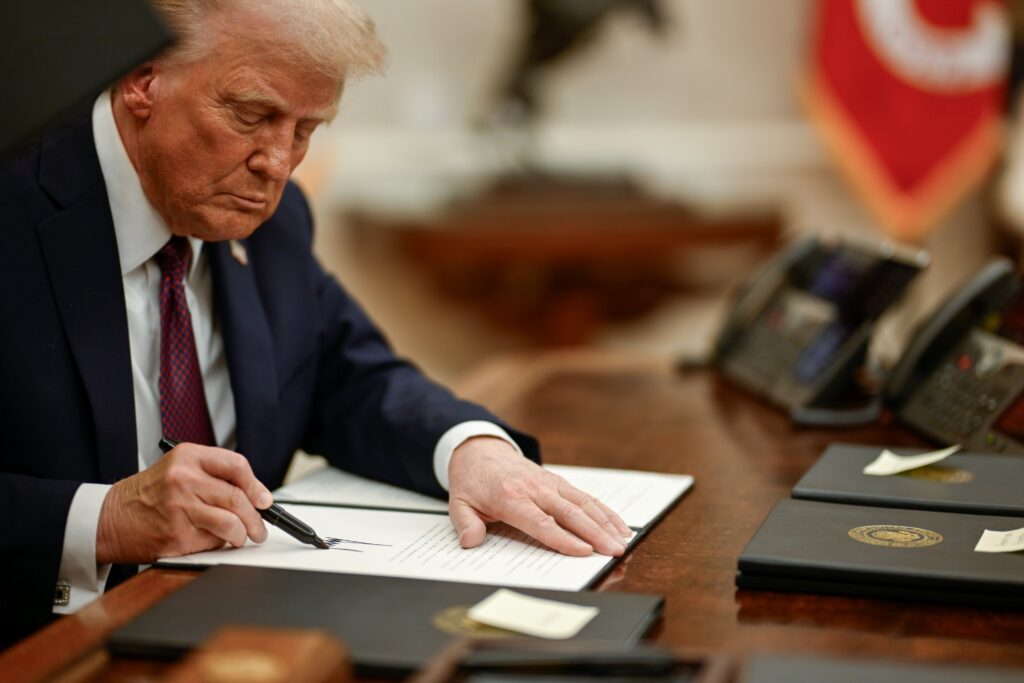
Donald Trump signed an executive order to create a reserve of digital assets. Source: @Whitehouse. This advice has the order to initiate the process to establish the reservation, Collaborate with Congress in Cryptactive Legislation and coordinate with regulatory agencies. With these measures, the United States seeks to position itself as a leader in the future where Bitcoin could be a pillar of the global economy. «The elites are betting on Bitcoin,» says Sapirreferring to both governments and large institutional investors. If this sovereign adoption trend is consolidated, the economist believes that BTC's current price will look like a retrospective bargain. «In the short term, it is easy to get carried away by fear,» he admits. However, he insists on that recent falls have historically been purchase opportunities for those who look in the long term. «The market reacts exaggeratedly, but the data shows that buying in moments of weakness has been a winning strategy,» he says.
The bullish potential: numbers that speak
Bitcoin challenges traditional assessment models, which forces analysts to seek alternative metrics. One of Sapir's favorites It is the Stock-Flux relationship, which measures the shortage of an asset based on its circulating offer and its emission rhythm. This relationship will be reduced by half after the next halving that will take place in 2028. This is an event scheduled in the bitcoin code that decreases the reward of the miners every four years. In past cycles, this mechanism has triggered massive price increases. According to current stock-flujo models, Bitcoin would be undervalued at at least 50%, which implies a fair value exceeding $ 120,000.
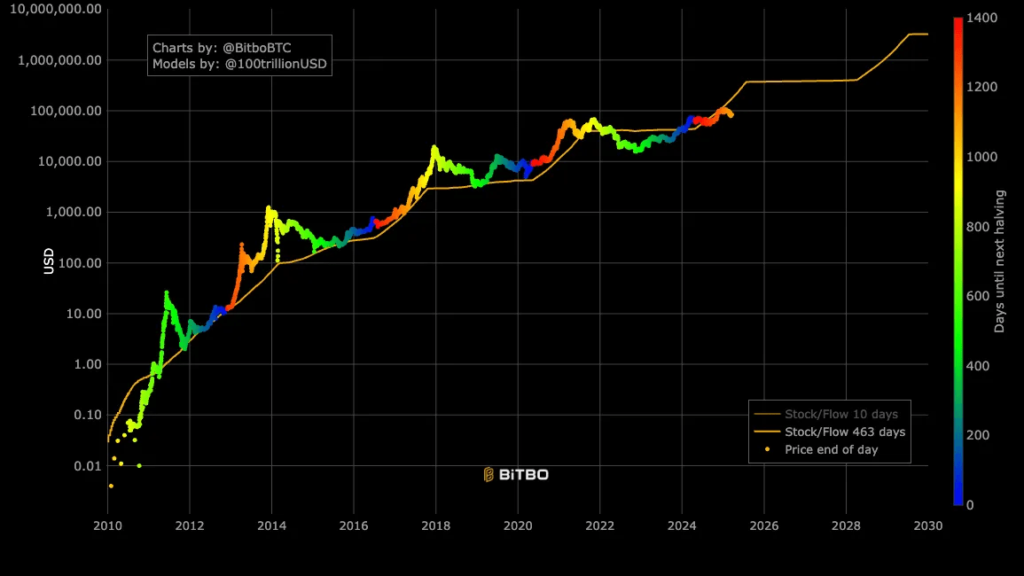
Current stock-flow relationship models suggest that Bitcoin is undervalued. Source: Seeking Alpha. Chain data reinforces this thesis: long -term holders reach record levels, reflecting solid confidence among those who understand the foundations of the asset. At the same time, Bitcoin reserves in the exchanges are at a minimum of several yearswhich reduces the available offer and usually precedes increases driven by scarcity.
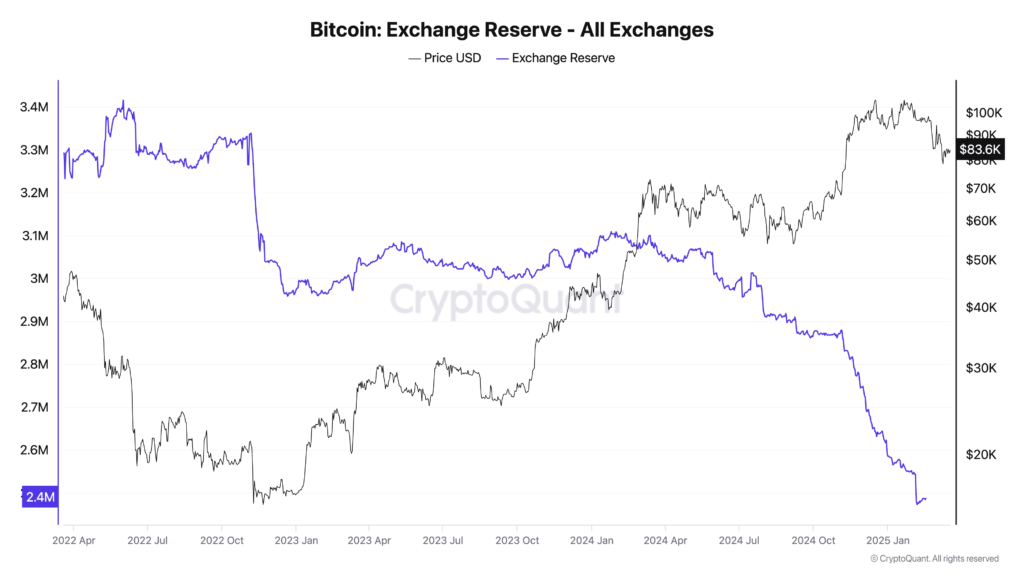
Bitcoin reserve in the exchanges. Source: Seeking Alpha.
Mixed feeling and winds of change
The panorama is not exempt from contradictions. Market feeling ranges from optimism and caution.
On the one hand, institutional accumulation is still underway. On the other hand, regulatory uncertainty and The costs associated with mining keep some investors on guard. However, Sapir relativizes these concerns: «In previous bearish markets, similar narratives emerged, and Bitcoin always ended up reaching new maximums once the dust settled.»
Horizon risks
Nothing is guaranteed in the world of Bitcoin. Regulation remains an unknown that could change the game. If governments impose more severe restrictions on exchanges, custodians or miners, the impact would be remarkable, explains the economist. Volatility, meanwhile, continues to be a barrier to less risk tolerant investors. Although institutional adoption could stabilize it over time, as happened with gold, that process is still in development. Liquidity also deserves attention. The ETF outputs generated selling pressure in early 2025, however, If institutional demand continues to grow, Bitcoin could be consolidated as a more robust asset.
An evolving currency
«Bitcoin is not perfect, but no asset is,» says Sapir. What distinguishes it, he says, is his unique combination of absolute shortage – with a limit of 21 million currencies – and an adoption that barely begins to take off. Between halving, institutional interest and the potential support of governments, The economist sees a clear path to $ 120,000 or $ 150,000 In the next 12 to 24 months, with a much higher roof if the sovereign adoption accelerates. While short -term investors deal with turbulence, who are committed to the long term could be facing a historical opportunity. Bitcoin, with his ups and downs and his aura of enigma, continues to defy expectations.
