The bitcoin (BTC) and cryptocurrency ecosystem in Panama faces a crisis of confidence that arises from the clash between digital adoption and an institutional system that still does not know how to process it. While commerce between people (Peer-to-Peer or P2P) is consolidated as a tool of financial freedom, for those who facilitate these transactions, the activity becomes a minefield of legal and financial risks. This reality was documented in a recent episode of the Chamber of Digital and Blockchain Commerce podcast, where Jonatan Arosemena, a merchant with five years of experience, recounted the judicial ordeal he experienced after being used, involuntarily, as a bridge by criminal gangs international. Their case reflects how the absence of specific regulation and the lack of technical training of the authorities are “taking their toll” on legitimate operators. Jonatan said in the podcast that he is a Binance P2P trader. It receives payments in dollars in Panama bank accounts for the sales of digital assets, mainly USDT (Tether), that it makes on that platform.
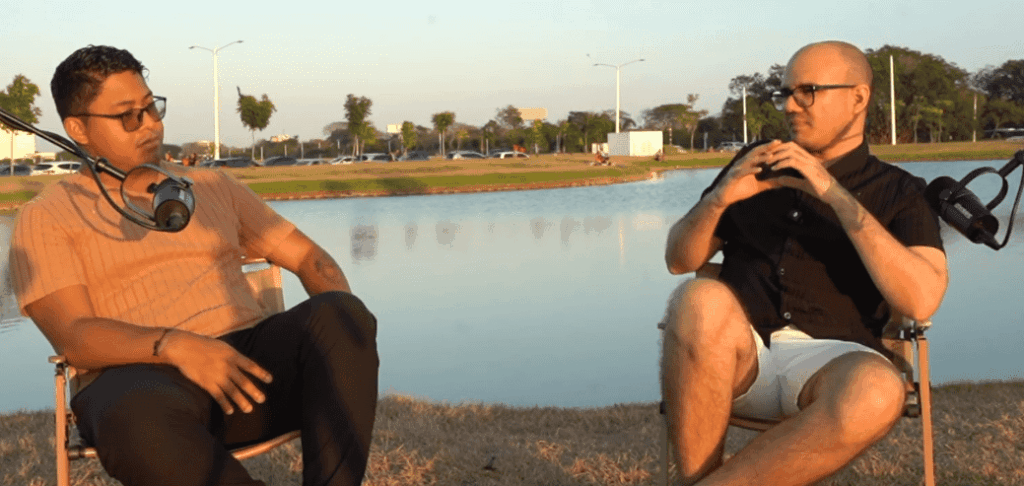 Jonatan (L) puts a face to the legal vacuum in Panama. In this scenario, the innovation of P2P commerce collides with the rigor of a financial system that still does not distinguish the legitimate operator from the criminal. Source: YouTube/Chamber of Digital and Blockchain Commerce. Now, he makes a forceful complaint by pointing out that The trader on P2P bitcoin and cryptocurrency platforms is usually the final victim of scams which he did not commit. In his story, he describes how he was involved in investigations by the Prosecutor’s Office for transactions that, although valid in their execution, came from illicit funds obtained by third parties through identity theft.
I have had to go to the Prosecutor’s Office several times because I received transfers from people who had been victims of identity theft. The money they paid me was dirty money, but I had no way of knowing that at the time. I was just selling my USDT normally through Binance P2P. In the end, the bank closes my account and the Prosecutor’s Office summons me as if I were part of the scam, when in reality I am the last link that receives the dirty money without knowing it. Jonathan Arosemena.
«It is a school that I still pay for; «It has been the most expensive course of my life,» he said, after explaining that he lost nearly $50,000 between mediation payments, fines and legal fees to avoid jail. The central problem, according to the testimony, is the inability of the authorities to trace the crime to its true perpetrators. Given the complexity of tracking criminal groups abroad, Panamanian justice usually opts for the simplest way out. This is making the local beneficiary responsible for the funds. «The Prosecutor’s Office could have done much more; they had the IP and all the data, but in the end it is as if I were an ‘X’, as if I were a nobody. You received the money, so you pay,» Jonatan lamented. To date, neither the Panama Prosecutor’s Office nor the country’s main banks have published official statements detailing the specific reasons behind the blocking and closure of accounts linked to P2P cryptocurrency trading.
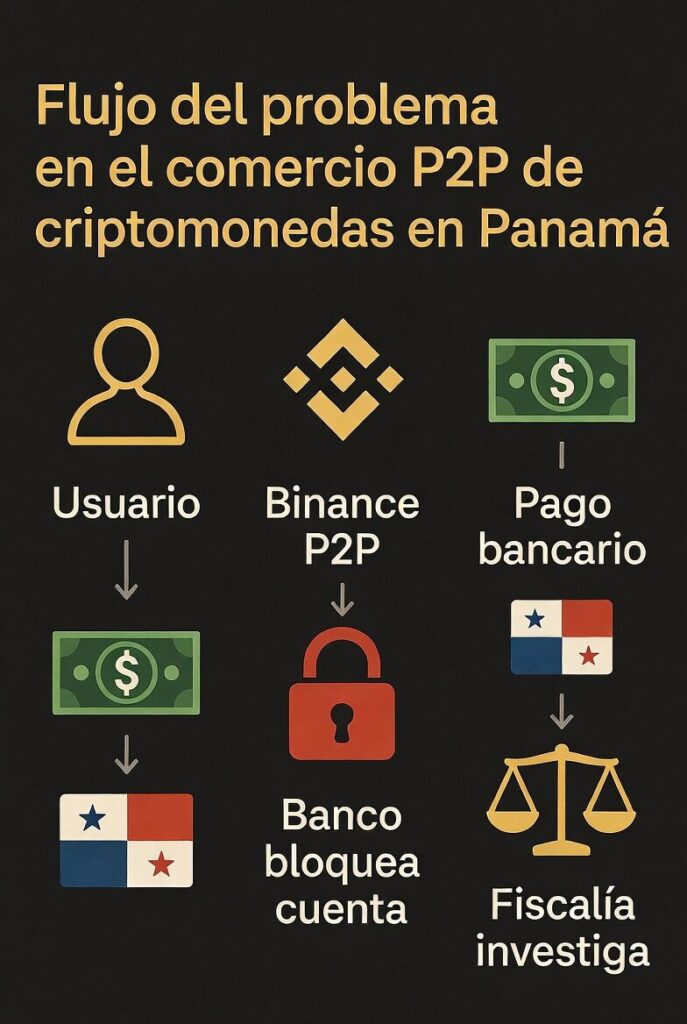 Typical flow of the problem in P2P cryptocurrency trading in Panama: from the exchange on Binance to the blocking of accounts and the intervention of the Prosecutor’s Office. Source: BitcoinDynamic/Grok.
The banking wall to cryptocurrencies and the regulatory “gray zone”
Added to this scenario is the defensive posture of traditional banks. Entities such as Banco General are singled out by users in specialized forums for their “zero tolerance” policy regarding any link with cryptoassets. Banks, operating under strict compliance with anti-money laundering regulations, They prefer to close accounts preventively rather than assume the risk of auditing P2P operations. This behavior has implicit institutional support. In technical documents from the Superintendency of Banks of Panama (SBP), it is recommended to tighten controls over virtual assets because the country does not yet have a framework for Virtual Asset Service Providers (VASP). Without clear rules, the trader is trapped. Therefore, if you try to formalize, The bank rejects it because it is “high risk”; and if it operates in the shadows, it is unprotected before the law. For the union sector, the solution is not to prohibit, but to train. As highlighted in the conversation, the traceability offered by cryptocurrency networks, and the collaboration that platforms such as Binance offer to authorities, are tools that the Prosecutor’s Office has not yet fully taken advantage of. As long as this knowledge gap is not closed, P2P commerce in Panama will continue to be a legitimate activity in practice, but dangerous in court.
This regulatory context is also reflected in supervised digital platforms in Panama. As BitcoinDynamic recently reported, Zinli generated numerous complaints among cryptocurrency users for preventive account blocking. Although, up to the time of writing this note, the company has not published a detailed official statement, it is clear that these actions respond to the same climate of caution that prevails in the Panamanian financial system. In the absence of a specific regulatory framework for cryptoassets, supervised entities choose to apply strict anti-money laundering and know-your-customer controls to mitigate risks.