Bitwise analyzes the impact of various bitcoin percentages on investment portfolios. In the long term, a strategy «Everything in Bitcoin» has been the most beneficial. Bitwise analysts, a specialized firm in digital asset management, shared their perspectives on how much Bitcoin (BTC) should be acquired to diversify an investment portfolios. In the report, the specialists indicated that Bitcoin has improved so much absolute returns such as those adjusted by risk in a traditional portfolio of actions and bonds. «The results show that, historically, adding Bitcoin to a portfolio would have increased both absolute and risk -adjusted returns in all periods of three years since 2014, assuming an adequate revergrowing strategy,» said Bitwise's specialists. The report evaluates the impact of adding BTC to a traditional portfolio composed of 60% of shares (represented by the ETF Vanguard Total World Stock – VT) and 40% of bonds (represented by the ETF Vanguard Total Bond Market – BND), analyzing the period of January 1, 2014 to December 31, 2024. That is, the analysts studied how beneficial BTC portfolio within a classic investment strategy composed of 60% in shares and 40% in bonds, using real data from the 2014 to 2024. In particular, it was evaluated The currency yield created by Satoshi Nakamoto In several possible combinations of periods of 1, 2 and 3 years within that range, with the aim of measuring its impact on different investment horizons and avoiding biases for the choice of specific dates. Among the metric analyzed are: the accumulated and annualized returns, which show how much the portfolio grew in total and per year; Volatility, which measures how much prices vary; the Sharpe ratio, which evaluates the risk adjusted by risk using a 2.36% risk -free rate (based on the 10 -year Treasury bonus); and the maximum falls, which reflect the greatest loss from a maximum point of value. In addition, different BTC assignments were evaluated within the portfolio, which went from 0% to 10%, and different reboil frequencies (monthly, quarterly, annual and without rebalancing) to measure how these decisions influenced the performance of the portfolio. The concrete is that Add Bitcoin to a traditional investment portfolio improves its performance. Without BTC, the base portfolio achieves an accumulated return of 96% (6.32% annualized), with a volatility of 8.49% and a Sharpe ratio of 0.456. Now, what happens when the investor assigns 1% BTC? With a bitcoin 1% allocation, the accumulated return increases to 115.67% (7.25% annualized), volatility rises slightly to 8.59%, the Sharpe improves to 0.557 and the maximum fall reaches 22.73%, showing a moderate improvement with low impact on risk. With 2.5% of Bitcoin, the accumulated return reaches 148.09% (8.62% annualized), the volatility is 8.89%, the share rises to 0.689 and the maximum fall is 23.72%, standing out as a balance point between profitability and risk.
Performance chart of a traditional portfolio with and without bitcoin assignments. Source: Bitwise. As seen in the previous table, if the investor decides to allocate 5% of the BTC portfolio, he would have raised the return to 210.6% (10.9% annualized), with a moderate volatility of 9.7% and a maximum drop of 25.3%. On the other hand, uploading the 10%allocation improved the return to 272.4%, but at the cost of greater volatility (15.8%) and more pronounced falls (29%). Here it is important to note that, at greater assignments, there was more return, But risk exposure also increased. The graph below shows the performance of a traditional portfolio compared to those that include BTC, with 1% assignments (dark green line), 2.5% (celestial line) and 5% (clear green line).
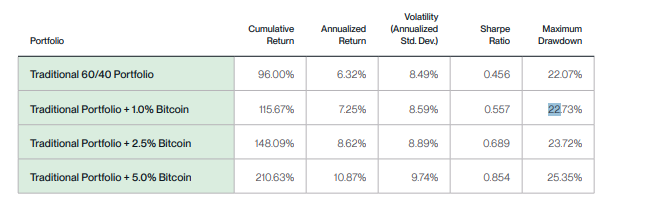
Portfolio performance metrics with or without bitcoin. Source: Bitwise. It is important to emphasize that the report does not recommend a fixed assignment of BTC for investors, but that the decision depends on factors such as temporary horizon, the frequency of rebalancing and the tolerance to the maximum falls. The report suggests that moderate assignments between 1% and 5% offer an attractive balance between risk and return within a traditional portfolio, especially in medium and long -term investment horizons. Beyond that, the evolution of the price of digital asset over time shows that It has been one of the assets with the best performance of the last decade.
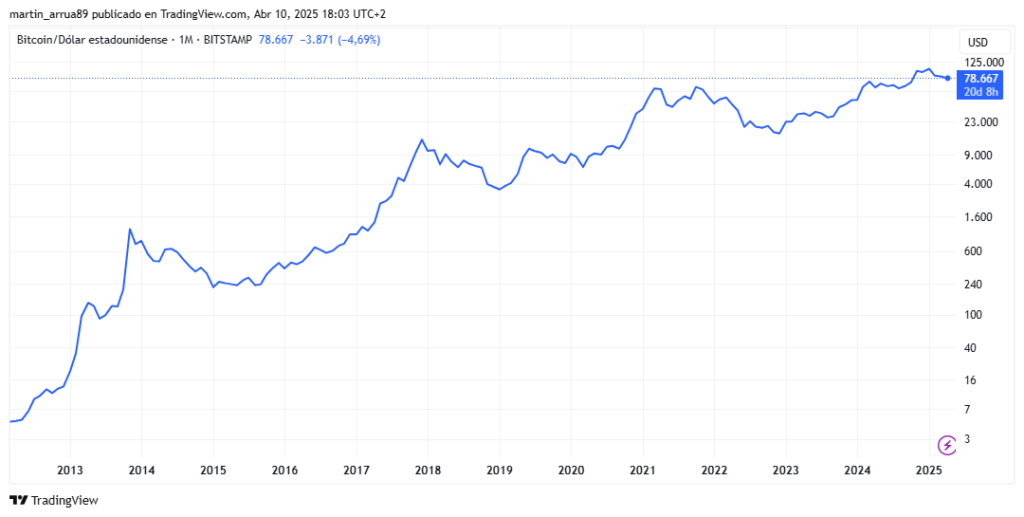
BTC quote in the last 10 years. Source: TrainingView. For that reason, companies such as Strategy (previously Microstrategy) are incorporating BTC into their treasury as a reserve asset. The company that presides over Michael Saylor, a Bitcoiner maximalist, is known for its aggressive BTC investment strategy. Currently, it is the company that lies in the stock market with the largest amount of BTC in its reserves, with a total of 528,185 BTC (41,780 million dollars), according to Bitcoin Treasuries data. For this reason, more and more companies are evaluating different strategies for issuing financial instruments in order to achieve funds and acquire BTC. As Cryptoics has reported, the Gamestop Board of Directors, the renowned Texas American video game chain, recently approved the inclusion of BTC in its corporate reserves as part of its treasury strategy. Institutional interest also grows at the state level. In addition to El Salvador, which maintains a strategic BTC reserve, Donald Trump has signed an executive order to follow a similar path in the United States.
Why Bitcoin?
A good answer to this question is Blackrock, the world's largest asset manager, which described the digital currency as a «unique diversifying asset.» Due to its characteristics, incorporate BTC in an investment portfolio or use it as a reserve asset It can serve as coverage against the devaluation of the dollar or any other Fíat currency.
As Cryptonoticia explained, the digital asset has properties that resemble gold. First, because it has a supply limited to 21 million units, and its broadcast is reduced every 4 years by the halving. It is a factor that impacts its medium and long term price. In addition, BTC differs from Fíat money because it is not devalued by the monetary emission or by the decisions of the central banks.