Organized crime finds in artificial intelligence (AI) the definitive engine for its expansion. According to the second edition of the Global Financial Fraud Threat Assessment, presented this March 16 in Lyon, the criminal ecosystem is going through a phase of «industrialization.» These are no longer isolated attempts at impersonation, but rather a technological machinery capable of managing thousands of victims simultaneously and autonomously. The report highlights the emergence of agentic AI, systems that generate content and execute complex processes without human intervention. These tools can perform target recognition, have long conversations to gain trust and close fraudulent transactions. This efficiency has a direct economic correlation, since AI-powered fraud is 4.5 times more profitable than conventional methods. Valdecy Urquiza, Secretary General of INTERPOL, underlined the human gravity behind the figures:
Thanks to artificial intelligence and low-cost digital tools, we are witnessing the industrialization of fraud. The cost is not just money, it is life savings, dignity and, in the worst case, people’s lives. Valdecy Urquiza.
The scale of the problem is reflected in a 54% increase in fraud notifications since 2024. INTERPOL claims to have intervened in 1,500 transnational cases, recovering assets worth $1.1 billion. However, the impact goes beyond the financial. The report reveals a critical nexus between fraud and terrorist financing, especially in Africa.
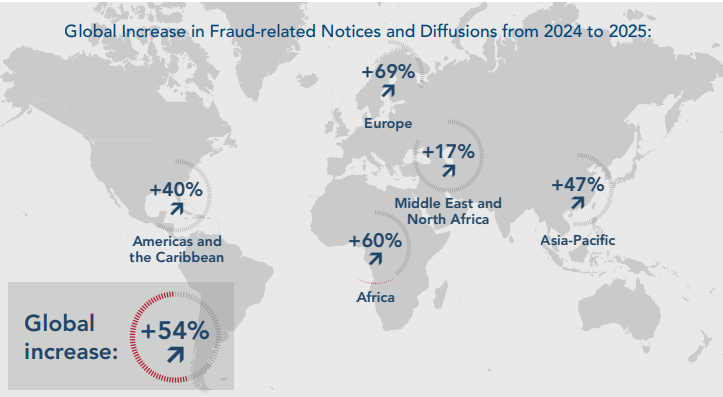 The graph shows how international alerts on criminals and modus operandi experience systemic growth in all regions, consolidating a global rebound of 54%. Source: Interpol Report. Operations like Catalyst (2025) dismantled schemes Ponzi based on cryptocurrencies that affected 100,000 people in 17 countriesdiverting funds towards extremist activities in Central Africa. Likewise, the proliferation of global «scam hubs» has also industrialized human tragedy with hundreds of thousands of people of 80 nationalities having been trafficked and coerced into operating these systems into modern slavery, according to the report.
Agentic AI: the end of the human factor
The technical ability of AI to operate in native financial layers is already a reality. Recent tests, such as those carried out by the autonomous agent Clawdius on March 11, demonstrated that AI can manage micro-payments on the Bitcoin Lightning network independently, as reported by BitcoinDynamic. However, this functionality, although legitimate in its origin, offers a risk horizon for money laundering. However, AI not only amplifies the capabilities of criminals in financial fraud, but also represents a powerful tool to combat them, especially in the space of cryptocurrencies and digital assets.
The United States Department of the Treasury published a report to Congress in March 2026, required by the GENIUS Act, that examines how financial institutions can employ innovative technologies, including AI, blockchain network analysis, APIs, and digital identity tools, to detect and mitigate illicit activities such as money laundering, terrorist financing, and sanctions evasion. The document, based on more than 220 public comments and specialist analysis, emphasizes that AI allows processing massive volumes of data in real timeidentify complex patterns (such as jumps between blockchains or fractional deposits) and reduce false positives in transaction monitoring, overcoming the limitations of traditional systems based on rigid rules