
Weiss’s model projects a bottom for bitcoin (BTC) near April 5. Bitcoin follows Japan’s M2, which anticipates a bottom around April 7. Weiss Ratings, a rating agency for financial institutions, projects that bitcoin (BTC) could find a price floor between April 5 and 7 depending on what happens with the war between the United States and Iran. The agency’s specialists point out that the indicated period coincides with its internal models and with the evolution of the money supply (M2) in Japan. According to the firm, bitcoin would be close to a minimum around April 5while the Japanese M2 tracking points to a similar level around April 7. The hypothesis is based on a macroeconomic reading. Weiss maintains that bitcoin is closely tracking the dynamics of Japan’s M2, a measure of liquidity that includes cash in circulation and bank deposits. To put it directly, it is a way of measuring how much money is available in the economy. When that liquidity contracts, risk assets tend to weaken; when it expands, they usually recover.
In this case, the firm interprets that The recent fall of the Japanese M2 anticipates a floor in the price of BTCin a logic where liquidity movements precede those of the market.
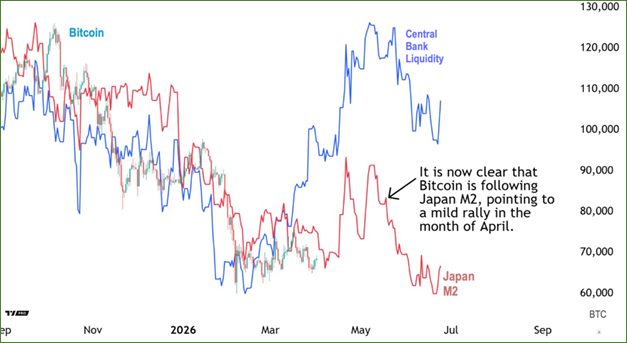 The fall of the Japanese M2 could anticipate a floor for the price of bitcoin. Source: Weiss Ratings. The graph released by Weiss allows us to visualize this relationship. Three variables are superimposed on it: the light blue line shows the price of BTC, the blue line represents the liquidity of central banks, and the red line corresponds to Japan’s M2. According to the firm’s reading, BTC has followed the latter’s trajectory more closely, which reinforces the idea that the fall of the red line would be signaling a near minimum for the asset. However, Weiss warns that this possible floor will not depend solely on monetary variables.
Bitcoin attentive to what is happening in the Middle East
The firm directly links this time window with the evolution of the conflict between the United States and Iran, which is going through a critical moment. In particular, he mentions that the period between April 5 and 7 coincides with a key political deadline for Iran to move towards some kind of agreement. The geopolitical factor is not minor. The conflict directly impacts the global energy market due to the strategic role of the Strait of Hormuz, a sea route through which nearly 20% of the world’s oil circulates, as explained by BitcoinDynamic. Any interruption or threat in that corridor tends to raise the price of crude oil, which puts pressure on inflation globally.
That point is key to understanding the link with BTC. More expensive oil complicates lowering interest rates in economies like the United States, as it forces central banks to maintain more restrictive monetary policies. Less liquidity and high rates usually translate into less appetite for assets considered risky, such as the currency created by Satoshi Nakamoto and cryptocurrencies. In this context, Weiss proposes two scenarios. If some kind of agreement is reached between the United States and Iran, markets could react with a rapid rebound driven by an improvement in macro expectations. On the contrary, if the tension is maintained or escalates, the environment would remain adverse for BTC, even if the technical models anticipate a bottom. The firm also clarifies that the minimum projected for April would not necessarily mark the end of the corrective phase, but rather the most relevant level identified so far in 2026. That is, it would be a tactical floor, not necessarily a change in cycle.
