There has been much talk that, with the arrival of institutions and regulatory clarity, the cryptocurrency market is maturing. Some talk about it passing the Wild West stage of cryptocurrencies because “the adults are now in the room.” The cases of market manipulation and insider trading revealed this week remind us of two things: that abuse of insider information is not restricted to companies native to the industry and that It is the transparency of cryptocurrency accounting itself, and not regulation, that helps combat these crimes.
The Wild West was an expanding frontier, where the population was growing rapidly due to gold rushes, ranching, and migration. The absence of an effective law enforcement system was the main problem: federal authorities were slow to arrive, and the responsibility for maintaining order initially fell to private individuals or communities. Factors such as the mix of Civil War veterans, alcohol, and the lack of government structures fueled violence in mining and ranching towns. However, contrary to the myth of total chaos, many settlers brought with them values of law and order, enforcing local codes of honor. Initially, communities formed posses (groups of volunteers) to chase bandits and keep the peace, acting as community justice. Over time, sheriffs, federal marshals, and courts were introduced. Private agencies like the Pinkertons captured hundreds of outlaws in a decade, helping to reduce crime. The privatization of law enforcement through bounties motivated bounty hunters and agents to go where the government could not.. The creation of barbed wire was also key to delimiting properties and mitigating land conflicts. A similar process was experienced in the Wild West of cryptocurrencies. In the early years, pump & dumps, hacks, scams, rug pulls abounded. Soon, the same community began to organize on social networks to hunt down the scammers; the projects carried out voluntary audits to avoid hacking; Companies started bug bounties programs so that white hat hackers would be rewarded for detecting vulnerabilities. However, so far, efforts to curb on-chain crimes have not been entirely successful. On the contrary, in 2025 the value in cryptocurrencies received by addresses marked as illicit almost tripled, especially due to the increase in activity by sanctioned jurisdictions and entities.
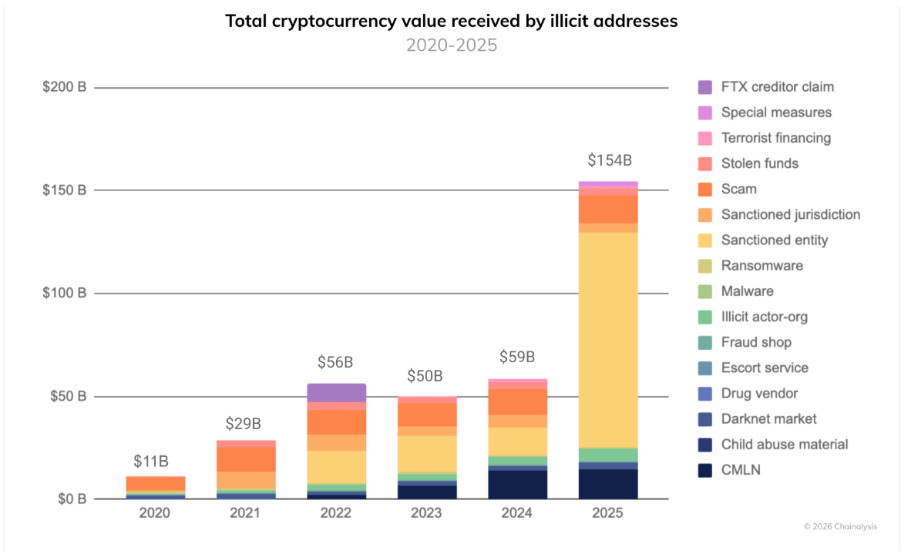 Total cryptocurrency value received by addresses marked as illicit. Source: Chainalysis. In contrast to what is often believed, the supposed maturation of the cryptocurrency market, with the arrival of institutions, regulators and governments, has not stopped the rise of crime. This increase in value transferred by illicit cryptocurrency addresses would make sense if currencies like Bitcoin or Monero were used, censorship-resistant and private assets, respectively. Counterintuitively, 84% of the volume of illicit transactions use stablecoinsthe favorites of the United States, and whose freezing is the order of the day. More than $1.6 billion has been frozen in more than 8,400 addresses in USDT alone. But this data also shows us something else of profound value, and that is that never in history have we had such a level of transparency about illicit activities in the world.
Cases of market manipulation and insider trading are nothing new that cryptocurrencies have brought. It is worth remembering the famous Enron case of 2001, in which executives such as Jeffrey Skilling and Kenneth Lay used accounting fraud to inflate profits, while selling shares with insider information (insider trading), and whose collapse erased $74 billion in market value. There were suspicions from journalists and investors, but it was not until the SEC intervened that it was really known that Enron manipulated its accounting. Or, of course, the Libor scandal of 2012, which involved several major banks such as Barclays, UBS and RBS in the systematic manipulation of the London InterBank Offered Rate (LIBOR), a key interbank interest rate that serves as a benchmark for trillions of dollars in derivatives, loans and global financial contracts. Between 2005 and 2009, these banks altered their rate submissions to profit from trading positions or to minimize perceptions of risk during the 2008 financial crisis, underestimating or overestimating rates as appropriate. As in the previous case, until the CFTC paid attention to the rumors and investigated, the manipulation remained ongoing without any civilians being able to find out. It is not surprising that, with the arrival of traditional institutions in the cryptocurrency ecosystem, also try to import their practices into this space, taking advantage of their privileged positions and the depth of their pockets to move the market. This is suggested by the accusations that Jane Street – a high-frequency trading firm founded in 1999 and alma mater of FTX founder Sam Bankman-Fried – is responsible for the collapse of Terra/Luna. As reported by BitcoinDynamic, this company, which was also accused of market manipulation in India, faces a lawsuit filed by a judicial administrator who is liquidating the assets of Terraform Labs. The lawsuit accuses them of allegedly having used inside information to operate against Terra during its collapse in 2022, exacerbating the systemic crisis that the stablecoin project suffered and that led to the crypto winter of the last cycle. Although there is no absolute proof yet, there is evidence on-chain which suggests that addresses linked to Jane Street were the ones that drained UST liquidity on Curve. On the other hand, this week the Axiom Exchange case also came to light. On-chain researcher ZachXBT published a report accusing several employees of the Axiom cryptocurrency exchange of abusing internal tools without adequate controls, since early 2025, to access sensitive user data and carry out operations with privileged information. If there has always been market manipulation and insider trading, why should we expect it to be different in cryptocurrencies? While they are assets, they will be used for everything that assets have been used for in history, which includes fraud and manipulation. The giant difference is that, unlike cases of manipulation and insider trading in traditional finance, In cryptocurrencies, when the activity is on-chain, an indelible mark of manipulation remains. Even years later, anyone with some knowledge can review the books and spot patterns that point to fraud. Never in history has anyone been able to know, first-hand, without having to wait for the authorities, that someone had manipulated the market by reviewing public and open accounting books. Before, manipulation was simpler since its detection was centralized in auditors and authorities. In the banking cases mentioned above Now, anyone with the will, and the cryptocurrency community has a lot, can review the accounting and detect inconsistencies. On the other hand, if someone tried to “cook the books,” that is, modify the accounting history, it would first be much more costly than in traditional finance, and then it would be visible to everyone. It is worth remembering the case of Ethereum, when it decided to “reverse” the transactions corresponding to the hack of The DAO. Whether it was with good intentions or not, Ethereum will forever bear the mark that its blocks were rewritten. Detecting cases of fraud and manipulation is something that will become increasingly refined with the improved use of artificial intelligence for on-chain analysis, so incentives will be aligned towards good behavior when it comes to transacting in cryptocurrencies. However, there is a possibility that, in the automation process, tasks are delegated to AI that are not yet prepared, which mistakenly identify transactions as suspicious that are not. These errors are already seen today, such as the AI that mistakenly transferred $600,000 to a user on X. But over time, they will become more precise. Once again it is shown that using Bitcoin and cryptocurrencies to commit crimes is a big mistake, since all the evidence remains public for the eyes of anyone who wants to investigate. AND, Like the bounty hunters of the Wild West, there will always be people willing to investigate. It has not been the increase in regulation or the greater government presence on the Internet that detects these cases, but rather the management of private actors. While on the one hand this transparency may end up becoming a financial panopticon, it is also likely that, to the extent that law-bound actors realize that, by committing crimes on-chain, sooner or later they could be brought to justice, it will serve as a natural deterrent that, through incentives, ends up reducing crime in this space. Just because “adults are in the room” does not stop crime; rather, we see how they may want to import their opaque practices into this industry. The true “maturation” and security of the cryptocurrency market does not come from the arrival of traditional institutions, regulators or greater government intervention, but from the inherent transparency of cryptocurrency accounting, which allows anyone to detect and expose fraud, manipulation and insider trading publicly, something impossible in traditional finance. Once again it is clear how decentralization and transparency are superior to centralized regulation.