War in sight! Once again, the war alarm is sounding in the world. This February 28, 2026, both the United States and Israel carried out air strikes on Iranian territory. In turn, the Iranian military responded with counterattacks on American targets in the Middle East. Furthermore, according to journalistic sources, the Iranian regime would have closed the Strait of Hormuz, a point of strategic importance in the oil industry between the Persian Gulf and the Gulf of Oman. All this is causing upheaval in the markets. As BitcoinDynamic reported this morning, the price of bitcoin fell below $64,000. Anyway, at the time of this publication it has partially recovered and is trading at $65,419.
Bitcoin price in the last 24 hours. Source: CoinGecko. In scenarios of growing geopolitical tension, such as the current conflict in the Middle East, there is usually a defensive movement on the part of investors. In these contexts, bitcoin is considered by a large part of the market as a risk asset, which is why it tends to be sold. In turn, capital tends to be relocated to instruments perceived as saferincluding cash or US Treasury bonds. That rotation towards traditional havens helps explain the drop in the price of BTC in the hours following the military escalation. But not all assets suffered. In the cryptocurrency space, gold-backed tokens – including Tether Gold (xAUT) and Pax Gold (PAXG), stablecoins that track the price of the metal per ounce – saw an accelerated rise, along with the price of the underlying asset. The following graph shows, as an example, the behavior of xAUT in the last 7 days, a period in which it rose 4.3% and reached $5,428:
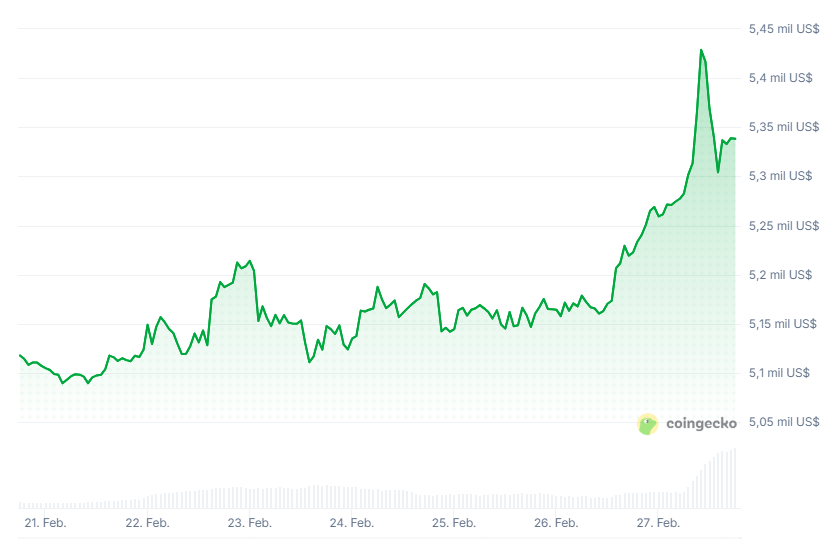 xAUT price in the last 7 days. Source: CoinGecko. In this context, Gold once again gains prominence as a safe haven asset. In times of war or strong global uncertainty, many investors stop prioritizing profitability and focus on preserving capital. Due to its history as a store of value, its liquidity and its almost zero exposure to the political or credit risk of an issuer, the precious metal usually captures part of these defensive flows. Such a search for coverage helps explain why, in the face of a geopolitical escalation like the current one, both the price of gold and the tokens backed by that metal rise.
And another asset that is on the rise is oil.. The blockade of the Strait of Hormuz triggers the feeling that The global distribution of this precious raw material could be at risk.
As seen in the following graph from the Investing platform, crude oil futures are trading at $67.02, a price that has not been seen since July 2025.
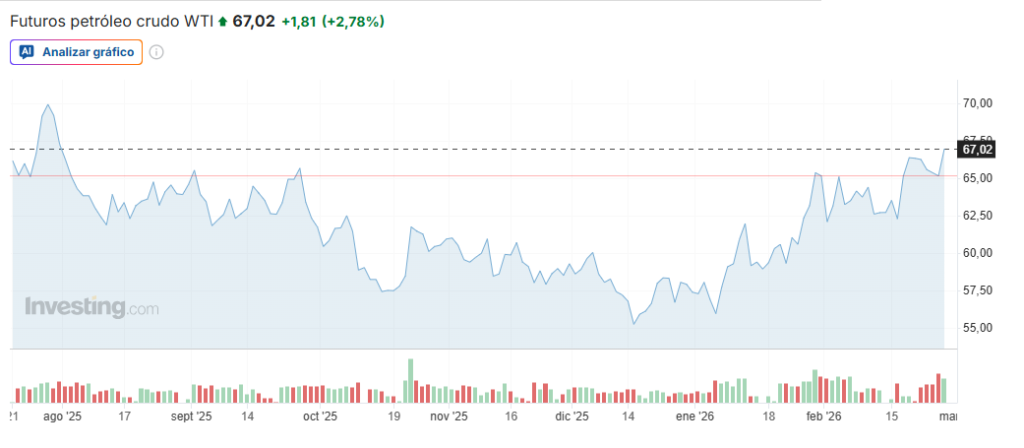 Crude oil futures price. Source: Investing. The episode once again leaves an uncomfortable lesson for bitcoin: when the noise of missiles drowns out everything else, the narrative gives way to the instinct of financial survival (at least at first). In those hours, capital does not reward promises of the future, but rather immediate safeguards. Therefore, while BTC retreats and gold, its tokenized versions and oil overheat, What emerges is the most basic reaction of the markets to the threat: first cover themselves; then, if anything, think about the long term again.